
Alcohol-resistant drug formulations
a technology of alcohol-resistant drugs and formulations, which is applied in the direction of drug compositions, anhydride/acid/halide active ingredients, microcapsules, etc., can solve the problems of serious side effects, respiratory depression or distress or changes in alertness, and significant risk of patients from dose dumping, etc., to achieve the effect of reducing the rate of ghb release after exposur
Patent Information
- Authority / Receiving Office
- US · United States
- Patent Type
- Applications(United States)
- Current Assignee / Owner
- Publication Date
- 2022-05-26
Smart Images
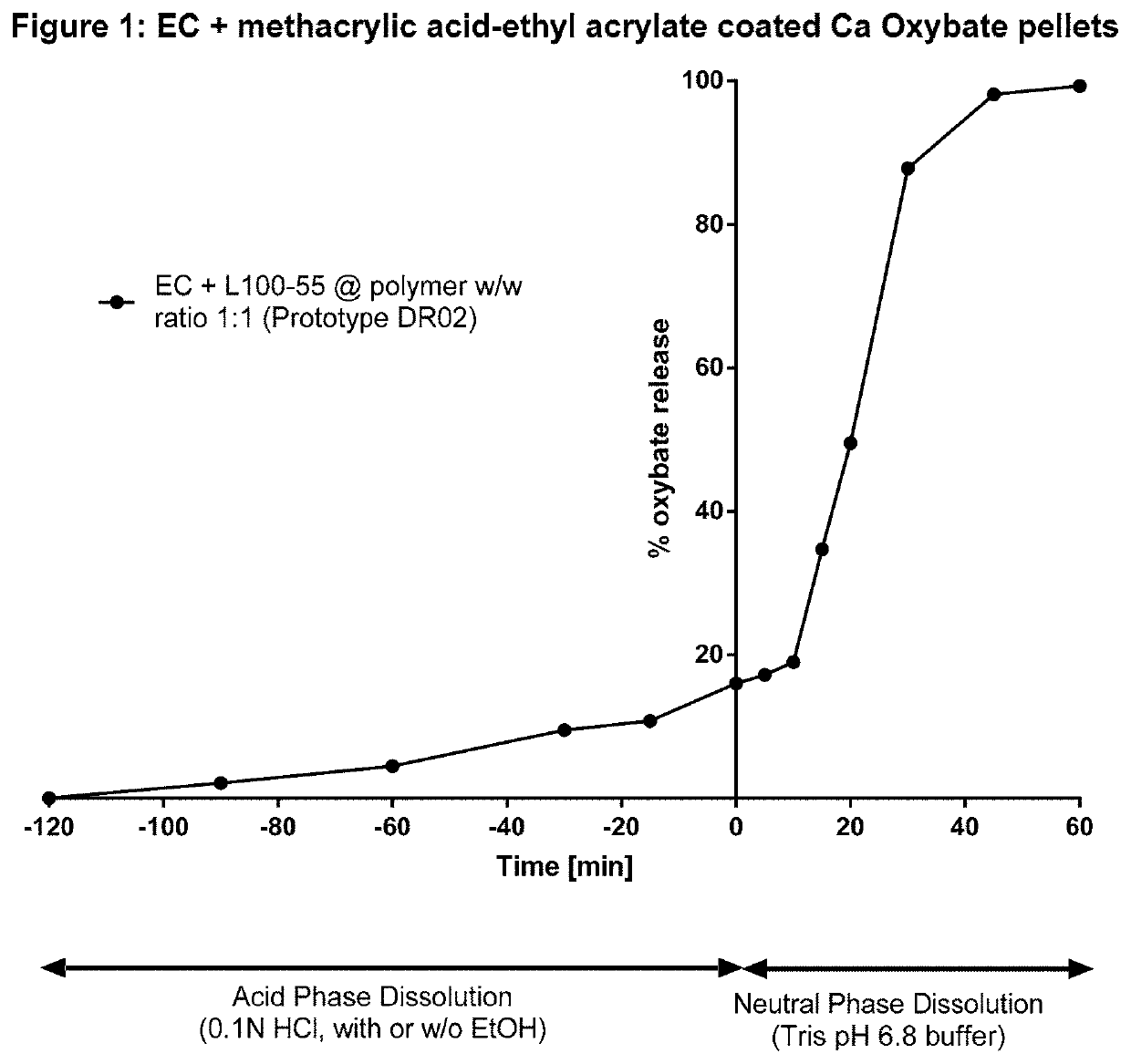
Figure 1 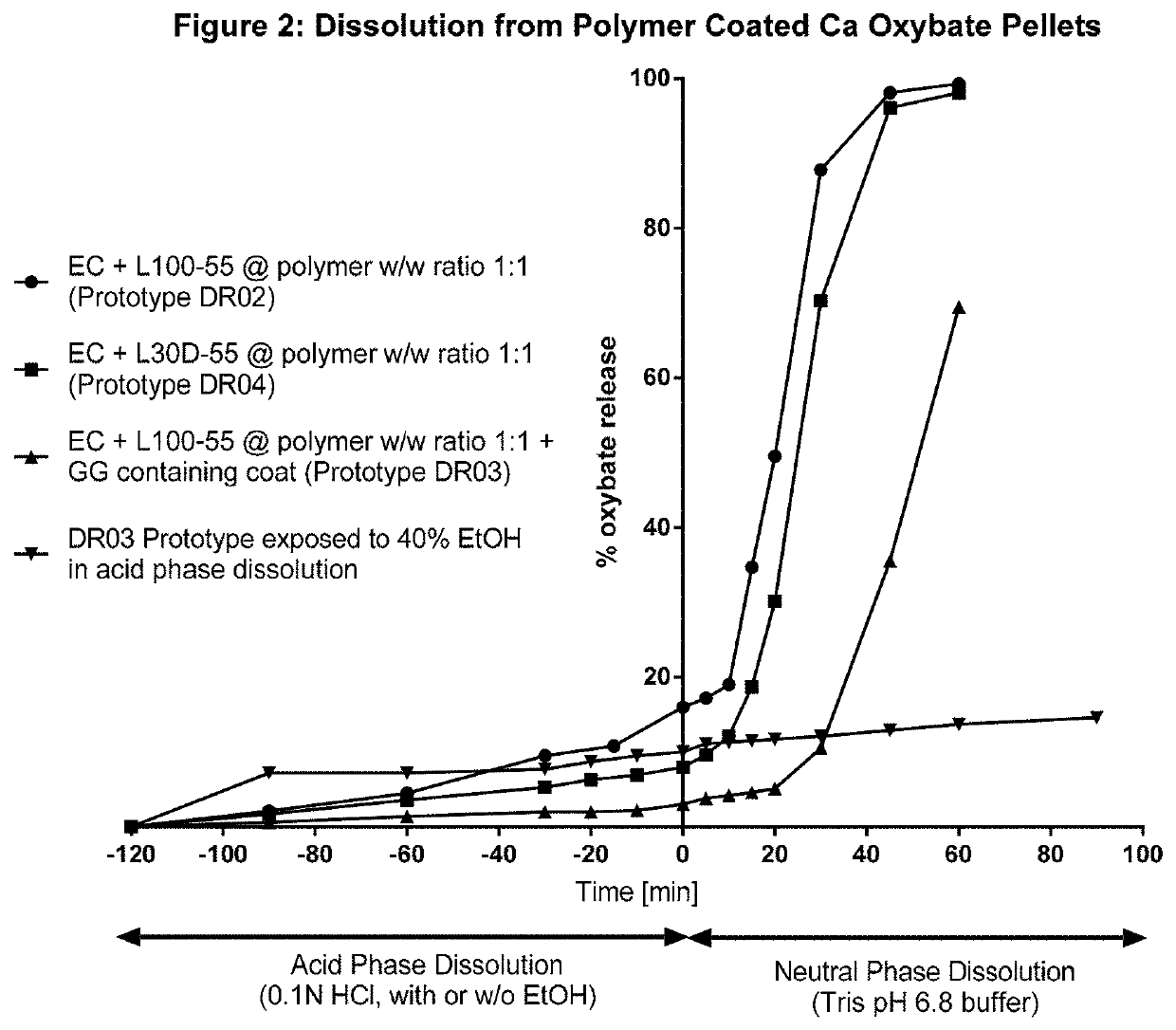
Figure 2 
Figure 3
Abstract
Description
RELATED APPLICATIONS
[0001] This application is a continuation of U.S. application Ser. No. 16 / 688,797, filed Nov. 19, 2019, which claims priority from U.S. Provisional Application Ser. No. 62 / 769,380 filed Nov. 19, 2018 and U.S. Provisional Application Ser. No. 62 / 769,382 filed Nov. 19, 2018, each of which is incorporated herein by reference in its entirety.FIELD OF THE INVENTION
[0002] The present invention relates to modified release formulations of therapeutic agents such as gamma hydroxybutyrate (GHB or oxybate), paracetamol, opioids or opiates that are resistant to alcohol-induced dose dumping. The invention is particularly applicable to therapeutic agents whereby there is a serious clinical consequence of an alcohol induced dose dumping event (e.g. GHB, paracetamol, codeine or oxycodone). The invention also relates to methods for safely administering such therapeutic agents (e.g. GHB, paracetamol, codeine or oxycodone), methods of making the formulations, and methods of their use...
Examples
example 1
ting Enteric Dissolution Behavior Using Ethylcellulose: Methacrylic Acid-Ethyl Acrylate Copolymer at a Ratio of 1:1 (% w / w)
[0192]Multi-particulate (pellet) drug carrier cores of calcium oxybate (monohydrate) were made by the process of extrusion-spheronisation. 17 g calcium oxybate (monohydrate), 1.4 g Avicel PH101, 0.6 g LH-31 and 0.6 g Klucel EF were weighed and added into the mixing bowl in Caleva Multi-lab for pre-blending for 1015 minutes at 100 RPM. The Klucel EF aqueous solution (9.6% or 8.3% w / w) was added slowly to the blend. The wet mass was well mixed for 15 minutes, during which time the mixer was stopped three to four times for visual checking and manual mixing. The wet mass was then moved to extruder and extruded through die plate with 1.0 mm or 0.8 mm pore size; the subsequent extrudate was rested at room temperature for 10 minutes before transferring into the spheronizer to be processed for 3-5 minutes at approximately 3000 RPM. The drug carrier cores (shaped like pe...
example 2
ting Enteric Dissolution Behavior Using Ethylcellulose and an Alternate Preparation of Methacrylic Acid-Ethyl Acrylate Copolymer at a Polymer Blend Ratio of 1:1 (% w / w)
[0195]An alternative method of binary polymer film preparation to that presented in Example 1 was examined whereby the L-100-55 powder was replaced with the aqueous polymer dispersion, L30D-55 (i.e. mixing two colloidal polymer dispersions, Aquacoat® ECD+Eudragit® L30D-55). As per Example 1, the calcium oxybate pellet core was coated to a total polymer weight gain of 30% w / w (of the starter core eight). The coated-cores were tested for 2 hours in acid (0.1N HCl) followed by 1 hour in Tris pH 6.8 buffer.
[0196]FIG. 2 shows the dissolution rate of pellet-shaped calcium oxybate drug carrier cores coated using the two different Eudragit® preparations. Comparing the powder form (“DR02”; circles) to the aqueous form (“DR04”; squares), it can be seen that similar dissolution profiles were obtained using either Eudragit L100-5...
example 2a
ing Shut Down of Oxybate Release Following Exposure to Ethanol Via Gel Layer Formation. Bi-Layer Coating of EC:L100+EC:L100:GG (Guar Gum)
[0197]An additional polymer film layer incorporating the polysaccharide guar gum (“GG”) was applied to the formulation of DR02 (described in Examples 1 and 2). This outer polymer film top coat consisted of EC: L100-55 at a 1:1 ratio and guar gum at a level of 5% w / w of the EC polymer content. The outer polymer film coat was applied to a level of 10% w / w of the pellet having the first polymer coating. The resulting pellets were tested for 2 hours in 0.1N HCl followed by 1 hour in Tris pH 6.8 buffer (USP 2, 37 C, 100 rpm, 300 mL). The dissolution profile of these bi-layer coated formulation is also shown in FIG. 2 (DR03, triangles) and is compared to that of the single layer coated formulations (DR02 (circles) and DR04 (squares)).
[0198]It can be seen that the additional polymer film on DR03 slows the dissolution rate in both acid and pH 6.8 buffers. ...