

Dispersible macromolecule compositions and methods for their preparation and use
a macromolecule and composition technology, applied in the field of macromolecule compositions and methods, can solve the problems of protein degradation, surface convolution (wrinkling) of particles, and insufficient activity for therapeutic us
- Summary
- Abstract
- Description
- Claims
- Application Information
AI Technical Summary
Benefits of technology
Problems solved by technology
Method used
Image

Examples
example 1
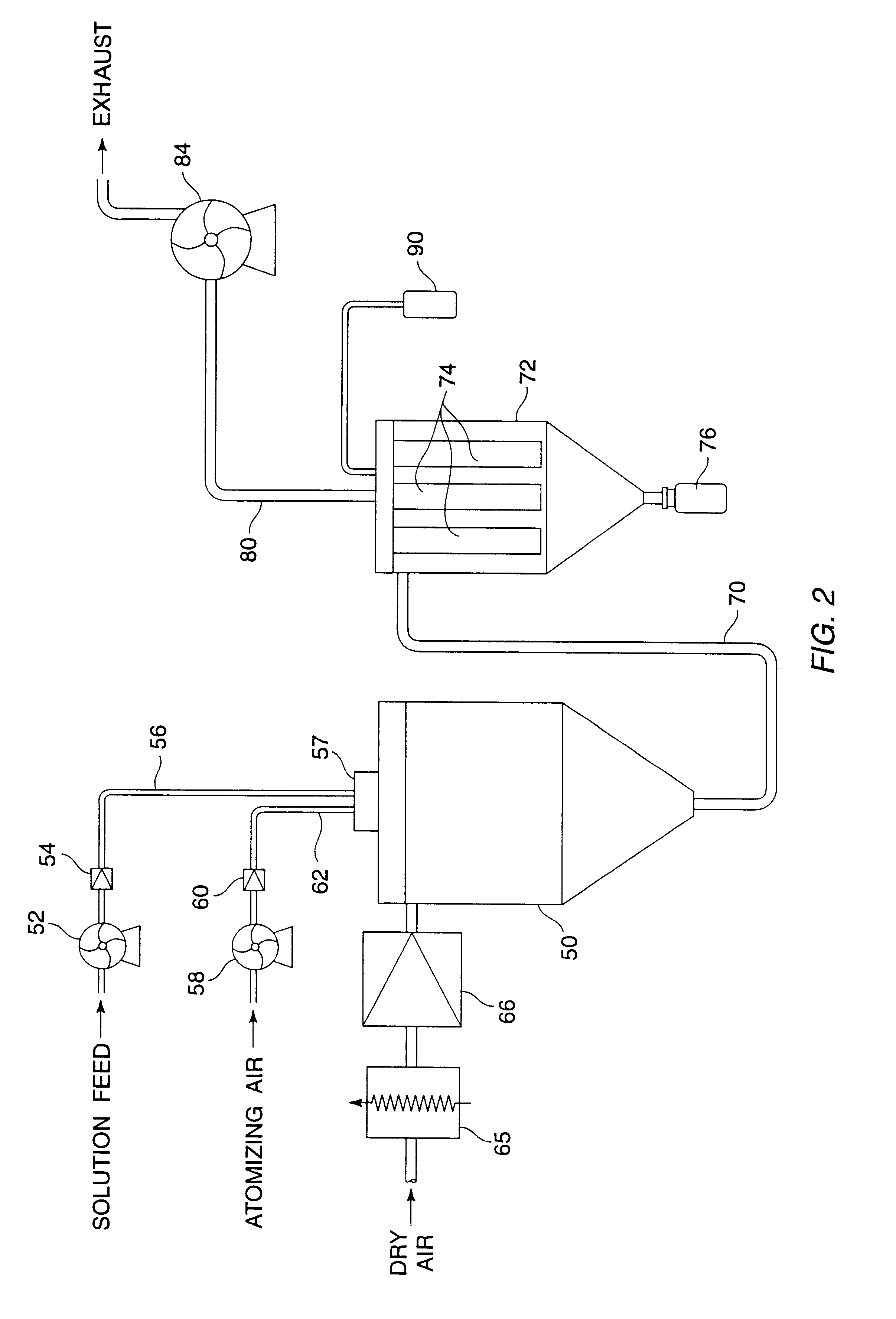
The spray drying equipment configuration is shown in FIGS. 2 and 4. A total of 20 liters of solution was processed during the run. The solution contained 250 grams (1.25% wt.) of total solids, 20% of which was insulin. The balance of the solids was a mixture of mannitol, sodium citrate and glycine. The solution was fed to the atomizer at 4.degree. C. at a rate of about 44 ml / min using a Watson Marlow peristaltic pump and silicone tubing. The actual feed rate was controlled by a PID loop using the spray dryer outlet temperature as the control variable. The atomizer temperature control circulation jacket had 4.degree. C. water circulated through it. The atomizer air was flow controlled and measured using a needle valve and glass rotameter at 12 scfm and 38 psig. Both the air and liquid flows passed through polishing filters just prior to entering the atomizer (Millipak 60 and Millipore Wafergard II F-40 In line gas filters). The powder was collected in a high efficiency cyclone operat...
example 2
A total of 2.4 liters of solution was processed. The solution contained 100 grams (4.0% wt.) of total solids, 20% of which was insulin. The balance of the solids was a mixture of mannitol, sodium citrate and glycine. The spray dryer used in Experiment 1 was used for this experiment. The solution was fed to the atomizer at 4.degree. C. at a rate varying with outlet temperature using a Watson Marlow peristaltic pump and silicone tubing. The actual feed rate was controlled by a PID loop using the spray dryer outlet temperature as the control variable. The atomizer temperature control circulation jacket had 45.degree. C. water circulated through it. The atomizer air was flow controlled and measured using a needle valve and glass rotameter at 13.8 scfm and 70 psig. Both air and liquid flows passed through polishing filters just prior to entering the atomizer (Millipak 60 and Millipore Wafergard II F-40 In line gas filters). The drying air flow rate was controlled by an AC speed control s...
example 3
The spray dryer was reconfigured with a bag house outfitted with sintered stainless steel fiber filter elements. (Fairey Microfiltrex) The equipment configuration is shown in FIG. 2.
A total of 8 liters of solution was processed during the insulin run. The solution contained 100 grams (1.25% wt.) of total solids, 20% of which was insulin. The balance of the solids was a mixture of mannitol, sodium citrate and glycine. The solution was fed to the atomizer at 4.degree. C. at a rate of 55 ml / min using a Watson Marlow peristaltic pump and silicone tubing. The atomizer temperature control circulation jacket had 4.degree. C. water circulated through it. The atomizer air was flow controlled and measured using a needle valve and glass rotameter at 12 scfm and 42 psig. Both air and liquid flows passed through polishing filters just prior to entering the atomizer (Millipak -60, and Millipore Wafergard II F-40 In line Gas Filter). The drying air flow rate was controlled by an AC speed control s...
PUM
| Property | Measurement | Unit |
|---|---|---|
| particle size | aaaaa | aaaaa |
| size | aaaaa | aaaaa |
| inlet temperature | aaaaa | aaaaa |
Abstract
Description
Claims
Application Information
 Login to View More