Multi-track integrated spiral inductor

a spiral inductor and multi-track technology, applied in the field of receiver circuits, can solve the problems of difficult to account for radio signals, difficult to design a receiver, and distortion of captured signals,

US6885275B1Inactive Publication Date: 2005-04-26AVAGO TECH INT SALES PTE LTD
38 Cites 85 Cited by

Patent Information

Authority / Receiving Office
US · United States
Patent Type
Patents(United States)
Current Assignee / Owner
Publication Date
2005-04-26
Estimated Expiration
Not applicable · inactive patent

Smart Images

  • Figure 1
    Figure 1
  • Figure 2
    Figure 2
  • Figure 3
    Figure 3
Patent Text Reader

Abstract

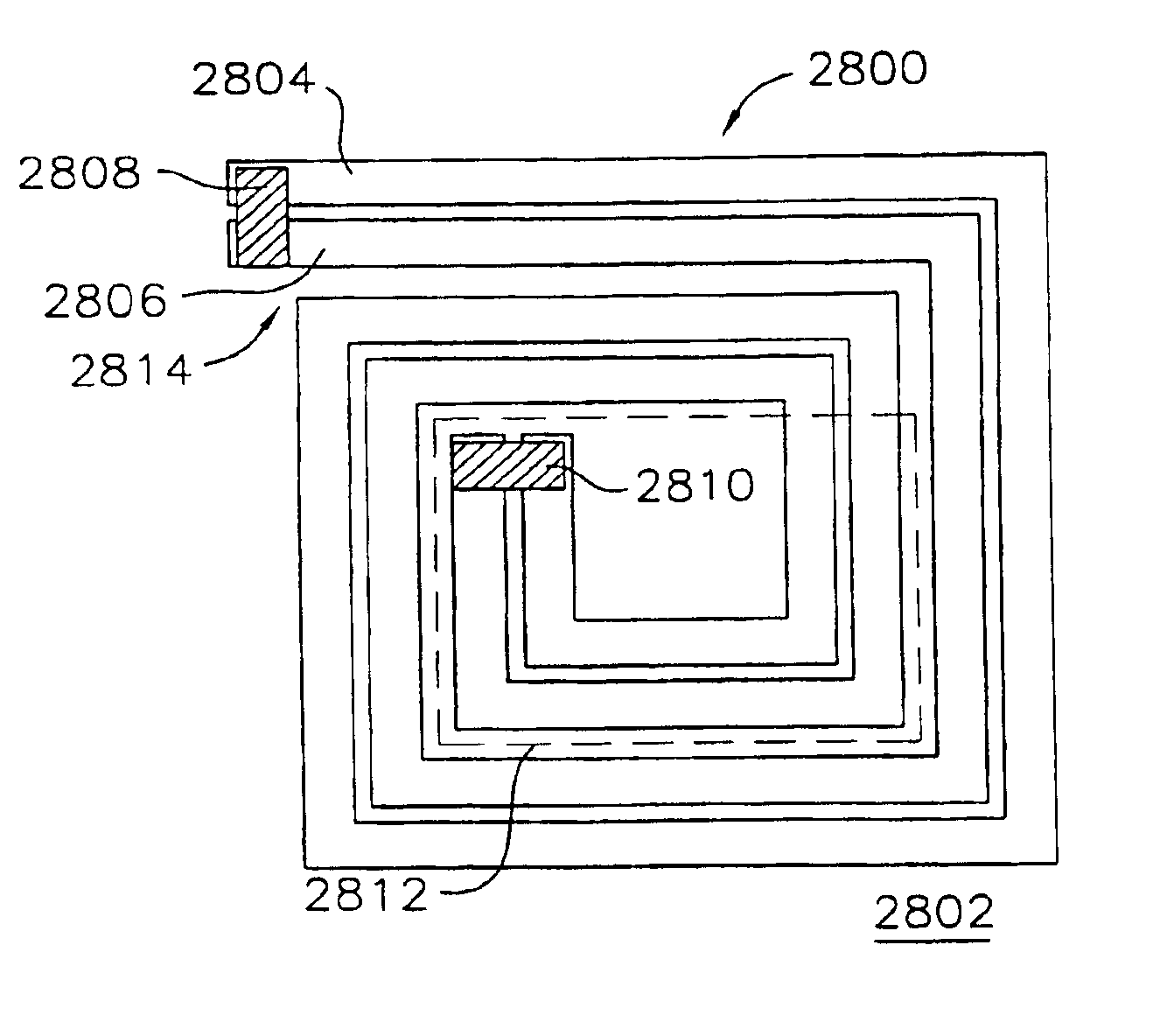
An integrated circuit inductor includes a spiral pattern disposed upon a substrate. The track of the spiral is divided into multiple tracks to form a multi-track inductor. The individual tracks are disposed side by side and in different layers. Tracks that are aligned vertically are coupled by feed throughs, or vias. Multiple vias are used along the length of each of the multiple tracks. Tracks disposed in the same layer are joined together at their beginning, and at their termination. A patterned shield is fabricated from conductive fingers of n+ salicided material that is separated by non conducting polysilicon that fills the gaps between the fingers. The conductive fingers are coupled together in groups, which are in turn tied to a single point ground. In tying the groups together, a gap in the conducting path is provided to prevent ground loop currents. The shield is disposed between the multi-track inductor and the substrate.
Need to check novelty before this filing date? Find Prior Art

Description

CROSS-REFERENCE TO RELATED APPLICATIONS

[0001] This application is a continuation-in-part of Ser. No. 09 / 483,551, filed Jan. 14, 2000, now U.S. Pat. No. 6,445,039, which is a continuation in part of Ser. No. 09 / 439,101 filed Nov. 12, 1999,

[0002] which claims benefit of 60 / 108,459 filed Nov. 12, 1998,

[0003] and claims benefit of Ser. No. 60 / 108,209 filed Nov. 12, 1998

[0004] and claims benefit of Ser. No. 60 / 108,210 filed Nov. 12, 1998

[0005] and claims benefit of Ser. No. 60 / 117,609 filed Jan. 28, 1999

[0006] and claims benefit of Ser. No. 60 / 136,115 filed May 26, 1999

[0007] and claims benefit of Ser. No. 60 / 136,116 filed May 26, 1999

[0008] and claims benefit of Ser. No. 60 / 136,654 filed May 27, 1999

[0009] and claims benefit of Ser. No. of 60 / 159,726 filed Nov. 15, 1999

[0010] which claims benefit of Ser. No. 60 / 116,003 filed Jan. 15, 1999

[0011] which claims benefit of Ser. No. 60 / 117,322 filed Jan. 26, 1999

[0012] which claims benefit of Ser. No. 60 / 122,754 filed Feb. 25, 1999.FIELD OF THE INVENTION...

Examples

Embodiment Construction

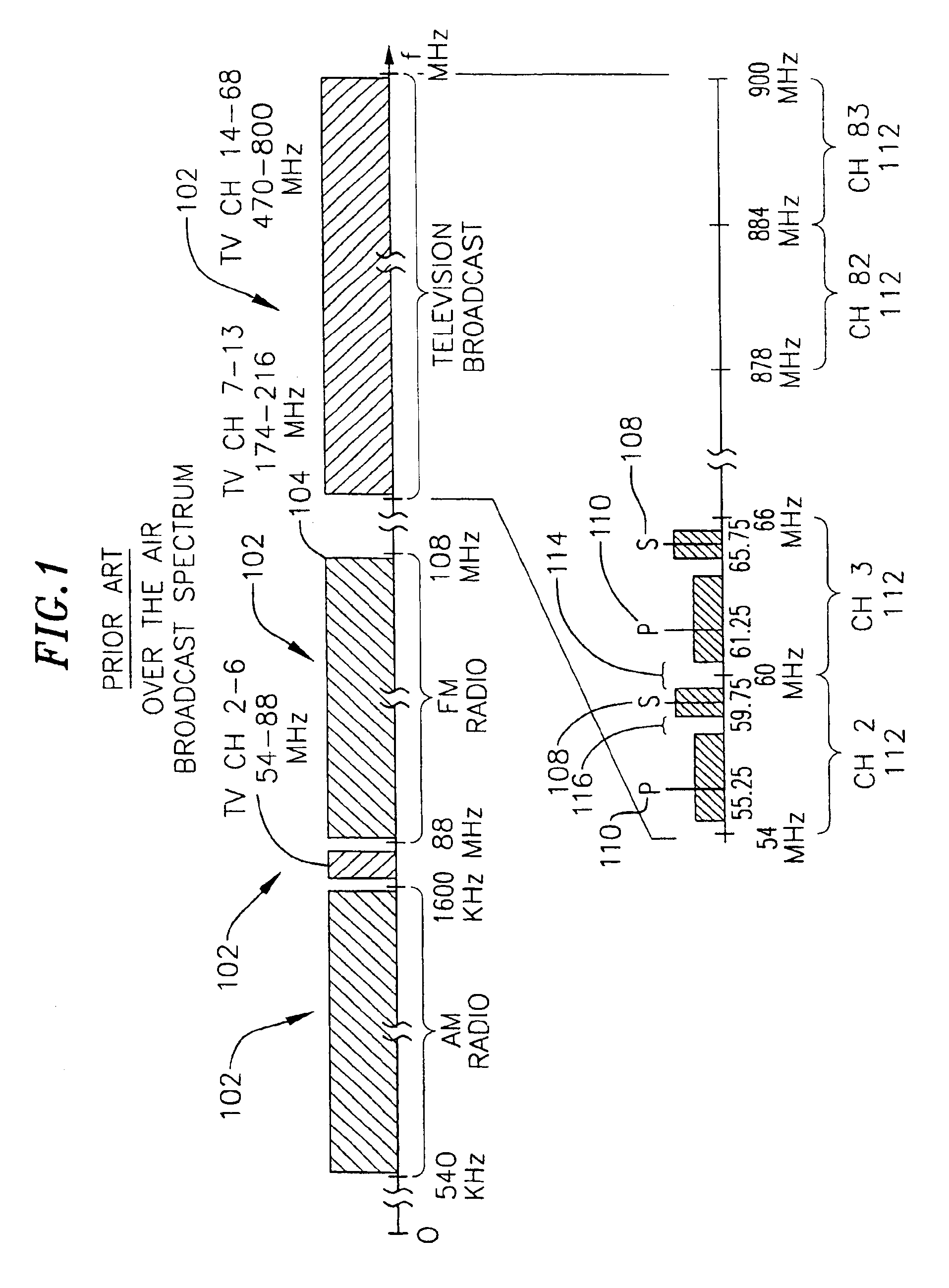
[0100]FIG. 1 is an illustration of a portion of the radio frequency spectrum allocations by the FCC. Transmission over a given media occurs at any one of a given range of frequencies that are suitable for transmission through a medium. A set of frequencies available for transmission over a medium are divided into frequency bands 102. Frequency bands are typically allocations of frequencies for certain types of transmission. For example FM radio broadcasts, FM being a type of modulation, is broadcast on the band of frequencies from 88 MHz to 108 MHz 104. Amplitude modulation (AM), another type of modulation, is allocated the frequency band of 540 kHz to 1,600 kHz 106. The frequency band for a type of transmission is typically subdivided into a number of channels. A channel 112 is a convenient way to refer to a range of frequencies allocated to a single broadcast station. A station broadcasting on a given channel may transmit one or more radio frequency (RF) signals within this band t...