
Therapeutic azide compounds
a technology of azide derivatives and azide derivatives, applied in the field of pharmaceuticals, can solve problems such as destroying effectiveness, and achieve the effect of increasing the half-life of drugs
- Summary
- Abstract
- Description
- Claims
- Application Information
AI Technical Summary
Benefits of technology
Problems solved by technology
Method used
Image

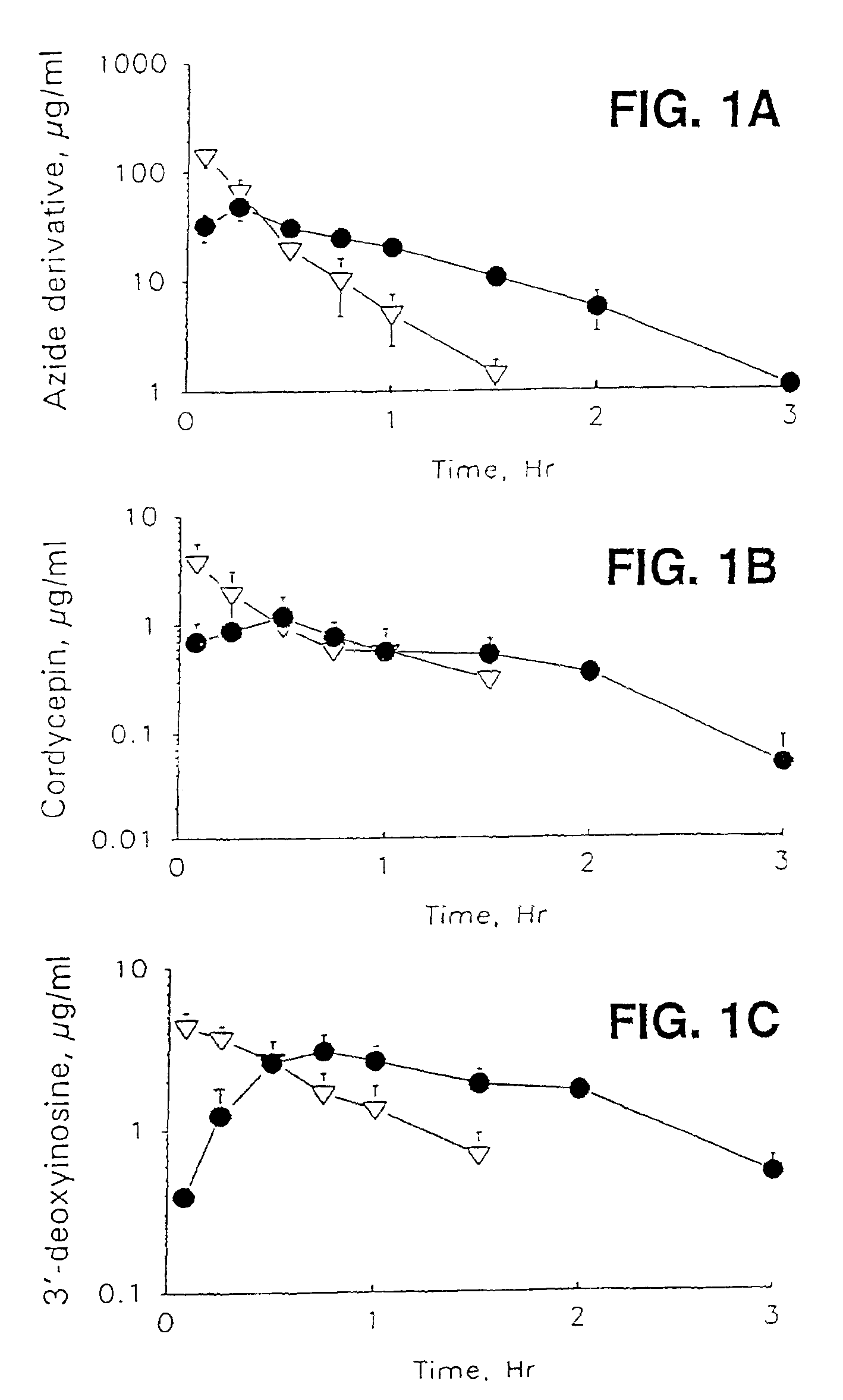
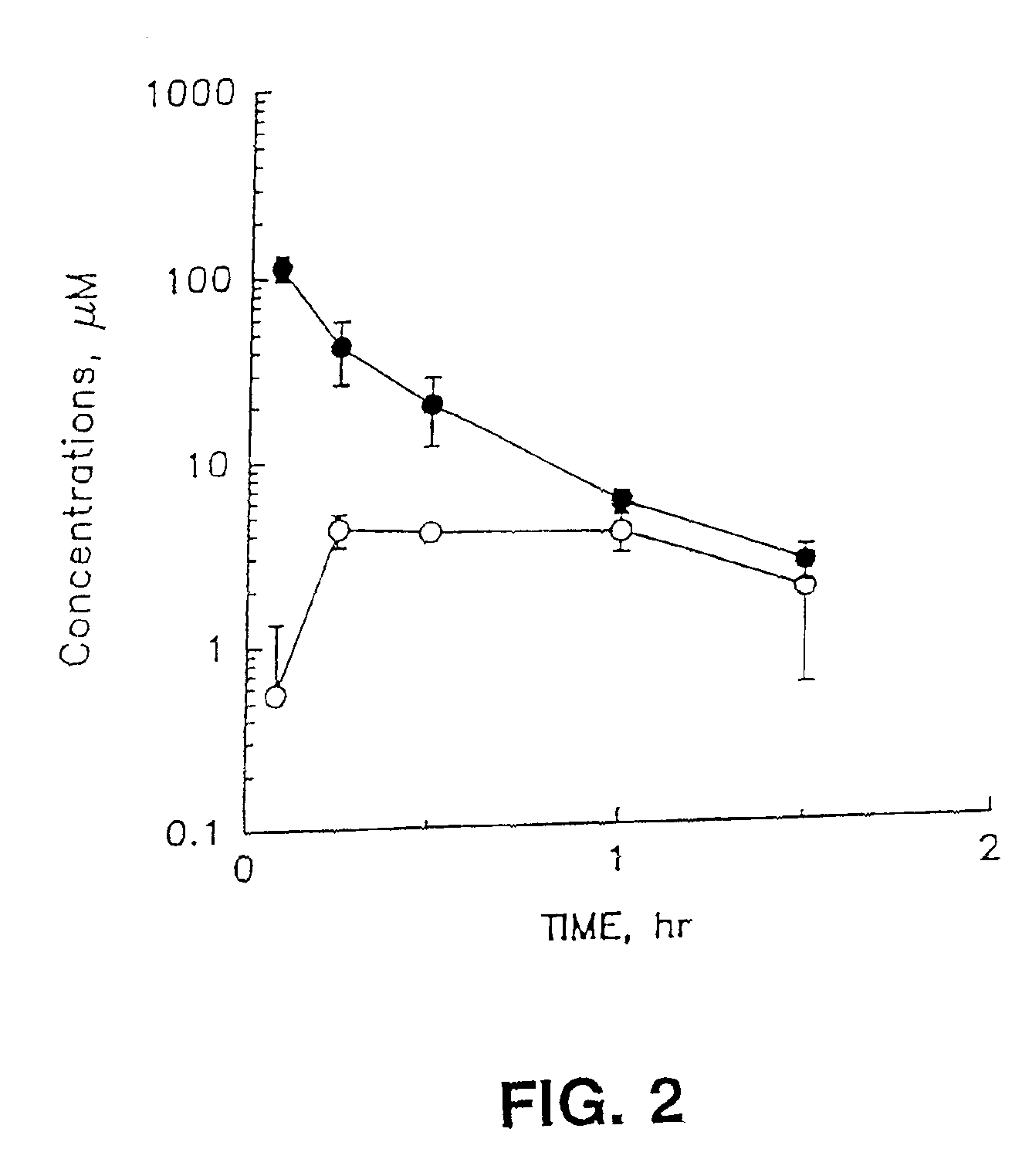
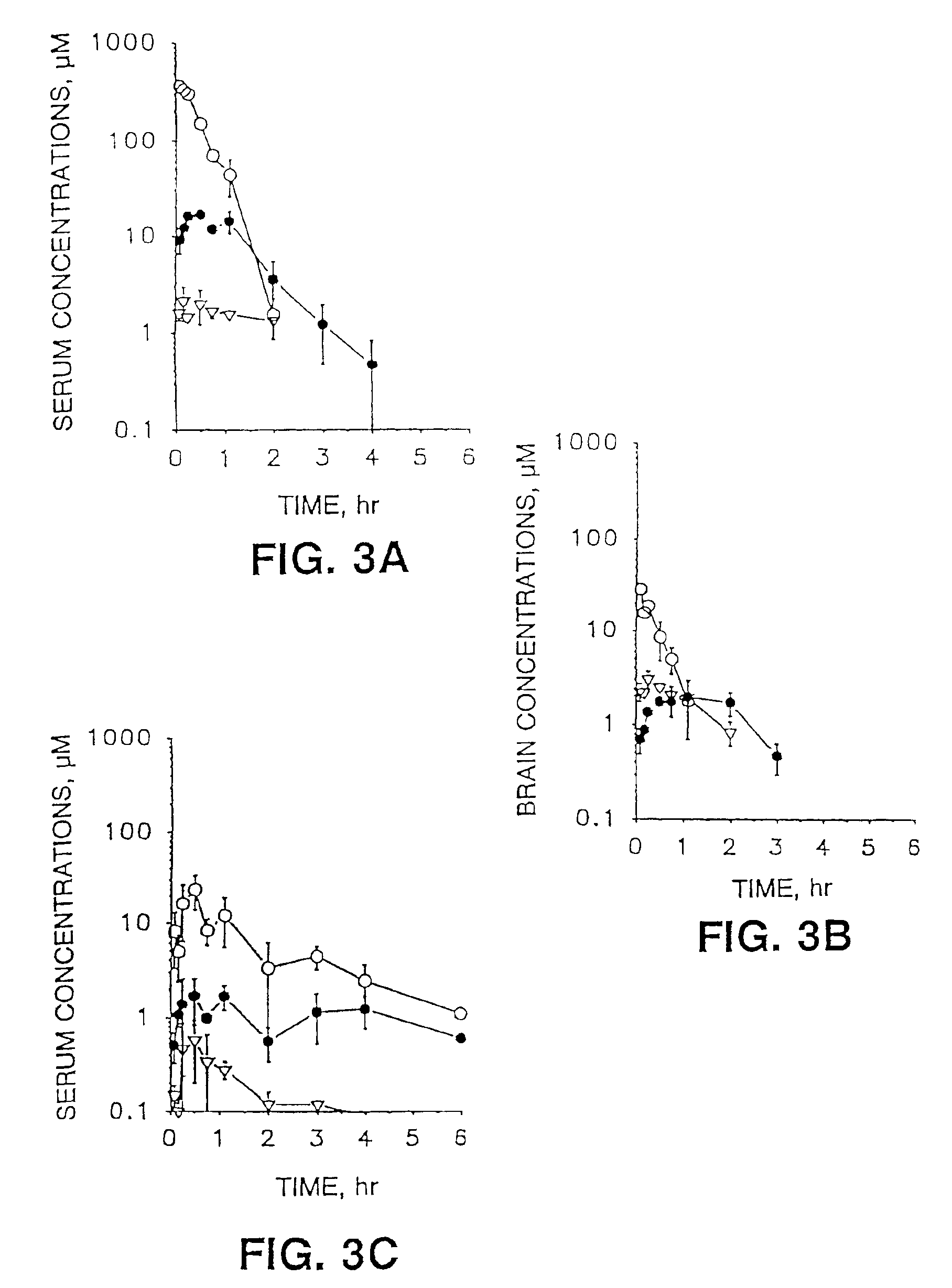
Examples
example 1
Synthesis of Cordycepin Derivative.
[0069]The cordycepin derivative, N6-azido-β-D-3′-deoxyribofuranosyl purine, was synthesized according to the following scheme:
[0070]Diaceton-D-glucose (156 g 0.6 mol.) was stirred in 1000 ml CHCl2. To this solution were added pyridimium dichromate (PDC 135 g 0.36 mol) and Ac2O (186 ml 1.98 mol). The mixture was refluxed for 30 min. After concentration, the residue was diluted with EtOAc (500 ml), filtered and the filtrate was filtered through a silica gel pad and was washed with EtoAc. The combined filtrate was concentrated and was evaporated with toluene to give an oil, 110 g, yield: 70.8%.
[0071]A solution of this oil (110 g 0.42 mol) and TSNHNH2 (86.1 g, 0.46 mol) in absolute EtOH (600 ml) was refluxed for 3 hours. After cooling, the white crystalline product was filtered and washed with MeOH (60 g., yield: 39%).
[0072]To a stirred solution of this white crystalline substance (60 g, 0.23 mol) in THP-MeOH (1:1, 700 ml) was added a trace of methyl ...
example 2
Bioactivity of Cordycepin Derivative.
[0079]Female NIH Swiss mice (Harland Sprague-Dawley, Indianapolis, Ind.) weighing 24-28 g were used for pharmacokinetic experiments. 100 mg / kg of cordycepin or the azide derivative of cordycepin were administered intravenously (iv) (dissolved in methylsulfoxide (20 mg / ml)), or orally (dissolved in 30% glycerin (8.3 mg / ml)). Three animals for each time point were sacrificed at 0.08, 0.25, 0.5, 0.75, 1.0, 1.5, 2.0, 3.0 and 4.0 h after drug administration. Blood (serum) was collected and immediately analyzed.
[0080]Concentrations of the inosine derivative, cordycepin and the azide derivative of cordycepin in serum were measured by high-performance liquid chromatography (HPLC).
[0081]To measure cordycepin and its metabolite concentrations in serum, 200 pl serum sample, 50 μl of internal standard 2′-F-ddI (5 μg / ml) and 50 μl 2 M perchloric acid as a protein precipitant were added to polypropylene microcentrifuge tubes (1.5 ml). An AzdU was used as an in...
example 3
Synthesis of 6-azido-2′,3′-dideoxy-2′-fluoro-β-D-arabinofuranosylpurine (FAAddP) and N6-methyl-2′,3′-dideoxy-2′-fluoro-β-D-arabinofuranosyladenine (FMAddA), 2′-F-ara-ddI azide prodrugs
[0095]Referring to Scheme 13, the prodrugs FAAddP (4) and FMAddA (5) were synthesized from the 6-chloropurine derivative 2. Compound 2 was synthesized from 5-O-benzoyl-3-deoxy-1,2-O-isopropylidine-α-D-ribofuranose (1) according to published procedures [Shanmuganathan, K. et al., “Enhanced brain delivery of an anti-HIV nucleoside 2′-F-ara-ddI by xanthine oxidase mediated biotransformation,” J. Med. Chem. (1994) 37:821-827]. Compound 2 was debenzoylated using DIBAL-H in CH2Cl2 at −78° C. to obtain compound 3. Upon treatment of compound 3 with LiN3 in DMF at room temperature, the 6-azido derivative 4 was obtained in 73% yield. The treatment of compound 2 with methylamine in DMF at 80° C. for 5 hours followed by the deprotection with saturated NH3 / MeOH for 15 hours gave compound 5 quantitatively [Chu, C. K...
PUM
| Property | Measurement | Unit |
|---|---|---|
| Molar density | aaaaa | aaaaa |
| Molar density | aaaaa | aaaaa |
| Molar density | aaaaa | aaaaa |
Abstract
Description
Claims
Application Information
 Login to View More