
Light source and display using the same
a technology of light source and display, applied in the direction of discharge tube luminescnet screen, identification means, instruments, etc., can solve the problems of insufficient color purity of red and insufficient quality of liquid crystal display images, and achieve excellent luminance characteristics and luminous efficiency.
- Summary
- Abstract
- Description
- Claims
- Application Information
AI Technical Summary
Benefits of technology
Problems solved by technology
Method used
Image

Examples
first embodiment
[0040]Phosphor Synthesis
[0041]For material, Y2O3, Gd2O3, Ce2(C2O4)39H2O, Al2O3 or Ga2O3 was used and further, after for a component of flux, potassium-sulfate of 0.5 mol was added for 1-mol phosphor, a mixture of these was put in an alumina crucible and the crucible was capped, the crucible was baked in air at 1600° C. for three hours. A baked product was washed enough to remove the flux component. Further, the baked product was dried and phosphor powder was acquired. As a result, phosphor which can be expressed by a composition formula (Y0.1Gd0.89Ce0.01)3Al2Ga3O12K was acquired. However, the content of potassium K in the composition formula is 150 wt-ppm.
[0042]Assembly of Light Source
[0043]After the phosphor power acquired as described above was dispersed in binder, it was uniformly applied on a plastic substrate, its solvent was evaporated at low temperature and a phosphor screen was formed. Next, an ultraviolet (UV) light lamp, a blue-fluorescent lamp or ultraviolet- or blue-LED ...
second embodiment
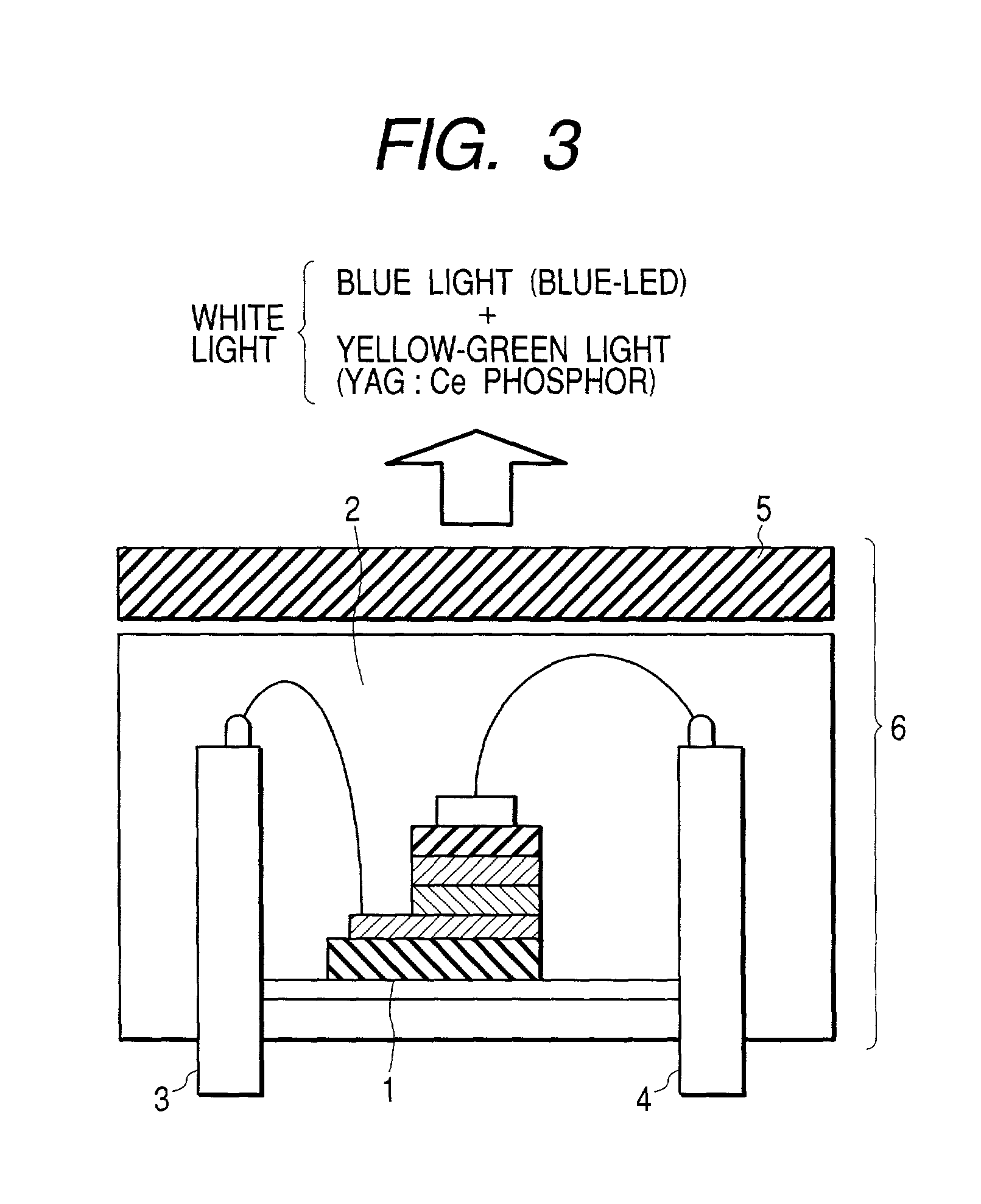
[0048]The performance of the phosphor screen was evaluated using the light source 6 in the configurational example shown in FIG. 3. However, the evaluation of the phosphor screen was performed in a state that the blue-LED 1 and the phosphor screen 5 were separated.
[0049]A phosphor screen expressed by a different composition formula (Y0.5-bGd0.5Ceb)3Al2Ga3O12 the density of Ce of which was b was produced by such a method and an excitation emission characteristic was evaluated using the blue-LED having the emission spectrum shown in FIG. 5 in the first embodiment. In that case, the density of Ce was 0.04 and for a metal element, potassium K was added by 500 wt-ppm. FIG. 7 shows an emission spectrum of a white light source depending upon excitation by the blue-LED.
[0050]The density b of Ce has dependency shown in FIG. 8, shows a satisfactory emission characteristic in a range of 0.001 to 0.08 and particularly, when the density b of Ce is 0.01 to 0.05, the emission intensity becomes max...
third embodiment
[0052]For material for the synthesis of phosphor, Gd2O3, Ce2(C2O4)39H2O, Al2O3 or Ga2O3 was used, further, for a flux component, potassium-nitrate, potassium-carbonate or barium-fluoride (BaF2) was used in place of potassium-sulfate in the first embodiment, phosphor having the composition of (Gd0.99Ce0.01)3Al2Ga3O12 was baked by the similar baking method to that in the first embodiment and further, phosphor screens were produced. In case potassium-nitrate was used, that of 0.6 mol was added for generated 1-mol phosphor or in case potassium-carbonate was used, that of 0.8 mol was added. In both cases, the content of potassium in phosphor is approximately 150 wt-ppm.
[0053]For these phosphor screens, an emission characteristic by excitation by blue-LED as in the second embodiment was also evaluated. FIG. 9 shows the result. FIG. 10 shows an emission spectrum of acquired typical phosphor.
PUM
| Property | Measurement | Unit |
|---|---|---|
| color temperature | aaaaa | aaaaa |
| luminance | aaaaa | aaaaa |
| color temperature | aaaaa | aaaaa |
Abstract
Description
Claims
Application Information
 Login to View More