Unlock instant, AI-driven research and patent intelligence for your innovation.

Crystal base plate and pressing device

a technology of crystal base plate and pressing device, which is applied in the direction of manufacturing tools, after-treatment details, instruments, etc., can solve the problems of difficult adjustment so as to achieve the degree of parallel orientation of the pressing surface of the upper block b>42/b> and the pressing surface of the lower block b>43/b> of a few microns, and achieves the effect of easy operation

Inactive Publication Date: 2008-08-19
NAT INST FOR MATERIALS SCI
View PDF15 Cites 3 Cited by
  • Summary
  • Abstract
  • Description
  • Claims
  • Application Information

AI Technical Summary

Benefits of technology

This approach enables the production of quartz crystal substrates with deep-reaching twin structures, ensuring uniform load application and improved temperature uniformity, facilitating the creation of efficient bulk optical elements for wavelength conversion.

Problems solved by technology

Consequently, since a periodic twin structure which extends into the interior portions, i.e., a periodic twin structure with a large aspect ratio, is not obtained, the realization of a bulk optical element that can be used for the wavelength conversion of laser light is impossible.
Furthermore, since etching proceeds to a greater extent in the direction oriented along the c axis, the following problem also arises: namely, the depth that is removed varies according to the angle of the c axis with respect to the normal of the quartz crystal substrate.
However, adjustment so that the pressing surface of the upper block 42 and the pressing surface of the lower block 43 maintain a degree of parallel orientation of a few microns is extremely difficult, since actual screws have play and backlash.
Furthermore, even assuming that such an adjustment is favorably accomplished, the following problem is encountered: namely, loosening of the screws, etc., in repeated pressing makes it impossible to maintain the degree of parallel orientation, so that re-adjustment must be performed for each operation.
For such reasons, the distribution of the load that is applied to the surface of the quartz crystal substrate becomes non-uniform, and this makes it difficult to manufacture a periodic twin structure in a uniform manner.
Furthermore, the surface flatness of conventionally used pressing surfaces is approximately 3 μm, which is more or less the same as the depth of the step working in the surface of the quartz crystal; accordingly, it is difficult to say that the load is uniformly applied.
Moreover, conventionally used pressing surfaces are formed from SUS304; this material tends to soften at high temperatures, and is therefore unsuitable for use in the formation of twins by applying a stress to the surface of the quartz crystal substrate.
Furthermore, other problems such as the following problem also occur: namely, traces corresponding to the protruding parts of the step working of the quartz crystal remain in the pressing surfaces after pressing, so that the surface flatness deteriorates.
Thus, in conventional pressing apparatuses, there are problems not only in terms of the degree of parallel orientation of the pressing surfaces, but also in terms of the surface flatness and material of the pressing surfaces.
Problems have also been encountered in the pressure control method used in conventional pressing apparatuses.
First of all, in the case of control by hydraulic pressure using a hydraulic pressure conversion amplifier, the drawback of a slow response speed is a problem.
Furthermore, there is a dead time of 100 ms or longer from the input of the voltage signal to the response of the hydraulic pressure.
Furthermore, in the case of control by hydraulic pressure, the problem of a narrow load setting range arises.
In the hydraulic pressure conversion amplifier described above, in cases where a very small air pressure is applied, there is a failure to respond because of the viscosity of the oil.
Accordingly, in a system with a maximum load of 10 kN, it is difficult to generate a load of approximately 2 kN or less.
In such cases, all of the oil in the hydraulic system must be removed and replaced, so that an extremely large amount of work is required; moreover, specialized expertise is required.
Furthermore, when the oil is injected following replacement of the hydraulic cylinder, care must be taken to ensure that no air is admixed with the oil, so that considerable time is required.
For such reasons, it is extremely difficult to find optimal load conditions for the manufacture of a periodic twin structure in the case of conventional pressing apparatuses.
As a result, a temperature variation with a maximum value of several tens of degrees Celsius is generated in the pressing surfaces, so that the following problem arises: namely, a temperature distribution is produced in the quartz crystal substrate as well, and even if a stress is uniformly applied, there is some irregularity in the manner in which the twin is formed.
Furthermore, in cases where a twin is formed in a quartz crystal using a conventional hot pressing method, the following problem arises: namely, as was described above, the work of forming a step structure on one side of the quartz crystal substrate using photolithographic and wet etching methods must be performed for each quartz crystal substrate.

Method used

the structure of the environmentally friendly knitted fabric provided by the present invention; figure 2 Flow chart of the yarn wrapping machine for environmentally friendly knitted fabrics and storage devices; image 3 Is the parameter map of the yarn covering machine
View more

Image

Smart Image Click on the blue labels to locate them in the text.
Viewing Examples
Smart Image
  • Crystal base plate and pressing device
  • Crystal base plate and pressing device
  • Crystal base plate and pressing device

Examples

Experimental program
Comparison scheme
Effect test

Embodiment Construction

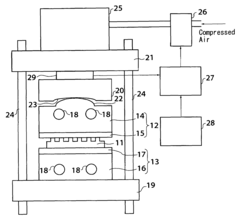
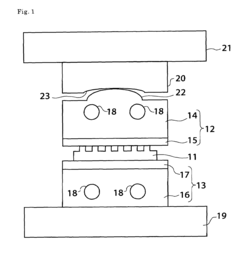
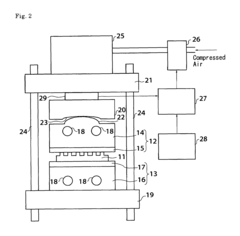
[0053]Working configurations of the present invention will be described below with reference to the figures. FIG. 1 is a schematic diagram showing a state in which a quartz crystal substrate constituting one working configuration of the present invention is pressed using a pressing apparatus which also constitutes one working configuration of the present invention. The basic construction of this pressing apparatus is substantially the same as that of the conventional apparatus shown in FIG. 5; accordingly, only the main parts are shown in schematic terms in FIG. 1.

[0054]A quartz crystal substrate 11 is heated in a state in which this substrate is clamped between an upper block 12 and a lower block 13, and is pressed so that a stress is applied. The upper block 12 is constructed from an upper heater block 14 and an upper pressing plate 15; the upper heater block 14 and upper pressing plate15 are connected by screws, a high-temperature adhesive agent, or the method described below. Th...

the structure of the environmentally friendly knitted fabric provided by the present invention; figure 2 Flow chart of the yarn wrapping machine for environmentally friendly knitted fabrics and storage devices; image 3 Is the parameter map of the yarn covering machine
Login to View More

PUM

PropertyMeasurementUnit
wavelengthaaaaaaaaaa
angleaaaaaaaaaa
thicknessaaaaaaaaaa
Login to View More

Abstract

The upper block 12 contacts the bearing block 20, and the bearing block 20 is coupled to the upper plate 21. The upper block 12 has a protruding part 22 on the upper surface that is worked into a convex surface with a radius of R1, and the bearing block 20 has a recessed part 23 in the undersurface that is worked into a concave surface with a radius of R2 (R2>R1). As a result of such a construction being used, the pressing surface of the upper pressing plate 15 always conforms to the surface of the quartz crystal substrate 11 during pressing, so that a uniform load is applied to the quartz crystal substrate 11. As a result, the surface of the quartz crystal can be uniformly pressed in the hot pressing method.

Description

[0001]This application is the United States national phase application of International Application PCT / JP2003 / 011882 filed Sep. 18, 2003.TECHNICAL FIELD[0002]The present invention relates to a quartz crystal substrate which is used to form a twin in a quartz crystal by a hot pressing method, and a pressing apparatus which is used to form a twin in a quartz crystal by a hot pressing method, and which is suitable for manufacturing the quartz crystal substrate described above.BACKGROUND ART[0003]A quasi-phase matched wavelength conversion optical element has been proposed in which a periodic polarization inversion structure is realized by applying a stress to quartz crystal (SiO2), which is a paraelectric material, in the vicinity of the α-β phase transition temperature, so that a periodic twin structure is created (S. Kurimura, R. Batchko, J. Mansell, R. Route, M. Fejer and R. Byer: 1998 Spring Meeting of the Japan Society of Applied Physics Proceedings 28a-SG-18). This is a method i...

Claims

the structure of the environmentally friendly knitted fabric provided by the present invention; figure 2 Flow chart of the yarn wrapping machine for environmentally friendly knitted fabrics and storage devices; image 3 Is the parameter map of the yarn covering machine
Login to View More

Application Information

Patent Timeline
no application Login to View More
Patent Type & Authority Patents(United States)
IPC IPC(8): A01J21/00B29B15/00C30B29/18G02F2/02B30B15/06C30B33/00
CPCB30B15/068C30B33/00G02F1/3558
Inventor KURIMURA, SUNAOHARADA, MASAKI
Owner NAT INST FOR MATERIALS SCI