VoIP enabled femtocell with a USB transceiver station

a usb transceiver and femtocell technology, applied in the field of telephone services, can solve the problems of limited adoption with subscribers, low voice quality, and low processing capacity of the central processing unit (cpu) of most personal computers, so as to reduce the cost of scaling the voip network, the effect of reducing the cost of form factor and component costs, and high quality audio

US7990912B2Inactive Publication Date: 2011-08-02SMALL CELL INNOVATIONS
8 Cites 85 Cited by

Patent Information

Authority / Receiving Office
US · United States
Patent Type
Patents(United States)
Current Assignee / Owner
Publication Date
2011-08-02
Estimated Expiration
Not applicable · inactive patent

Smart Images

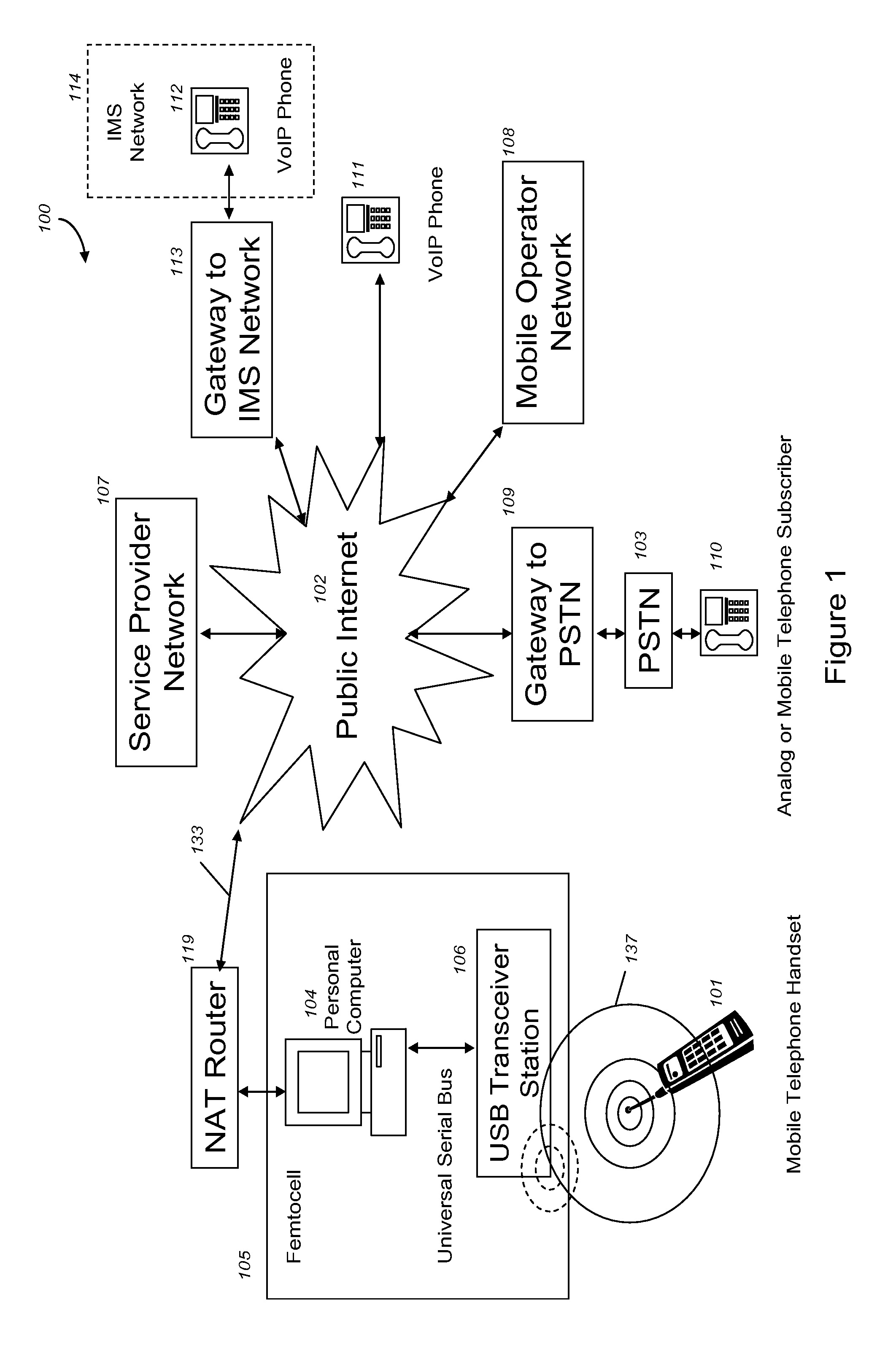
  • Figure 1
    Figure 1
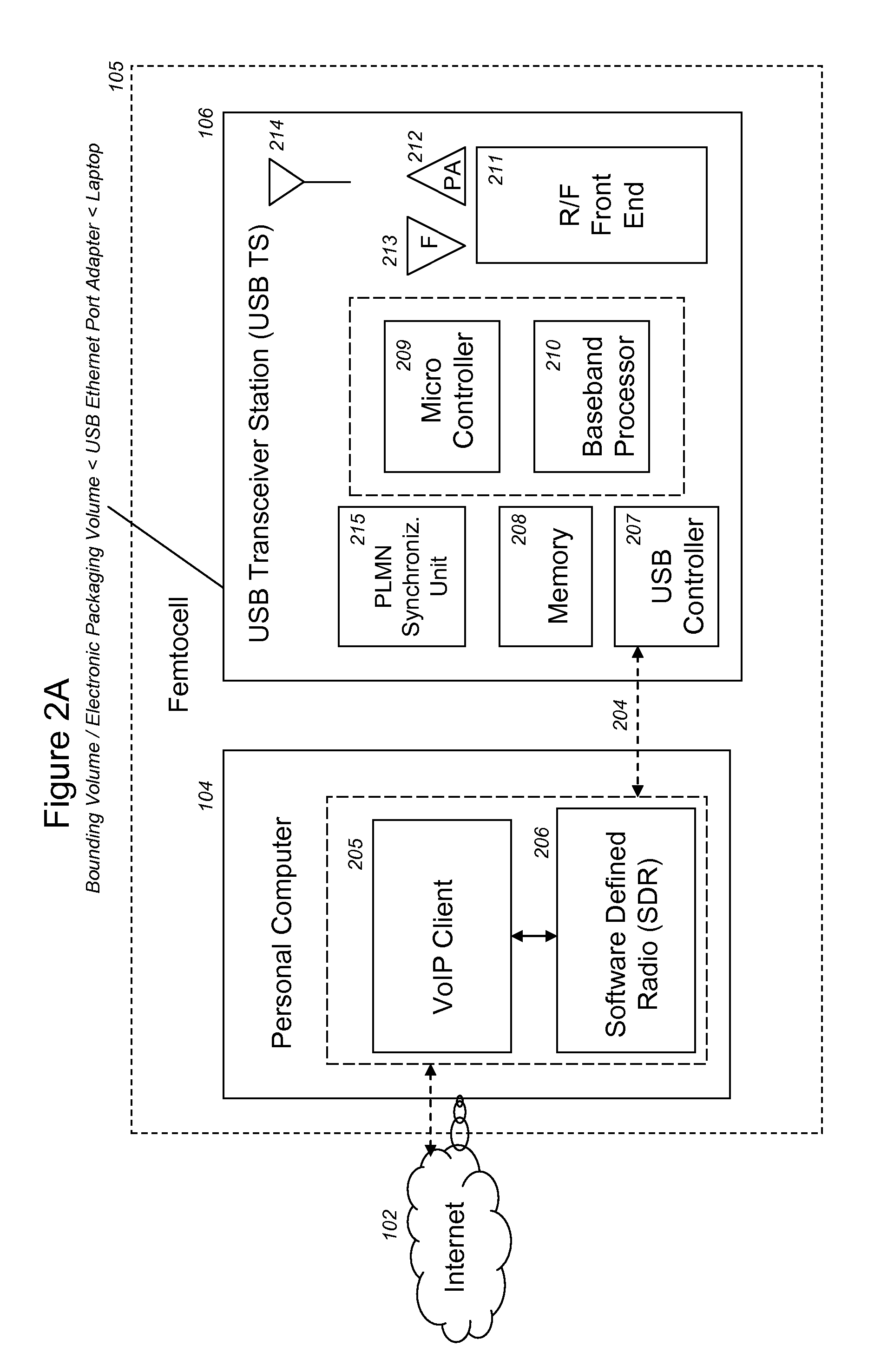
  • Figure 2
    Figure 2
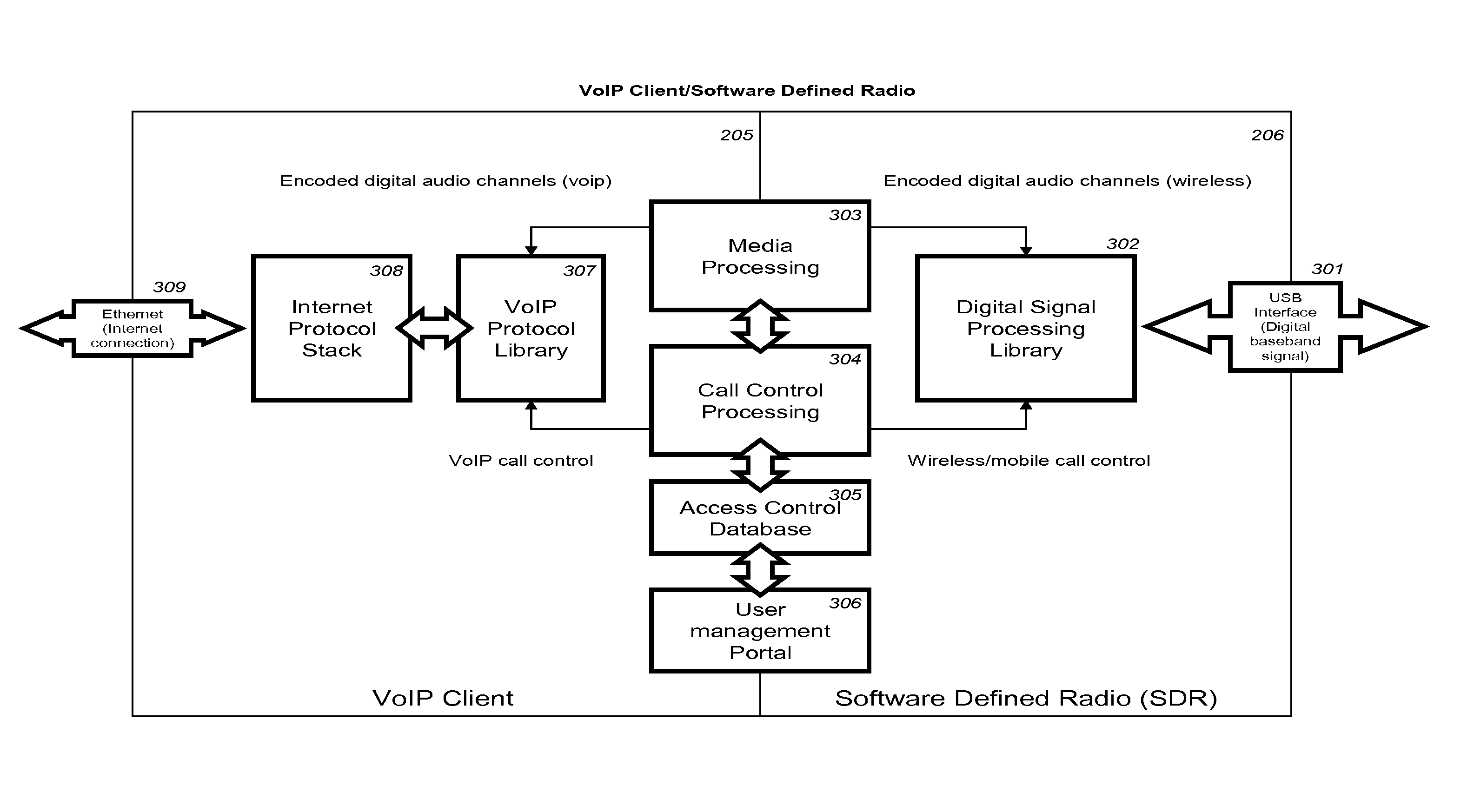
  • Figure 3
    Figure 3
Patent Text Reader

Abstract

Telephone calls between a mobile station (MS) and the mobile network or PSTN are routed through the Internet via VoIP using a femtocell, as opposed to the traditional macrocellular network. The femtocell can comprise a USB Transceiver Station that is connected to a personal computer through a universal serial bus port, which provides both power and a multi-megabit per second connection between the personal computer and the USB transceiver station. The USB transceiver station can comprise a microcontroller to manage signaling between the RF front end / baseband processor and the personal computer, as well as a precise timing mechanism to assist the synchronization of femtocell timing with the surrounding macrocellular network, if it is present. The USB transceiver station can have a compact form factor that facilitates a high degree of portability by the subscriber, such as being readily attachable to their keychain.
Need to check novelty before this filing date? Find Prior Art

Description

TECHNICAL FIELD

[0001] The present invention relates to telephony services. More particularly, the present invention relates to femtocells, or user base stations, in combination with a service provider network to allow a standard mobile handset to communicate voice and / or data through voice over internet protocol (VoIP). For example, data services such as text messaging received from or transmitted to a mobile handset can be supported.BACKGROUND OF THE INVENTION

[0002] Worldwide, the three of the most significant trends in the telecommunications industry are the rapid growth in the number of mobile subscribers, the adoption of Voice over Internet Protocol (VoIP) as the underlying transport method for voice services, and the steadily increasing number of broadband Internet connections for both residential and business users. According to GSM World, as of early 2007 there are 2.2 billion mobile telephony subscribers worldwide, and approximately 82% are on the Global System for Mobile (GSM...

Examples

Embodiment Construction

[0053]FIG. 1 is a graphical illustration of an exemplary system for a service provider to connect telephone calls with a femtocell 105 through VoIP 100. The system 100 includes a mobile station (MS) 101 from which a user wishes to place or receive a call to other users accessible either through the Internet 102, PSTN 103, or IMS network 114. The MS 101 connects to femtocell 105, which comprises a USB Transceiver Station 106 connected to a personal computer 104 through the universal serial bus. The USB Transceiver Station 106 communicates with the MS 101 via a licensed radio spectrum. The personal computer 104 can connect to the Internet 102 via a NAT router 119, although the personal computer could also bypass the NAT router 119 and access the Internet 102 directly.

[0054]The computers illustrated in FIG. 1 may be coupled to a LAN through a network interface or adaptor. When used in a WAN network environment, the computers may typically include a modem or other means for establishing...