
Hybrid superparamagnetic iron oxide nanoparticles and polyethylenimine as a magnetoplex for gene transfection
a superparamagnetic iron oxide and polyethylenimine technology, applied in the field of nanoparticles, can solve the problems of high transfection efficiency, complex processing steps of 0075701, and low efficiency of cytotoxicity, and achieve excellent transfection efficiency and high stability. , the effect of low cytotoxicity
- Summary
- Abstract
- Description
- Claims
- Application Information
AI Technical Summary
Benefits of technology
Problems solved by technology
Method used
Image

Examples
embodiment 1
[0070]2. The method , wherein the PAAIO is obtained by reacting a polyacrylic acid with an iron oxide.
[0071]3. The method according to at least one of embodiments 1 and 2, wherein the nanoparticle is a magnetic nanoparticle.
[0072]4. The method according to at least one of embodiments 1 to 3, wherein the PEC further includes the bound PEI, and the unbound PEI is removed by a magnetic force.
[0073]5. The method according to at least one of embodiments 1 to 4, wherein the genetic material is one selected from a group consisting of a DNA, an RNA, a complementary DNA, a micro RNA and a small interfering RNA.
[0074]6. The method according to at least one of embodiments 1 to 5, wherein the PAAIO is water soluble, and the nanoparticle has a superparamagnetic property.
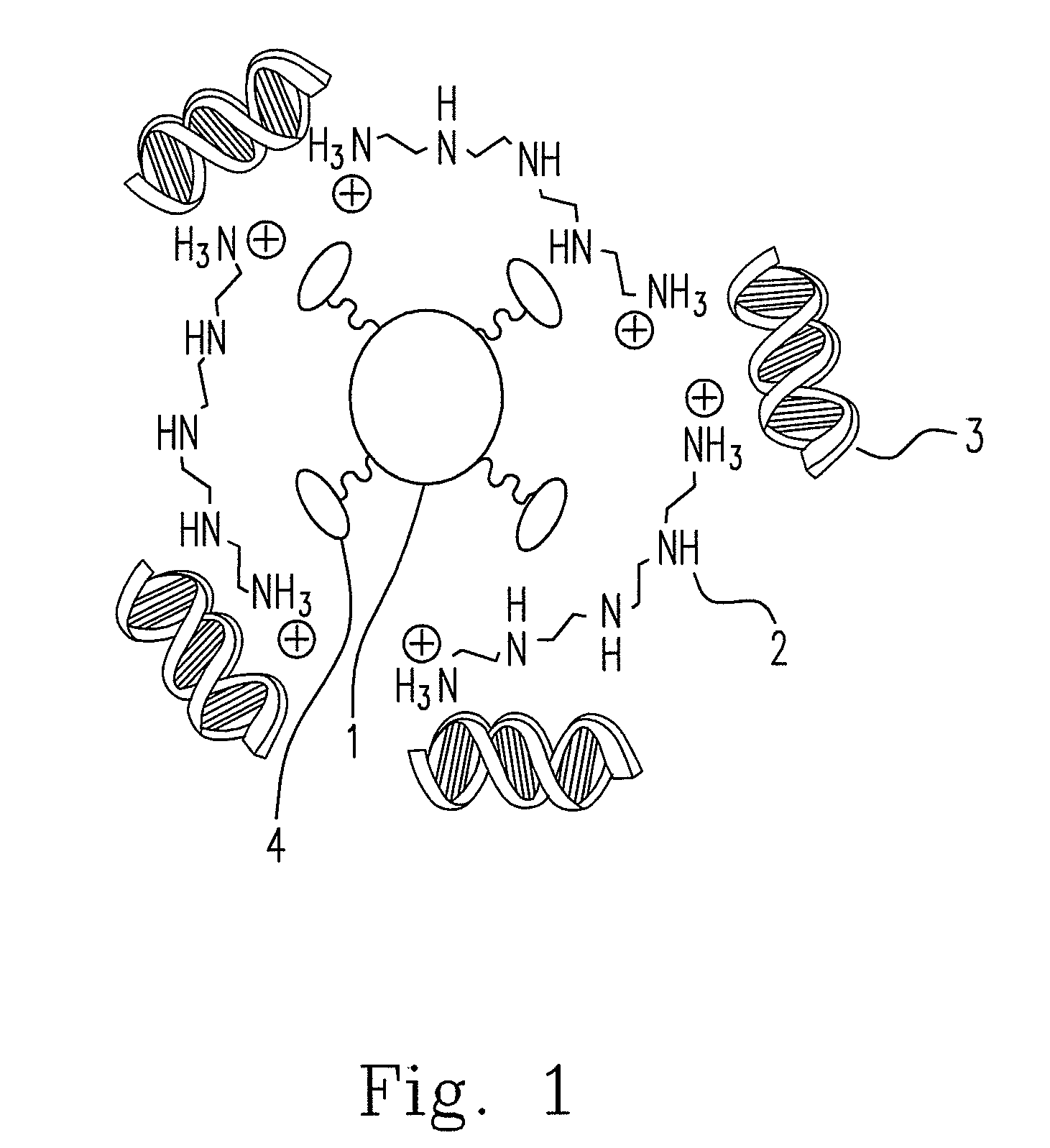
[0075]7. A nanoparticle, including: a PEC including a PEI and a PAAIO configured on the PEI; and a genetic material coupled to the PEI.
embodiment 7
[0076]8. The nanoparticle , wherein the genetic material is one selected from a group consisting of a DNA, an RNA, a complementary DNA, a micro RNA and a small interfering RNA.
[0077]9. The nanoparticle according to at least one of embodiments 7 to 8, wherein the PAAIO is water soluble.
[0078]10. The nanoparticle according to at least one of embodiments 7 to 9, wherein the PEC has a first concentration and a first volume, the genetic material has a second concentration and a second volume, the PEC and the genetic material are dissolved in a water, the first volume is equal to the second volume, and the first concentration and the second concentration have a ratio ranged from 1 / 1 to 1 / 30.
[0079]11. A nanoparticle, including: a PEC including a positive charge molecule and a magnetic particle configured on the positive charge molecule; and a genetic material coupled to the positive charge molecule.
embodiment 11
[0080]12. The nanoparticle , wherein the positive charge molecule is one selected from a group consisting of a PEI and a PEGlyated PEI.
[0081]13. The nanoparticle according to at least one of embodiments 11 to 12, wherein the metal particle is water soluble and is one selected from a group consisting of a gold nanoparticle, a silver nanoparticle and an iron nanoparticle.
[0082]14. The nanoparticle according to at least one of embodiments 11 to 13, wherein the genetic material is one selected from a group consisting of a DNA, an RNA, a complementary DNA, a micro RNA and a small interfering RNA.
[0083]15. The nanoparticle according to at least one of embodiments 11 to 14, wherein the magnetic particle is a metal particle.
[0084]16. The nanoparticle according to at least one of embodiments 11 to 15, wherein the genetic material is electrostatically coupled to the positive charge molecule.
PUM
| Property | Measurement | Unit |
|---|---|---|
| concentration | aaaaa | aaaaa |
| volume | aaaaa | aaaaa |
| binding energies | aaaaa | aaaaa |
Abstract
Description
Claims
Application Information
 Login to View More