
Providing selective via plating using laser resin activation
a laser resin activation and selective technology, applied in the field of electric connectors, can solve the problems of buried vias, blind vias and buried vias are significantly more expensive to fabricate than pth vias, backdrilling is a and achieve the effect of eliminating the costly and time-consuming process of via stub backdrilling
- Summary
- Abstract
- Description
- Claims
- Application Information
AI Technical Summary
Benefits of technology
Problems solved by technology
Method used
Image

Examples
Embodiment Construction
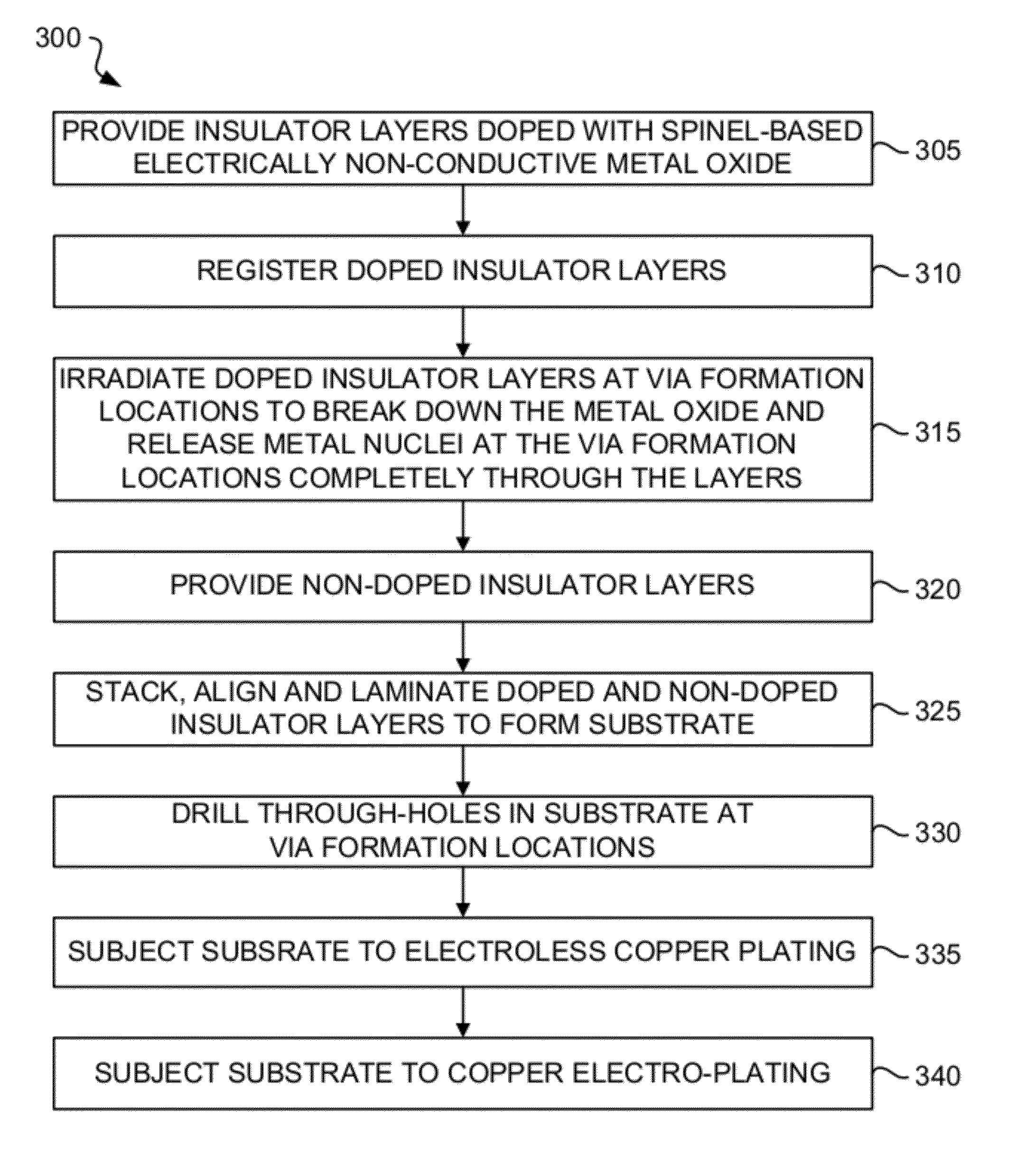
[0024]In accordance with the preferred embodiments of the present invention, laser resin activation is employed on a layer-by-layer basis to provide selective via plating and, thereby, achieve via stub elimination in printed wiring boards (PWBs) and other substrates, such as laminate subcomposites and interconnect substrates. To facilitate laser resin activation, at least one spinel-based electrically non-conductive metal oxide (e.g., the copper-containing spinel PK 3095 made by Ferro GmbH) is added to a conventional resin used to fabricate one or more insulator layers of the PWB. Preferably, only insulator layers through which vias will pass contain the metal oxide. Those layers are registered and laser irradiated at one or more via formation locations to break down the metal oxide and release metal nuclei. Laser irradiation is performed on a layer-by-layer basis to create areas of laminate that are electrically conductive and that can be dimensionally precisely controlled. This en...
PUM
| Property | Measurement | Unit |
|---|---|---|
| thickness | aaaaa | aaaaa |
| thickness | aaaaa | aaaaa |
| thickness | aaaaa | aaaaa |
Abstract
Description
Claims
Application Information
 Login to View More