Unlock instant, AI-driven research and patent intelligence for your innovation.

Methods for detecting targets

a target and composition technology, applied in the field of methods and compositions for detecting target molecules, can solve the problems of limited color range for distinguishing reaction products, system limitations, and difficulty in distinguishing even two colors

Inactive Publication Date: 2014-12-09
DANISCO US INC
View PDF12 Cites 0 Cited by
  • Summary
  • Abstract
  • Description
  • Claims
  • Application Information

AI Technical Summary

Benefits of technology

This method enables sensitive and specific detection of target molecules, particularly cancer markers, with improved color distinction and reduced background interference, facilitating precise visualization of targets in tissues.

Problems solved by technology

But, these systems have limitations.
For example, the range of colors for distinguishing reaction products is limited, and distinguishing even two colors is sometimes problematic, while distinguishing greater than two is not currently feasible.
Likewise, other than highly specialized systems, these methods are not used to generate fluorescent reaction products.
Also, endogenous enzymes present in tissues (e.g., alkaline phosphatases) can lead to high backgrounds (i.e., “noise”).

Method used

the structure of the environmentally friendly knitted fabric provided by the present invention; figure 2 Flow chart of the yarn wrapping machine for environmentally friendly knitted fabrics and storage devices; image 3 Is the parameter map of the yarn covering machine
View more

Image

Smart Image Click on the blue labels to locate them in the text.
Viewing Examples
Smart Image
  • Methods for detecting targets
  • Methods for detecting targets
  • Methods for detecting targets

Examples

Experimental program
Comparison scheme
Effect test

example 1

Construction of CAB 1.2 Molecule

[0143]In this Example, the construction of CAB 1.2 is described. Plasmid pME27.1 was generated by inserting a BglI-EcoKV fragment encoding a part of the pelB leader, the CAB1-scFv and a small part of BLA into the expression vector pME25. FIG. 12A provides a map of this plasmid. The insert which encoded CAB1-scFv was synthesized by Aptagen, based on the sequence of the scFv MFE-23 (See, Boehm et al., Biochem. J., 346(Pt 2): 519-528 [2000]). Both the plasmid containing the synthetic gene (pPCR-GME1) and pME25 were digested with Bg and EcoRV, gel purified, and ligated with Takara ligase. The ligation products were transformed into TOP10 (Invitrogen) electrocompetent cells, and plated on LA medium containing 5 mg / l chloramphenicol and 0.1 mg / l cefotaxime. Plasmid pME27.1 contained the following components.

[0144]

Plasmid pME27.1 ComponentsP lac4992-5113bppel B leader13-78bpCAB 1 scFv79-810bpBLA811-1896bpT7 term.2076-2122bpCAT3253-3912bp

[0145]As indicated ab...

example 2

Specificity and Localization of Staining in Viable Mixed Cell Cultures

[0164]In this Example, experiments conducted to determine the specificity and localization of staining in mixed cell cultures using sc-Fv-BLA fusion protein targeted to CEA in viable cultured cells are described. In these experiments, MC38 and MC38 CEA+ cells were used (MC38 cells are a mouse fibroblast cell line and MC38 CEA+ are fibroblasts from a transgenic mouse expressing human carcinoembryonic antigen (CEA)). Cells of both lines were cultured in standard growth medium (50:50 DMEM / Ham's F12 media) supplemented with 10% fetal bovine serum, non-essential amino acids, glutamine and pyruvate. Cells were grown at 37° C. in a 5% CO2 atmosphere using standard cell culture methods as known in the art. Medium was removed from cells, and the cells were then washed in phosphate buffered saline (PBS). CEA-targeted beta-lactamase-scFv with a CAB molecule (See, Example 1, and FIG. 12) was added at 1 ug / ml in PBS and allowe...

example 3

Specificity and Localization of Staining in Fixed Mixed Cell Culture

[0167]In this Example, experiments conducted to determine the specificity and localization of staining in mixed cell cultures using sc-Fv-BLA fusion protein targeted to CEA in formaldehyde-fixed cultured cells are described. The methods used were similar to those described in Example 2. In these experiments, LSI 74T (CEA+ LS174T colon carcinoma cells) and MRC5 (diploid human fibroblasts; ATCC) were co-cultured as described above, fixed for 10 minutes at room temperature with 3% formaldehyde (Polysciences), then stained as described above in Example 1, with 0.5 ug / ml stain. Then, substrate (See, FIG. 2A) was added in distilled water.

[0168]The cells were observed using fluorescence microscopy with a filter set having 350 nm excitation and 585 nm emission optics. Imaging was performed with a Leica DMRA fluorescence microscope and a Hamamatsu Orca CCD camera and image processed with Image Pro software.

[0169]As indicated...

the structure of the environmentally friendly knitted fabric provided by the present invention; figure 2 Flow chart of the yarn wrapping machine for environmentally friendly knitted fabrics and storage devices; image 3 Is the parameter map of the yarn covering machine
Login to View More

PUM

PropertyMeasurementUnit
total volumeaaaaaaaaaa
Login to View More

Abstract

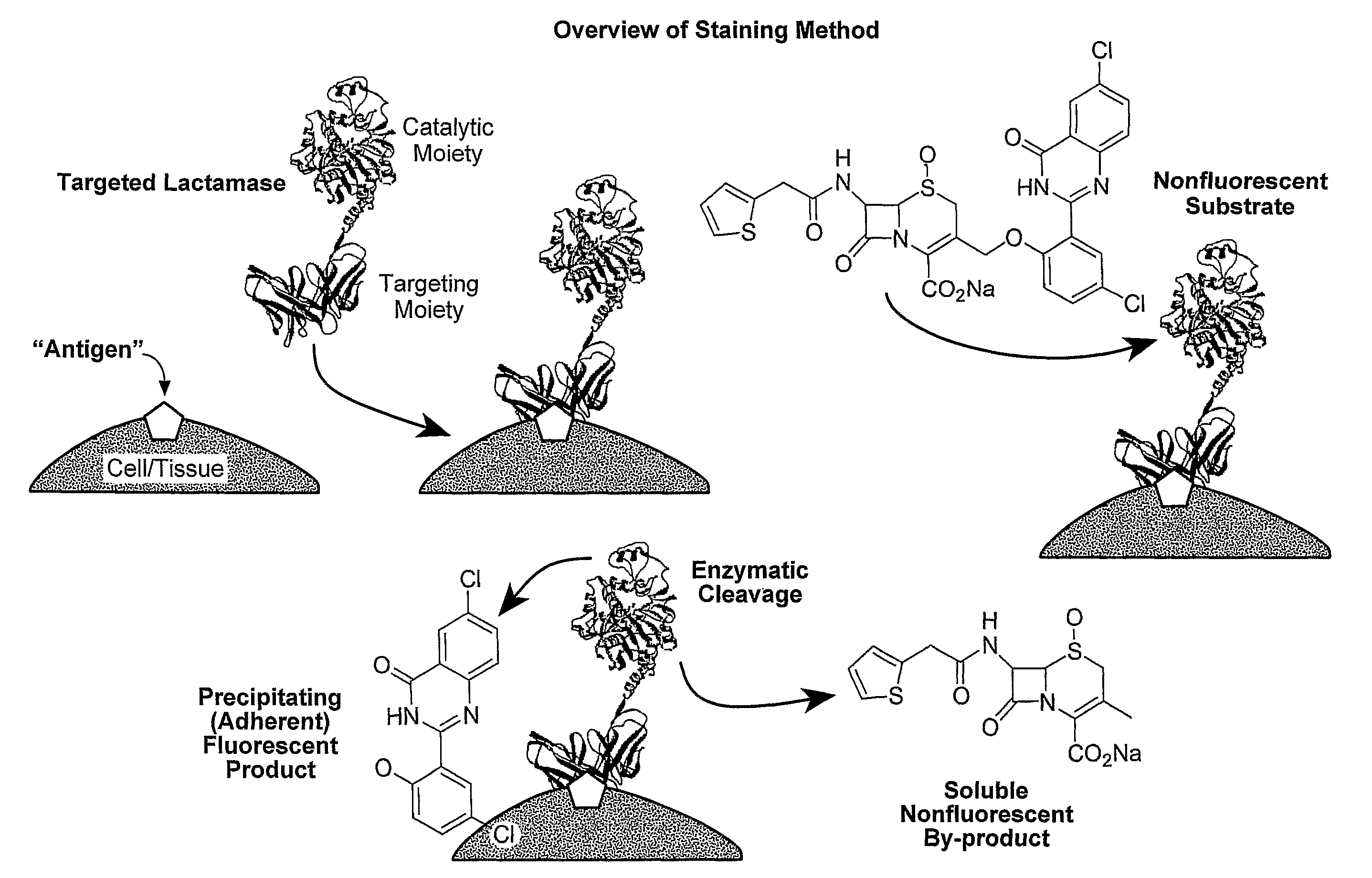
The present invention provides method and compositions for detecting target molecules present on cells and tissues. In particular, the methods involve adding primary antibodies such as scFv-targeted lactamase that are directed against a target of interest (e.g., cancer markers) to a tissue sample, followed by adding a lactam-containing compound and finally a lactamase reporter system. In some preferred embodiments, the lactamase reporters are fluorescent reporters that bind to the test tissue. In some particularly preferred embodiments, the test tissue contains at least once cancer cell and / or at least one cancer-associated marker.

Description

[0001]The present application claims priority under 35 U.S.C. §119, to co-pending U.S. Provisional Patent Application Ser. No. 60 / 609,082, filed Sep. 10, 2004, and co-pending U.S. Provisional Patent Application Ser. No. 60 / 609,205, filed Sep. 10, 2004.SEQUENCE LISTING[0002]The sequence listing submitted via EFS, in compliance with 37 C.F.R. §1.52(e), is incorporated herein by reference. The sequence listing text file submitted via EFS contains the file “30849US_SequenceListing”, created on Jun. 4, 2012, which is 16,125 bytes in size.FIELD OF THE INVENTION[0003]The present invention provides methods and compositions for detecting target molecules present on cells and tissues. In particular, the methods involve adding primary antibodies such as scFv-targeted lactamase that are directed against a target of interest (e.g., cancer markers) to a tissue sample, followed by adding a lactam-containing compound and finally a lactamase reporter system. In some preferred embodiments, the lactam...

Claims

the structure of the environmentally friendly knitted fabric provided by the present invention; figure 2 Flow chart of the yarn wrapping machine for environmentally friendly knitted fabrics and storage devices; image 3 Is the parameter map of the yarn covering machine
Login to View More

Application Information

Patent Timeline
no application Login to View More
Patent Type & Authority Patents(United States)
IPC IPC(8): C12Q1/37G01N33/569G01N33/574G01N33/542A61K38/00
CPCG01N33/57492G01N33/56966
Inventor SHERWOOD, STEVEN, W.
Owner DANISCO US INC