High-capacity complex hydrogen storage materials and a process of releasing hydrogen
a hydrogen storage material, complex technology, applied in the direction of physical/chemical process catalysts, other chemical processes, explosives, etc., can solve the problems of ammonia on board use, unacceptably high reaction temperature, slow reaction rate, etc., to achieve easy adducting to libh4, reduce particle size, and well-dispersed and nano-sized metal catalysts
- Summary
- Abstract
- Description
- Claims
- Application Information
AI Technical Summary
Benefits of technology
Problems solved by technology
Method used
Image

Examples
example 1
Neat and Co-Doped LiBH4- 4 / 3NH3
[0033]Mixture of CoCl2—LiBH4 (molar ratio 0.026:1) was mechanical milled at 200 rpm for 8 hours on a planetary Retch PM 400 mill. The sample LiBH4—NH3 (molar ratio 3:4) was prepared by exposing LiBH4 to anhydrous NH3 atmosphere.
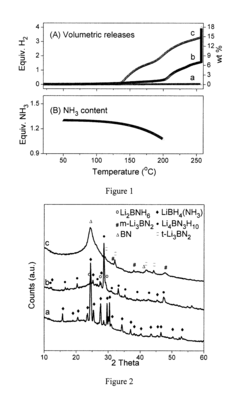
[0034]FIG. 1B reveals that 1.30, 1.26 and 1.07 equiv. NH3 retained in the sample at 55° C. (Li(NH3)4 / 3BH4 transfers to liquid state), 135° C. (onset temperature for Co-doped sample) and 200° C. (onset temperature for neat sample), respectively. In other words, the majority of NH3 stays in the condensed phase and in the vicinity of LiBH4. FIG. 1A shown the thermal decomposition feature of Li(NH3)4 / 3BH4 in the closed vessel. Slight pressure increase (which is mainly due to NH3 release) was detected at temperatures below 200° C. However, a remarkable pressure jump due to H2 release was observed when the temperature surpassed 200° C.; finally 17.9 wt % or about 4.0 equivalent moles of H2 can be detached after heating the sample at ...
example 2
Co-Doped Li(NH3)BH4
[0037]Co-doped Li(NH3)BH4 sample was prepared in the LiBH4 / NH3 molar ratio of 1 / 1, following the same procedures given in Example 1.
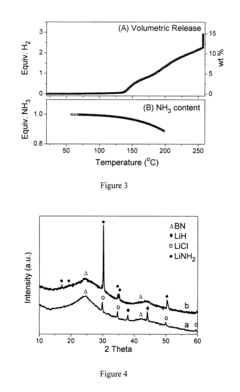
[0038]FIG. 3 shows the volumetric hydrogen release and calculated equivalent NH3 remaining in the Co-doped Li(NH3)BH4 sample. Hydrogen evolution took place at 140° C., with 0.97 equiv. NH3 retained in the vicinity of the sample. 15.3 wt % or about 3.0 equivalents H2 can be detached after heating the sample at 250° C. for about 11 hours. High purity of hydrogen was evolved with the NH3 concentration in the gaseous phase of below 106 ppm. FIG. 4a shows the final products are LiCl (from the interaction of LiBH4 and CoCl2). LiH and BN, thus, the dehydrogenation can be written as reaction 2:
Li(NH3)BH4→LiH+BN+3H2 (2)
example 3
Co-Doped Li(NH3)2BH4
[0039]Sample was prepared in the LiBH4 / NH3 molar ratio of 1 / 2, following the same procedures given in Example 1.
[0040]FIG. 5 shows the volumetric hydrogen release and calculated equivalent NH3 remaining in the Co-doped Li(NH3)2BH4 sample. Hydrogen evolution took place at about 125° C., with 1.83 equiv. NH3 retained in the vicinity of the sample. 14.3 wt % or about 4.0 equivalents H2 can be detached upon heating the sample to 250° C. FIG. 4b shows the final products are LiNH2 and BN, thus, the dehydrogenation can be written as reaction 3:
Li(NH3)2BH4→LiNH2+BN+4H2 (3)
[0041]FIG. 6 shows the hydrogen release results of the Co-doped Li(NH3)BH4, Li(NH3)4 / 3BH4 and Li(NH3)2BH4 samples. It can be seen that the hydrogen desorption kinetics (i.e., onset temperatures and desorption rates) could be better improved by presenting more NH3, but the maximum desorption amount is 4 equivalent moles of H2. Compare to the Li(NH3)BH4 and Li(NH3)2BH4 samples, the Li(NH3)4 / 3BH4 sample ...
PUM
| Property | Measurement | Unit |
|---|---|---|
| temperature | aaaaa | aaaaa |
| temperature | aaaaa | aaaaa |
| temperatures | aaaaa | aaaaa |
Abstract
Description
Claims
Application Information
 Login to View More