Unlock instant, AI-driven research and patent intelligence for your innovation.

Method for producing 1,2-phenylethane compound using atom transfer radical coupling reaction

一种制造方法、苯基乙烷的技术,应用在1领域,能够解决反应收率低、易发生副反应、除去困难等问题,达到高收率的效果

Inactive Publication Date: 2009-04-01
NIPPON SODA CO LTD
View PDF3 Cites 0 Cited by
  • Summary
  • Abstract
  • Description
  • Claims
  • Application Information

AI Technical Summary

Problems solved by technology

[0006] However, in the reaction in the presence of a sulfuric acid catalyst alone as in the method described in Patent Document 1, there are problems that side reactions are likely to occur, and the reaction is easily out of control, and the like is difficult to control.
In addition, although the reaction at high temperature using a large excess of phenol has the characteristics of no reaction solvent, short reaction time, and low cost, it is prone to side reactions and cannot obtain high yields, and there are many kinds of products obtained by side reactions. , which removes the very difficult problem of
[0007] In addition, as in the method described in Patent Document 2, by performing condensation in the presence of a mixed acid catalyst of sulfuric acid and phosphoric acid, side reactions are suppressed, and tetrakis(hydroxyphenyl)alkanes can be efficiently and selectively produced. The yield is about 40 to 70%, and the reaction takes a long time of several hours to tens of hours
[0008] In addition, as in the method described in Patent Document 3, a compound having a tetraphenyl skeleton in which an ester group is bonded to a phenyl group can be produced by a coupling reaction using zinc as a catalyst, but this method also needs to be refluxed for 24 It takes about an hour to react, the reaction time is long and the reaction yield is also low

Method used

the structure of the environmentally friendly knitted fabric provided by the present invention; figure 2 Flow chart of the yarn wrapping machine for environmentally friendly knitted fabrics and storage devices; image 3 Is the parameter map of the yarn covering machine
View more

Image

Smart Image Click on the blue labels to locate them in the text.
Viewing Examples
Smart Image
  • Method for producing 1,2-phenylethane compound using atom transfer radical coupling reaction
  • Method for producing 1,2-phenylethane compound using atom transfer radical coupling reaction
  • Method for producing 1,2-phenylethane compound using atom transfer radical coupling reaction

Examples

Experimental program
Comparison scheme
Effect test

Embodiment 1

[0058]

[0059] Add PhCOOEt to 50ml flask 2 -Br 0.39g (1mmol), CuBr 0.14g (1mmol), Cu(0) 0.25g (4mmol), toluene 20ml, degassed. Then add N, N, N', N', N"-pentamethyldiethylenetriamine 0.35g (2mmol), and stir at 80°C for 30 minutes. After the reaction solution is cooled, filter the insoluble matter. Wash the filtrate with water until The coloring disappears in the water layer, with MgSO 4 to dry. After the solvent was distilled off, it was dried under reduced pressure to obtain 0.30 g of white crystals (isolation yield 97%).

Embodiment 2

[0061]

[0062] In a 30ml flask, add 1.15g (5mmol) of 4-(bromomethyl) methyl benzoate, 0.72g (5mmol) of CuBr, 1.27g (20mmol) of Cu(0), 1.56g (10mmol) of bipyridine, 20ml of toluene and After degassing, it was stirred at 100°C for 1 hour. After cooling the reaction solution, 10 ml of chloroform was added, and the insoluble matter was filtered. After washing the filtrate with MgSO 4 to dry. After distilling off the solvent, recrystallization was performed with ethyl acetate / hexane. The obtained crystals were dried under reduced pressure to obtain 0.32 g of pale yellow crystals (isolation yield 43%).

Embodiment 3

[0064]

[0065] 9.6 g (48 mmol) of bis(4-hydroxyphenyl)methane, 11.8 g (117 mmol) of triethylamine, and 200 ml of tetrahydrofuran were placed in a 200 ml flask, and cooled to 0°C. 14.9 g (106 mmol) of benzoyl chloride was added thereto, followed by stirring at room temperature for 1 hour. After removing triethylamine hydrochloride by filtration, the filtrate was concentrated. After dissolving in dichloromethane, it was washed with water three times, and dried over magnesium sulfate. After concentrating the reaction solution, recrystallization was carried out from hexane / ethyl acetate to obtain 16.8 g of pale yellow needle crystals A (isolation yield: 86%).

[0066] 14.4 g (35 mmol) of A synthesized just now, 6.5 g (37 mmol) of N-bromosuccinimide, and 70 ml of benzene were placed in a 200 ml flask, and refluxed for 1 hour. After cooling, the reaction solution was concentrated. After dissolving in dichloromethane, it was washed with water three times, and dried over magnes...

the structure of the environmentally friendly knitted fabric provided by the present invention; figure 2 Flow chart of the yarn wrapping machine for environmentally friendly knitted fabrics and storage devices; image 3 Is the parameter map of the yarn covering machine
Login to View More

PUM

No PUM Login to View More

Abstract

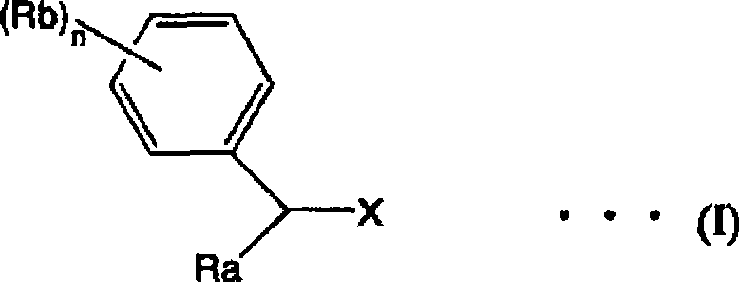
Disclosed is a method for producing a 1, 2-phenylethane compound with an extremely high yield through a short-time reaction. Specifically disclosed is a method for producing a 1, 2-phenylethane compound, wherein a compound represented by the formula (II) below is produced by subjecting a compound represented by the formula (I) below to a coupling reaction in the presence of a transition metal complex. [Chemical formula 1] (I) (In the formula, Ra represents a hydrogen atom or a substituted or unsubstituted phenyl group; Rb represents a hydrogen atom or a substituent, n represents an integer of 1-5, and when n is not less than 2, Rb's may be the same as or different from each other and may combine together to form a ring; and X represents a halogen atom.) [Chemical formula 2] (II).

Description

technical field [0001] this application claims priority based on Japanese Patent Application No. 2006-074463 for which it applied on March 17, 2006, and uses the content here. [0002] The present invention relates to a method for producing a 1,2-phenylethane-based compound, and more specifically, to a method for producing a 1,2-phenylethane-based compound using a transition metal compound as a catalyst. Background technique [0003] Tetrakis(hydroxyphenyl)alkanes can be used as host compounds in multimolecular inclusion compounds. For example, 1,1,2,2-tetrakis(4-hydroxyphenyl)ethane and various organic guest compounds selectively form inclusion compounds (compounds with a structure in which the guest molecule enters the cavity formed by the host molecule), Therefore, applications in technical fields such as selective separation, chemical stabilization, non-volatization, and powderization are expected. [0004] Conventionally, as a method for producing tetrakis(hydroxyphen...

Claims

the structure of the environmentally friendly knitted fabric provided by the present invention; figure 2 Flow chart of the yarn wrapping machine for environmentally friendly knitted fabrics and storage devices; image 3 Is the parameter map of the yarn covering machine
Login to View More

Application Information

Patent Timeline
no application Login to View More
Patent Type & Authority Applications(China)
IPC IPC(8): C07C67/343C07C69/773C07C61/00
CPCC07C67/293C07C67/343C07C69/78C07C69/76
Inventor 新谷武士
Owner NIPPON SODA CO LTD
Features
  • R&D
  • Intellectual Property
  • Life Sciences
  • Materials
  • Tech Scout
Why Patsnap Eureka
  • Unparalleled Data Quality
  • Higher Quality Content
  • 60% Fewer Hallucinations
Social media
Patsnap Eureka Blog
Learn More