Room temperature plasma torch array device for simultaneous fiber modification and sewage treatment

A plasma torch and sewage treatment technology, which is applied in fiber treatment, illuminated water/sewage treatment, oxidized water/sewage treatment, etc., can solve the problems of burnt materials, small area of ​​plasma torch, and easy cracking of the medium layer, and achieve The effect of prolonging the working life, avoiding medium rupture, and accelerating the degradation rate

CN101538792BInactive Publication Date: 2011-12-21ZHEJIANG SCI-TECH UNIV
0 Cites 0 Cited by

Patent Information

Authority / Receiving Office
CN · China
Patent Type
Patents(China)
Current Assignee / Owner
Publication Date
2011-12-21
Estimated Expiration
Not applicable · inactive patent

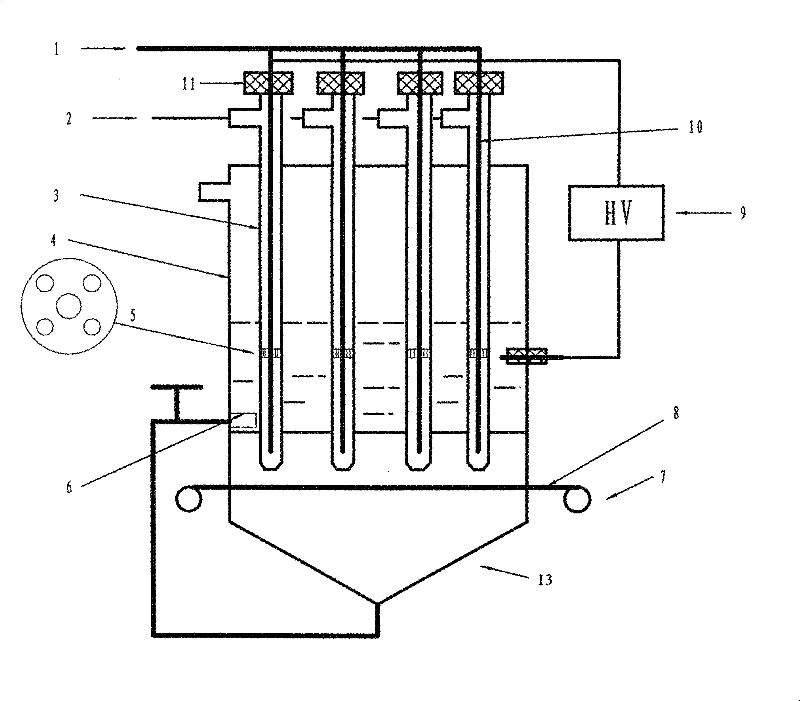
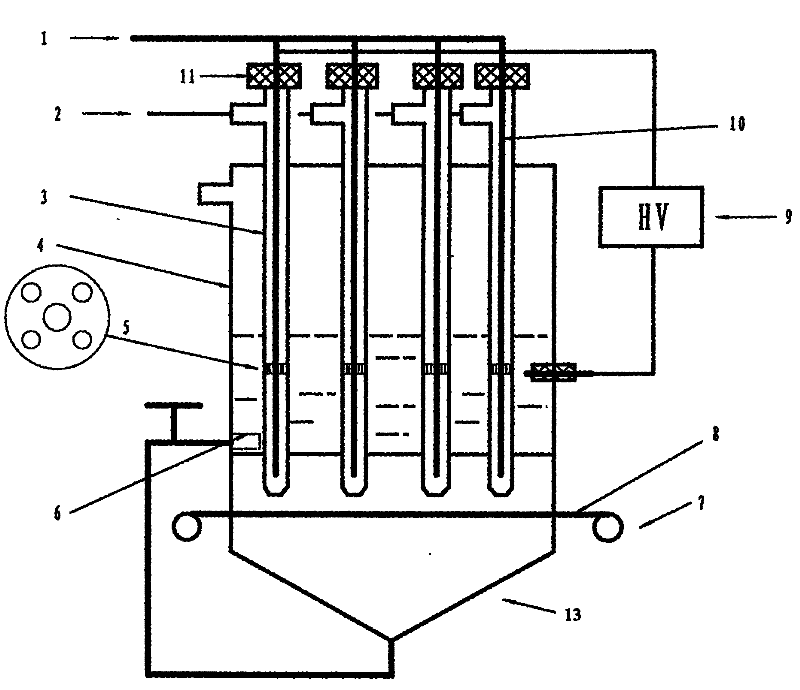
Smart Images

  • Figure 1
    Figure 1
  • Figure 2
    Figure 2
Patent Text Reader

Abstract

The invention discloses a room temperature plasma torch array device for simultaneously modifying fiber filaments and treating sewage. Multiple rows of quartz tubes with built-in tubular metal electrodes are inserted into the conductive sewage solution electrodes. One end of the quartz tubes passes through the bottom of the plexiglass tank and enters the modification chamber, and the other end exposes the plexiglass tank and is sealed with a Teflon sleeve outside the tube-shaped metal electrodes. It passes through the polytetrafluoroethylene sleeve to communicate with the active gas source, and the outside of the quartz tube communicates with the inert gas source. There are holes at the bottom of the end of the quartz tube. In the modification chamber, there are rows of fibers perpendicular to the bottom holes of each row of quartz tubes. The wire and tubular metal electrodes are connected in parallel to the high-voltage end, and the low-voltage end is connected to the conductive sewage solution electrode. The conductive liquid of the present invention is used as an external electrode, has a cooling discharge system, reduces energy consumption, and avoids the phenomenon of arcing caused by the short circuit of the two electrodes caused by the reflected plasma; at the same time, the liquid electrode avoids the use of a metal electrode that is different from the expansion coefficient of the medium. The phenomenon of medium rupture occurs.
Need to check novelty before this filing date? Find Prior Art

Description

technical field

[0001] The invention relates to a method and a device for generating an atmospheric pressure dielectric resistance plasma torch array. Background technique

[0002] In traditional plasma research, plasma generation under vacuum conditions has always occupied a dominant position. Recently, atmospheric pressure low-temperature glow plasma source has attracted more and more attention of scientific researchers because of its advantages such as no need for expensive vacuum devices, simple system, and convenient operation. So far, many atmospheric pressure glow plasma sources have been designed, and their frequencies range from 50 Hz of direct current to 2.45 GHz of microwave. These discharge sources have shown good application prospects, such as for sterilization, ozone generation, plasma Display screen, surface modification, waste water and waste gas treatment, etc. However, the external electrodes of these discharge systems are all metal, and are covered or pl...

Examples

Embodiment Construction

[0013] The present invention will be further described below in conjunction with the accompanying drawings and embodiments.

[0014] As shown in the accompanying drawings, the present invention contains a conductive aqueous solution electrode in a plexiglass tank 4, a plurality of rows of quartz tubes 3 with built-in tubular metal electrodes 10 are inserted into the conductive aqueous solution electrode, and one end of the quartz tube 3 passes through the plexiglass tank 4 The bottom enters the modification chamber 13, and the other end of the quartz tube 3 exposes the plexiglass water tank 4 and is sealed with a polytetrafluoroethylene sleeve 11. The tubular metal electrode 10 passes through the polytetrafluoroethylene sleeve 11 to communicate with the active gas source 1. Connected with the inert gas source 2, the bottom of one end of the quartz tube 3 is tapered and has a through hole, and the modification chamber 13 is equipped with fiber filaments 8 corresponding to the nu...