
Flame-retardant polystyrene/layered inorganic nanocomposite and preparation method thereof
An inorganic and layered technology, which is applied in the field of phosphorus and nitrogen-containing flame-retardant polystyrene/layered inorganic nanocomposites and its preparation, can solve the problem of low flame-retardant efficiency, single flame-retardant components, and difficulty in meeting flame-retardant requirements. Requirements and other issues, to achieve the effect of good compatibility, high flame retardant efficiency, good fire protection effect
- Summary
- Abstract
- Description
- Claims
- Application Information
AI Technical Summary
Problems solved by technology
Method used
Image

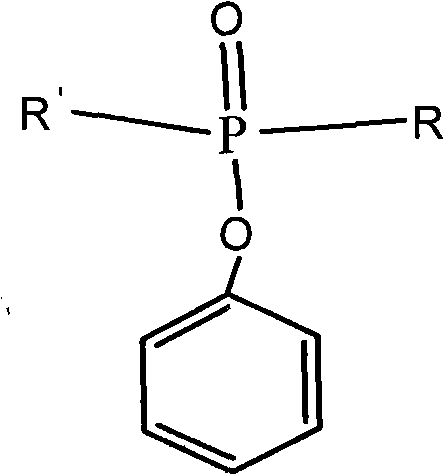
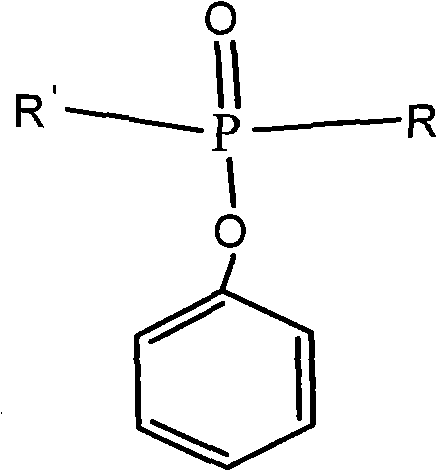
Examples
Embodiment 1
[0026] In a 250ml three-neck flask equipped with mechanical stirring and a constant pressure dropping funnel, add 21.1g (0.1mol) of phenyl phosphate dichloride and 80ml of tetrahydrofuran, stir in an ice bath at -5 to 5°C, and after 20 minutes, add 21.2 g (0.21 mol) of triethylamine, and slowly add a mixed solution of 11.6 g (0.1 mol) of hydroxyethyl acrylate and 20 ml of tetrahydrofuran dropwise within 2 hours under continuous stirring, and continue to react for 4 hours. Then, 7.32 g (0.1 mol) of diethylamine was dissolved in 80 ml of tetrahydrofuran, and slowly dropped into the above reaction system under the condition of ice bath at -5-5° C. under constant stirring, and reacted for 8 hours. Suction filtration under reduced pressure to remove the triethylamine salt, distillation under reduced pressure to remove the solvent, and the obtained light yellow transparent liquid is the product of the present invention. The yield was 80%.
[0027] The obtained product was analyzed ...
Embodiment 2
[0031] In a 250ml three-necked flask equipped with mechanical stirring and a constant pressure dropping funnel, add 21.1g (0.1mol) phenyl phosphate dichloride and 80ml methylene chloride, stir in an ice bath, and after 10 minutes, add 21.2g (0.21 mol) triethylamine, then slowly dropwise added a mixed solution of 11.6 g (0.1 mol) of hydroxyethyl acrylate and 20 ml of dichloromethane in 2 hours under continuous stirring, and continued to react for 4 hours. Then 7.32 g (0.1 mol) of diethylamine was dissolved in 60 ml of dichloromethane, and slowly dropped into the above reaction system under constant stirring, and reacted for 8 hours. Suction filtration under reduced pressure to remove the triethylamine salt, distillation under reduced pressure to remove the solvent, and the obtained light yellow transparent liquid is the product of the present invention. The yield was 85%.
[0032] The obtained product was analyzed by nuclear magnetic resonance spectrum. The peak position of th...
Embodiment 3
[0035] In a 250ml three-neck flask equipped with mechanical stirring and a constant pressure dropping funnel, add 21.1g (0.1mol) phenyl phosphate dichloride and 80ml tetrahydrofuran, stir in an ice bath, and after 10 minutes, add 21.2g (0.21mol) Triethylamine, and a mixed solution of 11.6 g (0.1 mol) of hydroxyethyl acrylate and 20 ml of tetrahydrofuran was slowly added dropwise within 2 hours under continuous stirring, and the reaction was continued for 4 hours. Then diethylamine was dissolved in 80ml of tetrahydrofuran, and slowly dropped into the above reaction system under continuous stirring, and reacted for 8 hours. Suction filtration under reduced pressure to remove the triethylamine salt, distillation under reduced pressure to remove the solvent, and the obtained yellow transparent liquid is the product of the present invention. The yield was 80%.
[0036]The obtained product was analyzed by nuclear magnetic resonance spectrum. The peak position of the chemical shift ...
PUM
| Property | Measurement | Unit |
|---|---|---|
| Total heat release | aaaaa | aaaaa |
Abstract
Description
Claims
Application Information
 Login to View More