
A tunable laser system
A technology for tuning lasers and tuning filters, which is used in lasers, laser parts, semiconductor lasers, etc., can solve problems such as increased cost, difficult alignment and positioning, and achieves low mass production costs, easy design structures, and reduced system costs. Effect
- Summary
- Abstract
- Description
- Claims
- Application Information
AI Technical Summary
Problems solved by technology
Method used
Image

Examples
Embodiment Construction
[0040] Embodiments of the present invention will be further described below in conjunction with the accompanying drawings.
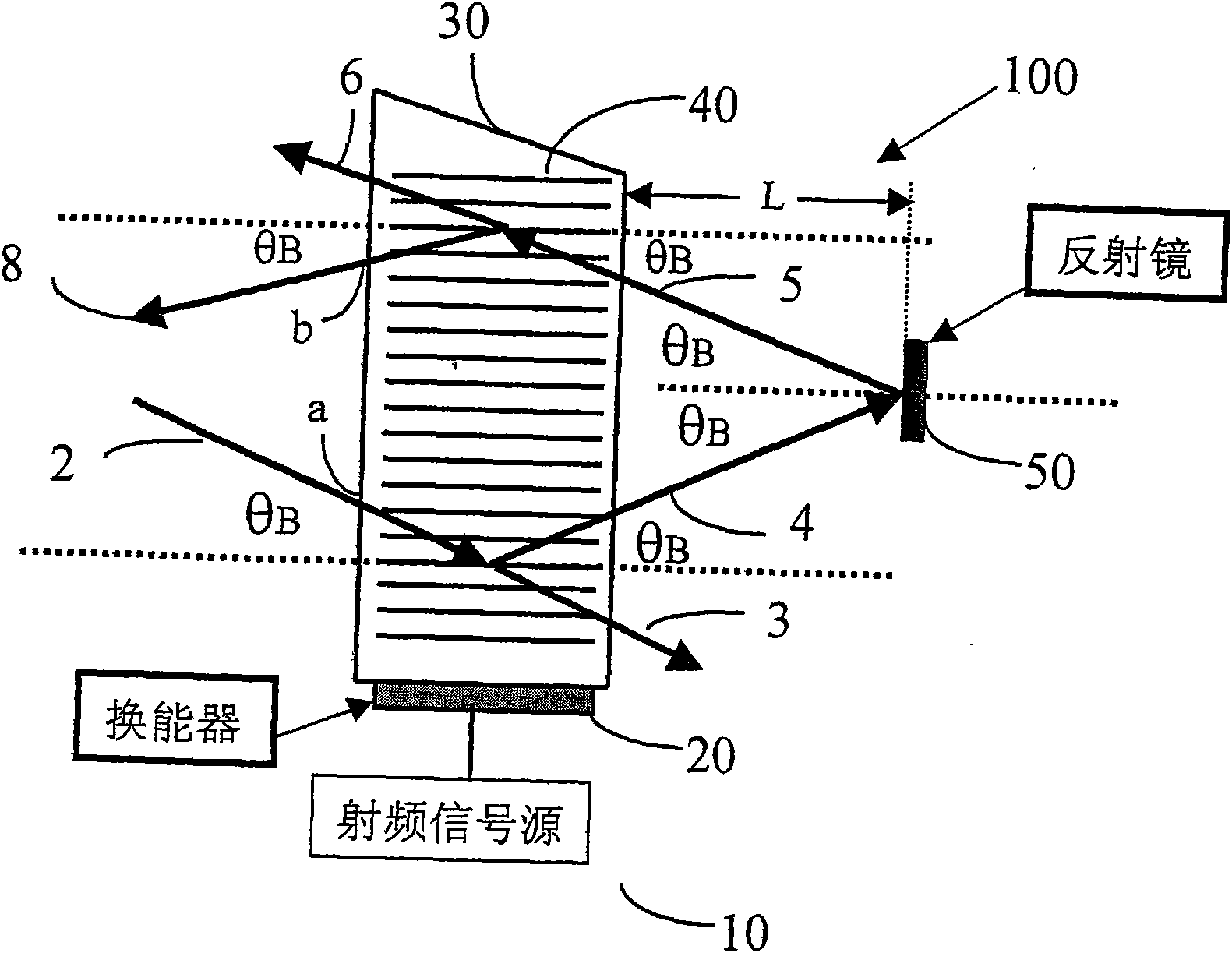
[0041] figure 1 An implementation of a compact, frequency offset compensated, wavelength tunable optical filter is shown. The implementation 100 includes a medium 30 , an acousto-optic transducer 20 , a radio frequency (RF) power source 10 , and an optical mirror 50 .
[0042] There are two types of tunable acousto-optic filters: collinear and non-collinear. Among them, the non-collinear type includes isotropic Bragg diffraction type and non-paraxial anisotropic Bragg diffraction type. Among them, the non-paraxial anisotropic Bragg diffraction type, as discussed in several other US patents, is more valuable in practical applications because of its narrow tuning bandwidth.
[0043] In one implementation, the medium 30 is anisotropic and birefringent, which is required for narrow bandwidth tuning. A substance that satisfies these characteristics is tel...
PUM
 Login to View More
 Abstract
Description
Claims
Application Information
 Login to View More