This helps you quickly interpret patents by identifying the three key elements:
Problems solved by technology
Method used
Benefits of technology
Problems solved by technology
[0004] The present invention proposes a T-ZnOw antibacterial agent doped and modified by rare earth elements and its preparation method in order to overcome the problems of insufficient response in the visible light field, short effective antibacterial time and low utilization rate of antibacterial agents commonly existing in current photocatalysts.
Method used
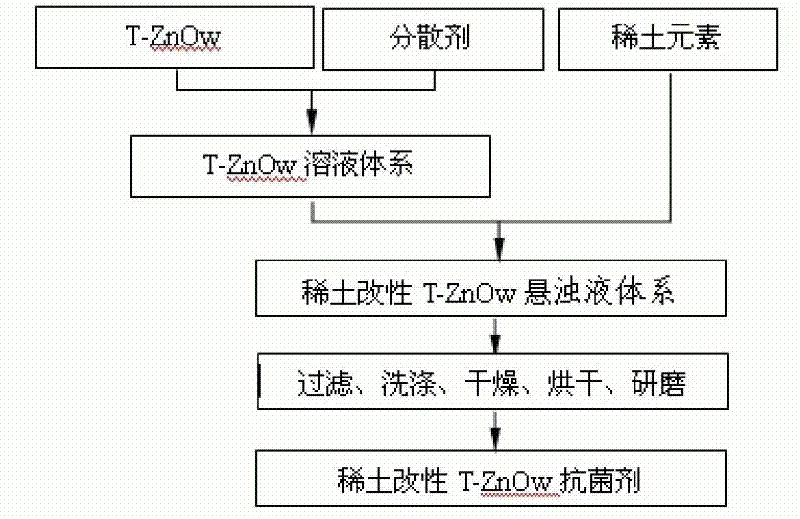
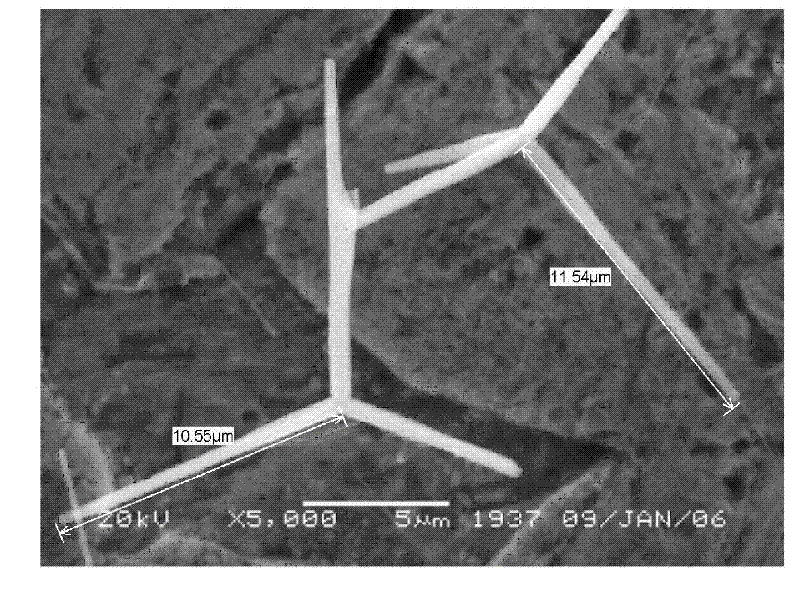
the structure of the environmentally friendly knitted fabric provided by the present invention; figure 2 Flow chart of the yarn wrapping machine for environmentally friendly knitted fabrics and storage devices; image 3 Is the parameter map of the yarn covering machine
View more
Image
Smart Image Click on the blue labels to locate them in the text.
Viewing Examples
Smart Image
Click on the blue label to locate the original text in one second.
Reading with bidirectional positioning of images and text.
Smart Image
Examples
Experimental program
Comparison scheme
Effect test
Embodiment 1
[0037] LaCl 3 , deionized water, polyacrylamide, and ammonia water are all analytical reagents
[0038] Put 1.000g of T-ZnOw into a beaker, add deionized water to 100mL, stir well, and add 0.0500g of polyacrylamide under stirring condition, continue to stir for 20min, and oscillate ultrasonically for 10min. Adjust the pH to about 9 with ammonia water to obtain a dispersion system of T-ZnOw in water medium.
[0039] Add 0.0250g LaCl to the T-ZnOw dispersion system under ultrasonic conditions 3. Stir for 40 minutes and then sonicate for 20 minutes, filter the obtained suspension, wash, dry, dry at 300°C for 1 hour, and fully grind to obtain a single rare earth element modified T-ZnOw antibacterial agent.
Embodiment 2
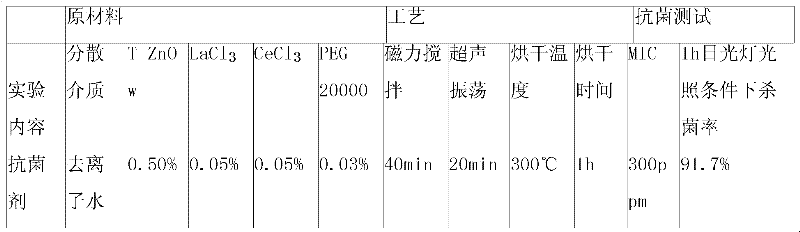
[0041] LaCl 3 , CeCl 3 , deionized water, and PEG20000 are all analytical reagents
[0042] Put 0.5000g T-ZnOw into a beaker, add deionized water to 100mL, stir well, and add 0.0300g PEG20000 under stirring condition to continue stirring for 30min, and ultrasonic vibration for 10min. A dispersion system of T-ZnOw in water medium is obtained.
[0043] Add 0.0500g LaCl to the T-ZnOw dispersion system under ultrasonic conditions 3 and 0.0500g CeCl 3 . Stir for 40 minutes and then sonicate for 20 minutes. The obtained suspension is filtered, washed, dried, dried at 300°C for 1 hour, and fully ground to obtain two kinds of rare earth element modified T-ZnOw antibacterial agents.
Embodiment 3
[0045] Ho 2 o 3 , EuCl 3 , CeCl 3 , acetone, and titanate are all analytical reagents
[0046] Put 2.000g of T-ZnOw into a beaker, add 100ml of titanate and acetone at a ratio of 1:2, stir thoroughly for 40min, and oscillate ultrasonically for 20min. The dispersion system of T-ZnOw in acetone medium is obtained.
[0047] Add 0.0025gHo to the T-ZnOw dispersion system under ultrasonic condition 2 o 3 , 0.0050g EuCl 3 and 0.0025g CeCl 3 . Stir for 60 minutes and then sonicate for 20 minutes, filter the obtained suspension, wash, dry, dry at 400° C. for 1.5 hours, and fully grind to obtain three kinds of rare earth element modified T-ZnOw antibacterial agents.
the structure of the environmentally friendly knitted fabric provided by the present invention; figure 2 Flow chart of the yarn wrapping machine for environmentally friendly knitted fabrics and storage devices; image 3 Is the parameter map of the yarn covering machine
Login to View More
PUM
Login to View More
Abstract
The invention provides a modified T-ZnOw antibiotic material and a preparation method thereof. T-ZnOw is a photocatalysis type antibiotic material, mainly uses a natural light source of an ultravioletwave band, and has low utilization ratio on visible light. The rare-earth element can introduce lattice defect in T-ZnOw whiskercrystal or change crystallinity, generates additional energy band in T-ZnOw whisker forbidden band, expands the spectrum response range of the T-ZnOw, improves the effective utilization of the visible light, and greatly improves the catalytic efficiency of photocatalyst; on the other side, the rare-earth element served as a dispersing agent ensures that the T-ZnOw is evenly dispersed and suspended in a dispersed medium for long time, and can remarkably improve the antibiotic performance of the finished product T-ZnOw.
Description
technical field [0001] The invention relates to a photocatalytic inorganic composite T-ZnOw antibacterial material and a preparation method thereof, belonging to the technical field of new functional materials. Background technique [0002] Economic development and environmental protection have always been difficult problems that the country has worked hard to solve. With the improvement of people's living standards and the enhancement of environmental awareness, the voice of protecting the ecological environment, saving human living space and improving environmental quality is increasing day by day. Therefore, a healthy living environment has increasingly become the pursuit goal of human beings. Environmental microorganisms that endanger human health have also attracted people's attention. The Escherichia coli O-157 infection incident in Japan in 1996 and the sudden SARS epidemic in the world in 2003 once caused panic all over the world. In the world, the death of human b...
Claims
the structure of the environmentally friendly knitted fabric provided by the present invention; figure 2 Flow chart of the yarn wrapping machine for environmentally friendly knitted fabrics and storage devices; image 3 Is the parameter map of the yarn covering machine
Login to View More
Application Information
Patent Timeline
Application Date:The date an application was filed.
Publication Date:The date a patent or application was officially published.
First Publication Date:The earliest publication date of a patent with the same application number.
Issue Date:Publication date of the patent grant document.
PCT Entry Date:The Entry date of PCT National Phase.
Estimated Expiry Date:The statutory expiry date of a patent right according to the Patent Law, and it is the longest term of protection that the patent right can achieve without the termination of the patent right due to other reasons(Term extension factor has been taken into account ).
Invalid Date:Actual expiry date is based on effective date or publication date of legal transaction data of invalid patent.


 Login to View More
  Login to View More