
Carboxymethyl chitosan quaternary ammonium salt/PAMAM(Polyamidoamine) core-shell nanoparticles and preparation method
A technology of carboxymethyl chitosan and quaternary ammonium salt, which is applied in the field of functional polymer materials to achieve good water solubility and biocompatibility
- Summary
- Abstract
- Description
- Claims
- Application Information
AI Technical Summary
Problems solved by technology
Method used
Image

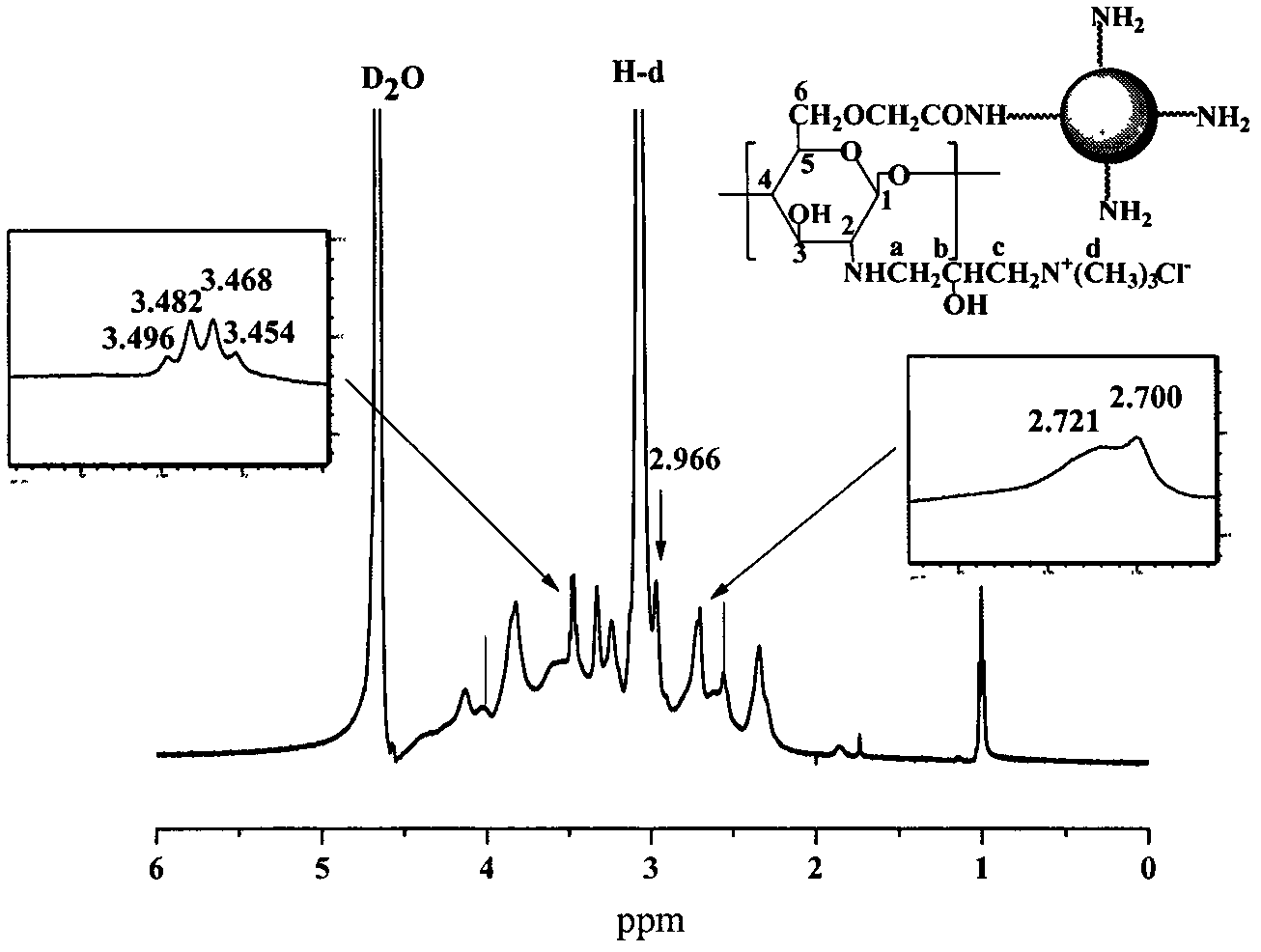
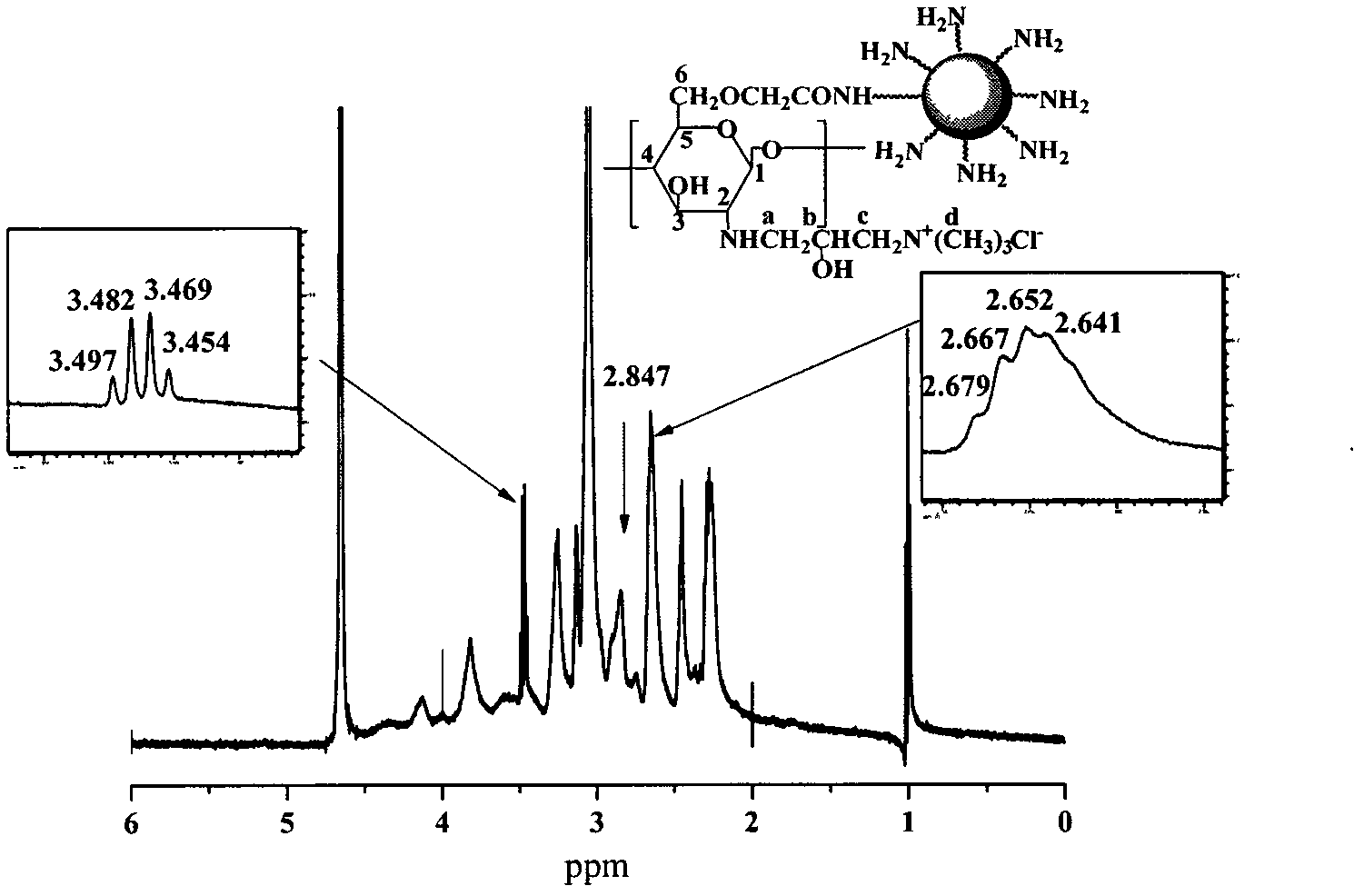
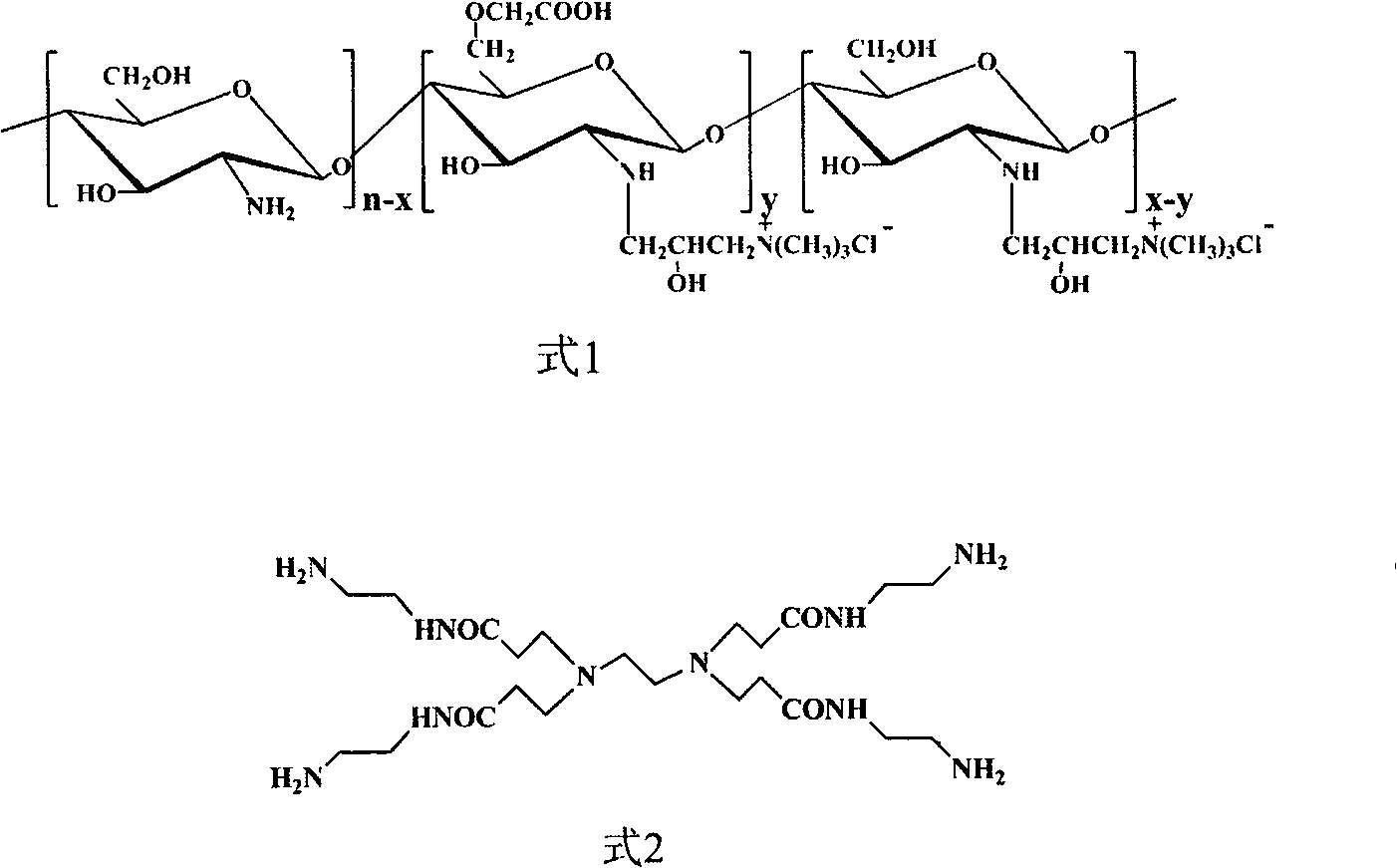
Examples
Embodiment 1
[0041] 4g chitosan (molecular weight: 200,000, degree of deacetylation: 80%) is suspended in 40ml of isopropanol, slowly add 24ml of NaOH solution with a mass fraction of 40% under stirring, heat up to 60°C, and basify with stirring at 600 rpm 4h. Then, 128 ml of 69% (w / v) CTA aqueous solution was slowly added dropwise, and after 60 minutes of completion of the dropwise addition, the temperature was raised to 80° C., and the reaction was stirred for 9 hours. After the reaction was finished, the filtered reaction product was dialyzed in deionized water for 72 hours, freeze-dried to obtain N-(2-hydroxypropyl)trimethylammonium chloride chitosan, and the degree of quaternization substitution was 74%.
[0042] Suspend 4 g of the N-(2-hydroxypropyl)trimethylammonium chloride chitosan in 30 ml of NaOH solution with a mass fraction of 50%, and basify overnight at -20°C. Then the chitosan quaternary ammonium salt after alkalization was moved in 90ml isopropanol. At room temperature, ...
Embodiment 2
[0047] The preparation process of N-(2-hydroxypropyl)trimethylammonium chloride-O-carboxymethyl chitosan and compound 2 is the same as that of Example 1.
[0048] Under the protection of nitrogen in an ice-water bath at 2°C, 4 g of compound 2 was dissolved in 40 ml of anhydrous methanol under stirring at 800 rpm in the dark, and a methanol solution with a concentration of 0.1 g / ml of compound 2 was prepared. 11.2 ml of methyl acrylate was dissolved in 20 ml of anhydrous methanol under stirring in an ice-water bath, and then slowly dropped into the methanol solution of compound 2. After the dropwise addition was completed for 30 minutes, the mixture was stirred and reacted at 35° C. in the dark for 24 hours. After the reaction, unreacted methyl acrylate and methanol were removed by rotary evaporation at 50° C. to obtain 1.5-generation polyamide-amine dendrimers with ethylenediamine as the core.
[0049] In an ice-water bath at 2°C, under nitrogen protection, and under stirring...
Embodiment 3
[0052] The preparation process of N-(2-hydroxypropyl)trimethylammonium chloride-O-carboxymethyl chitosan is the same as in Example 1.
[0053] Add 5.0 g of ammonia to 120 ml of absolute ethanol in an ice-water bath at 2° C. under nitrogen protection and stirring at 800 rpm to obtain a methanol solution with a concentration of 0.04 g / ml of ammonia. 90 g of methyl acrylate was dropped into the methanol solution of ammonia within 100 min. Afterwards, the reaction was stirred for 36 h at 25° C. in the dark. After the reaction, unreacted methyl acrylate and methanol were removed by rotary evaporation at 50° C. to obtain 0.5-generation polyamide-amine dendrimers with ammonia as the core.
[0054] In an ice-water bath at 2°C, under nitrogen protection, under stirring at 800 rpm in the dark, dissolve the 2.0 g of 0.5 generation polyamide-amine dendrimer with ammonia as the core in 20 ml of methanol solution, and then slowly drop into 100g ethylenediamine. After the dropwise additio...
PUM
| Property | Measurement | Unit |
|---|---|---|
| degree of grafting | aaaaa | aaaaa |
| degree of grafting | aaaaa | aaaaa |
Abstract
Description
Claims
Application Information
 Login to View More