Check patentability & draft patents in minutes with Patsnap Eureka AI!

Method for preparing epsilon-caprolactone from cyclohexanone by in-situ oxidation

An in-situ oxidation and cyclohexanone technology, applied in organic chemistry and other directions, can solve the problems of high material consumption and energy consumption, many processes, and high requirements for safety measures, and achieve production process safety, shorten the process flow, and require low equipment safety factors. Effect

Active Publication Date: 2015-10-14
LIMING RES INST OF CHEM IND
View PDF2 Cites 4 Cited by
  • Summary
  • Abstract
  • Description
  • Claims
  • Application Information

AI Technical Summary

Problems solved by technology

These two methods will prepare a certain concentration of anhydrous peracetic acid in advance, and then use anhydrous peracetic acid to oxidize cyclohexanone to produce ε-caprolactone; the advantages of the process are good oxidation effect and high product conversion rate, and the disadvantages Because of high requirements for safety measures, many processes, high material consumption and energy consumption

Method used

the structure of the environmentally friendly knitted fabric provided by the present invention; figure 2 Flow chart of the yarn wrapping machine for environmentally friendly knitted fabrics and storage devices; image 3 Is the parameter map of the yarn covering machine
View more

Image

Smart Image Click on the blue labels to locate them in the text.
Viewing Examples
Smart Image
  • Method for preparing epsilon-caprolactone from cyclohexanone by in-situ oxidation

Examples

Experimental program
Comparison scheme
Effect test

Embodiment 1

[0021] Weigh 112g of percarbamide with an active oxygen content of 14.3% and add it to a glass reactor with a stirring device, add 96g of ethyl acetate, then weigh 49g of cyclohexanone and add it to the reactor, start the stirrer to evenly disperse percarbamide in A mixture of ethyl acetate and cyclohexanone. Then the reaction kettle was heated until the ethyl acetate was slightly refluxed and 110 g of acetic anhydride was injected through a constant pressure dropping funnel. During the process of adding acetic anhydride, percarbamide was gradually dissolved, and the reaction mixture was gradually transparent. After the addition of acetic anhydride, the temperature of the reaction solution was automatically lowered, during which a white solid formed during the reaction gradually precipitated, and the reaction was maintained at 70°C for 3 hours. After the reaction is completed, cool the reaction liquid to 0°C, and filter the precipitated white precipitate with a sand core funne...

Embodiment 2

[0023] Weigh 97g of percarbamide with an active oxygen content of 16.5% and add it to a glass reactor with a stirring device, add 128g of ethyl acetate, then weigh 74g of cyclohexanone and add it to the reactor, start the stirrer to evenly disperse percarbamide in A mixture of ethyl acetate and cyclohexanone. Then the reaction kettle was heated until the ethyl acetate was slightly refluxed and 150 g of acetic anhydride was injected through a peristaltic pump. During the process of adding acetic anhydride, percarbamide was gradually dissolved, and the reaction mixture was gradually transparent. After the addition of acetic anhydride, the temperature of the reaction solution was automatically lowered, during which a white solid formed during the reaction gradually precipitated, and the reaction was maintained at 50°C for 4 hours. After the reaction, the reaction solution was cooled to 3°C, and the precipitated white precipitate was filtered with a sand core funnel while it was c...

Embodiment 3

[0025] Weigh 102g of percarbamide with an active oxygen content of 15.7% and add it to a glass reactor with a stirring device, add 135g of ethyl acetate, then weigh 98g of cyclohexanone and add it to the reactor, start the stirrer to evenly disperse percarbamide in A mixture of ethyl acetate and cyclohexanone. Then heat the reactor until the ethyl acetate is slightly refluxed and inject 200g of acetic anhydride through a constant flow pump. During the process of adding the acetic anhydride, the percarbamide is gradually dissolved, and the reaction mixture is gradually transparent. After the addition of acetic anhydride, the temperature of the reaction solution was automatically lowered, during which a white solid formed during the reaction gradually precipitated, and the reaction was maintained at 30°C for 5 hours. After the reaction is completed, cool the reaction liquid to 5°C, and filter the precipitated white precipitate with a sand core funnel while it is cold. The colorl...

the structure of the environmentally friendly knitted fabric provided by the present invention; figure 2 Flow chart of the yarn wrapping machine for environmentally friendly knitted fabrics and storage devices; image 3 Is the parameter map of the yarn covering machine
Login to View More

PUM

No PUM Login to View More

Abstract

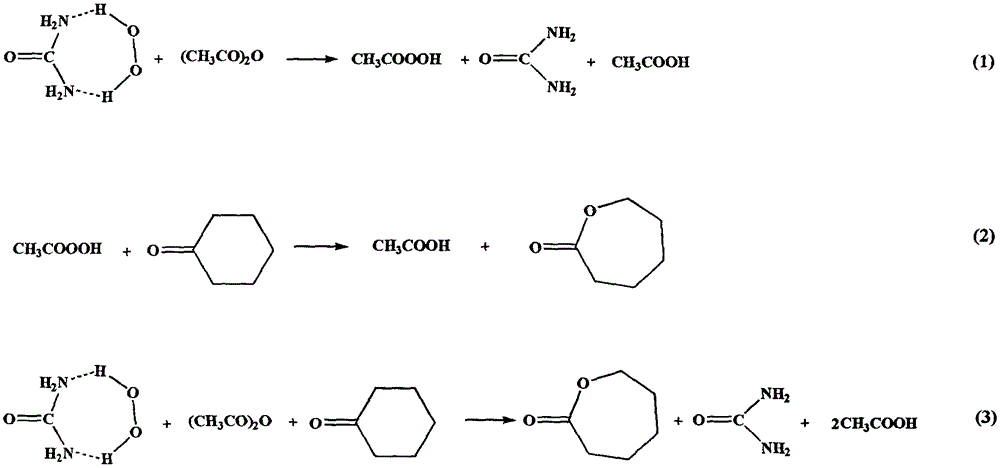
The invention discloses a method for preparing epsilon-caprolactone from cyclohexanone by in-situ oxidation. According to the method, a one-pot process is adopted; with cyclohexanone as a reaction raw material, percarbamide as an oxidant, acetic anhydride as a co-oxidant and ethyl acetate as a solvent, percarbamide reacts with acetic anhydride to generate peracetic acid which is used for in-situ oxidation of cyclohexane to obtain the epsilon-caprolactone. According to the invention, epsilon-caprolactone is prepared from cyclohexanone by in-situ oxidation through a one-pot process, peroxy acid does not need to be prepared in advance in the preparation process of the epsilon-caprolactone, distillation and concentration of peroxides such as peroxy acid and hydrogen peroxide are not needed, and compared with the existing epsilon-caprolactone preparation method, the method is greatly reduced in equipment input and energy consumption and is shortened in technological process.

Description

technical field [0001] The invention relates to a preparation method of ε-caprolactone, in particular to a method for preparing ε-caprolactone by in-situ oxidation of cyclohexanone. Background technique [0002] ε-caprolactone is an important intermediate in organic synthesis and a reactive polar solvent. As a raw material, ε-caprolactone can be used to produce materials such as fully biodegradable thermoplastic polycaprolactone, polycaprolactone polyol, polycaprolactone polyurethane, and caprolactone-lactide copolymer; Solvents can dissolve many polymers and are reactive. Therefore, it is widely used in the production of biodegradable plastics, medical polymer materials, synthetic leather, adhesives, coatings, etc. [0003] The good biodegradability and biocompatibility of polycaprolactone materials make it more and more widely used in the fields of environmental protection and medical treatment. However, the synthesis of ε-caprolactone requires high production safety, p...

Claims

the structure of the environmentally friendly knitted fabric provided by the present invention; figure 2 Flow chart of the yarn wrapping machine for environmentally friendly knitted fabrics and storage devices; image 3 Is the parameter map of the yarn covering machine
Login to View More

Application Information

Patent Timeline
no application Login to View More
IPC IPC(8): C07D313/04
CPCC07D313/04
Inventor 李韶峰何红振宋世平于文杰王宏伟
Owner LIMING RES INST OF CHEM IND
Features
  • R&D
  • Intellectual Property
  • Life Sciences
  • Materials
  • Tech Scout
Why Patsnap Eureka
  • Unparalleled Data Quality
  • Higher Quality Content
  • 60% Fewer Hallucinations
Social media
Patsnap Eureka Blog
Learn More