
Nucleic acid sequence and method for detecting herbicide-tolerant soybean plant dbn9004
A nucleic acid sequence, soybean technology, applied in botany equipment and methods, chemicals for biological control, herbicides and algicides, etc.
- Summary
- Abstract
- Description
- Claims
- Application Information
AI Technical Summary
Problems solved by technology
Method used
Image

Examples
no. 1 example
[0150] The first embodiment, cloning and transformation
[0151] 1.1. Vector cloning
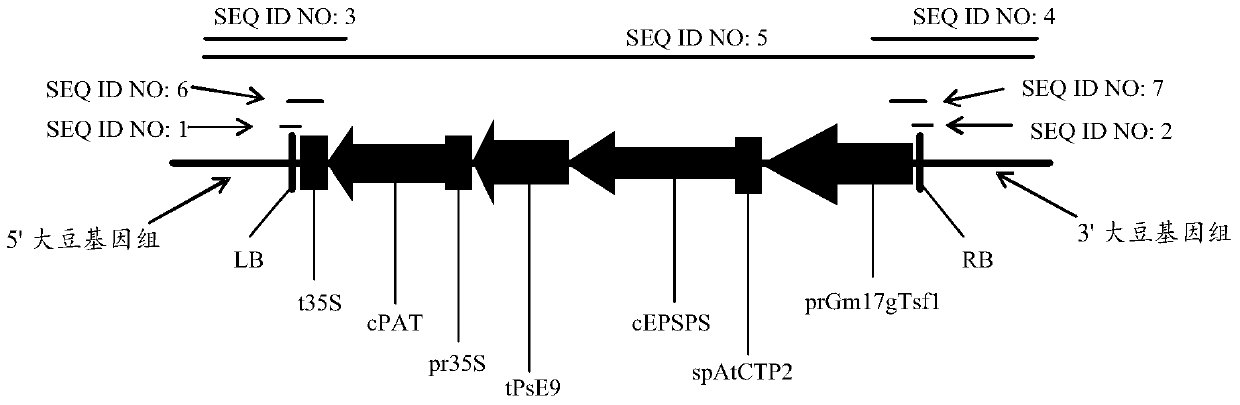
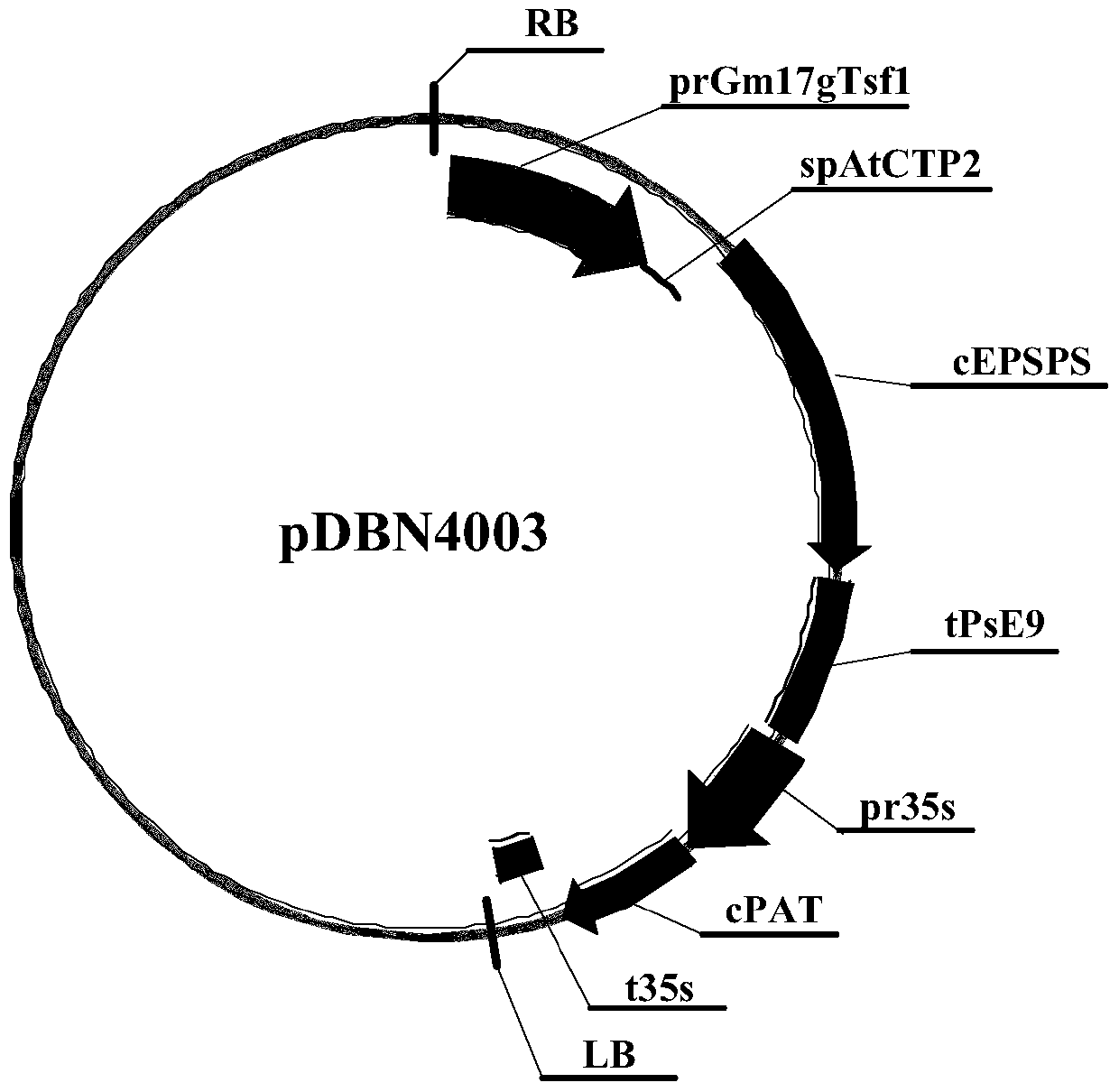
[0152] Use standard gene cloning techniques to construct recombinant expression vector pDBN4003 (such as figure 2 shown). The vector pDBN4003 contains two tandem transgene expression cassettes, the first expression cassette is operably linked to the coding sequence of the Arabidopsis EPSPS chloroplast transit peptide by the soybean Tsf1 gene (encoding elongation factor EF-1α) promoter (prGm17gTsf1) (spAtCTP2), operably linked to the glyphosate-tolerant 5-enol-pyruvylshikimate-3-phosphate synthase (cEPSPS) of Agrobacterium sp. CP4 strain, operably linked to sugar-1,5-bisphosphate carboxylase on the 3' untranslated sequence (tPse9); the second expression cassette consists of a tandem repeat of the cauliflower mosaic virus 35S promoter (pr35S) containing an enhancer region, which can The composition is operatively linked to the glufosinate-tolerant phosphinothricin N-acetyltransferase (cPAT...
no. 2 example
[0161] The second embodiment, detection of transgenic soybean event DBN9004 with TaqMan
[0162] About 100 mg of the leaves of the transgenic soybean event DBN9004 were taken as a sample, and the genomic DNA was extracted with a plant DNA extraction kit (DNeasy Plant Maxi Kit, Qiagen), and the copy numbers of the EPSPS gene and the PAT gene were detected by fluorescent quantitative PCR with Taqman probes. At the same time, the wild-type soybean plants were used as a control, and the detection and analysis were carried out according to the above method. The experiment was repeated 3 times, and the average value was taken.
[0163] The specific method is as follows:
[0164] Step 11, take 100 mg of leaves of the transgenic soybean event DBN9004, grind it into a homogenate with liquid nitrogen in a mortar, and take 3 replicates for each sample;
[0165] Step 12, using the DNeasy Plant Mini Kit of Qiagen to extract the genomic DNA of the above sample, the specific method refers ...
no. 3 example
[0183]The third embodiment, detection of transgenic soybean event DBN9004
[0184] 3.1. Genomic DNA extraction
[0185] The DNA was extracted according to the conventional CTAB (cetyltrimethylammonium bromide) method: take 2 grams of tender leaves of transgenic soybean event DBN9004 and grind them into powder in liquid nitrogen, add 0.5mL and pre-cook at 65°C. Hot DNA extraction CTAB buffer (20g / L CTAB, 1.4M NaCl, 100mM Tris-HCl, 20mM EDTA (ethylenediaminetetraacetic acid), adjust the pH to 8.0 with NaOH), mix thoroughly, and pump at a temperature of 65°C Extract for 90 minutes; add 0.5 times the volume of phenol and 0.5 times the volume of chloroform, mix upside down; centrifuge at 12,000 rpm (revolutions per minute) for 10 minutes; absorb the supernatant, add 2 times the volume of absolute ethanol, and gently shake the centrifuge tube. Let stand at 4°C for 30 minutes; centrifuge at 12,000 rpm for 10 minutes; collect DNA to the bottom of the tube; discard the supernatant and...
PUM
 Login to View More
 Abstract
Description
Claims
Application Information
 Login to View More