AI technical title is built by PatSnap AI team. It summarizes the technical point description of the patent document.
An avian influenza virus, virus technology, applied in the direction of antiviral agents, viruses/phages, biochemical equipment and methods, etc., can solve problems such as increasing pollution and increasing product costs
Pending Publication Date: 2017-05-31
YEBIO BIOENG OF QINGDAO
View PDF5 Cites 6 Cited by
Summary
Abstract
Description
Claims
Application Information
AI Technical Summary
This helps you quickly interpret patents by identifying the three key elements:
Problems solved by technology
Method used
Benefits of technology
Problems solved by technology
At present, the breeding method of avian influenza virus mainly relies on chicken embryos, and the increase of virus content is mainly achieved through the method of concentration, but concentration also significantly increases the cost of the product and increases the chance of contamination
Method used
the structure of the environmentally friendly knitted fabric provided by the present invention; figure 2 Flow chart of the yarn wrapping machine for environmentally friendly knitted fabrics and storage devices; image 3 Is the parameter map of the yarn covering machine
View more
Image
Smart Image Click on the blue labels to locate them in the text.
Viewing Examples
Smart Image
Click on the blue label to locate the original text in one second.
Reading with bidirectional positioning of images and text.
Smart Image
Examples
Experimental program
Comparison scheme
Effect test
Embodiment 1
[0024] The avian influenza virus propagation method of the present embodiment comprises the following steps:
[0029] 2. The propagation of the virus, the method is as follows:
[0030] 1) Take Re-6, Re-7, and Re-8 strains, respectively dilute them 10,000 times with the above diluent, inoculate 10-day-old SPF chicken embryos, 0.1ml / piece, culture at 36°C, and harvest undead embryonic urine for 72 hours Cystic fluid, collect allantoic fluid, measure HA to...
Embodiment 2
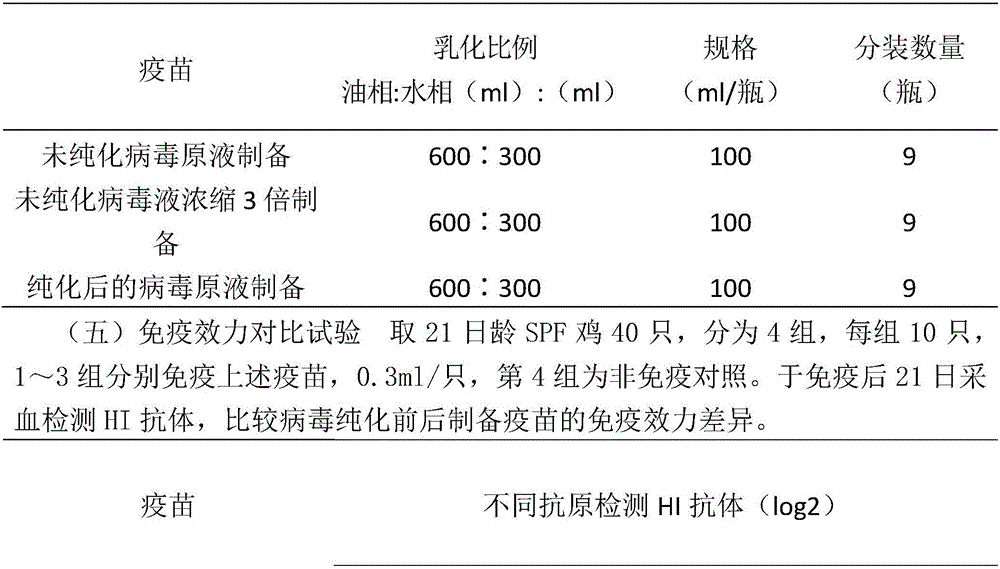
[0038] Vaccines were prepared from the above-mentioned harvested virus fluids for comparison of immune efficacy
[0040] 1. Each 100ml of the virus liquid before the propagation and purification in Example 1.
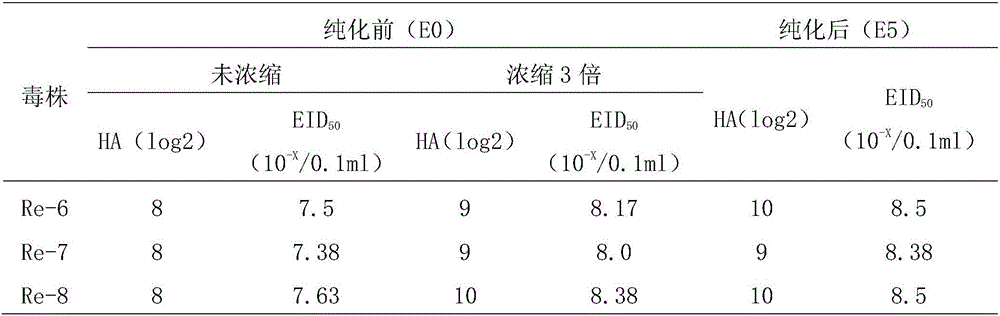
[0041] 2. Each 300ml of the virus liquid before propagation and purification in Example 1 was concentrated to 100ml.
[0042] 3. Each 100ml of the virus liquid after propagation and purification in Example 1.
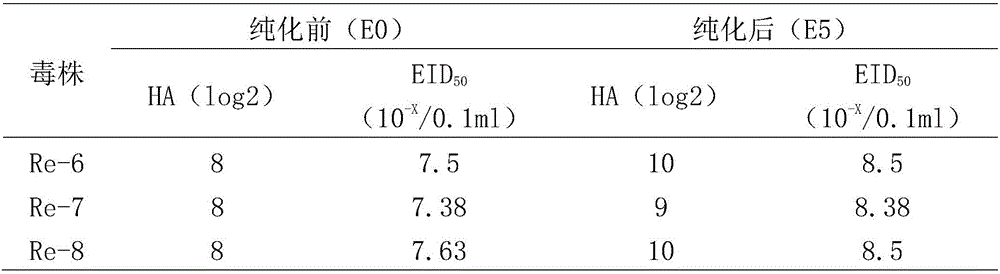
[0043] (2) Determination of the virus content of the antigen solution The HA titer and EID of the (1) antigen solution were determined respectively 50 . It can be seen from the test results that even if the unpurified virus liquid is concentrated 3 times, its virus content is difficult to reach the virus content of the purified virus.
[0044]
[0045] (3) Inactivation of the antigen solution The above-mentioned virus solutions were inactivated with 0.05% formaldehyde solution for 16 hours, and stored at 2-8°C. Af...
the structure of the environmentally friendly knitted fabric provided by the present invention; figure 2 Flow chart of the yarn wrapping machine for environmentally friendly knitted fabrics and storage devices; image 3 Is the parameter map of the yarn covering machine
Login to View More
PUM
Login to View More
Abstract
The invention provides a method for proliferation of an H5 subtype avian influenza virus. The H5 subtype avian influenza virus is diluted by a virusdiluent and is inoculated into 10-day-old SPF chicken embryo and then the chicken embryo is cultured at 36 DEG C. The allantoic fluid of the chicken embryo not dead within 72 hours is collected and stored at 40 DEG C; the collected allantoic fluid is then diluted with the virusdiluent in a ratio of 10 times. The virus liquid with a dilution degree of 10<6> -10<9> is selected to inoculate into a 10-day-old SPF chicken embryo and then the chicken embryo is cultured at 35.5 DEG C. The allantoic fluid of the chicken embryos not dead within 72 hours is collected and then mixed with the allantoic fluid of a high dilution degree and highest HA titer to obtain a seed liquid. The collected seed liquid is Continuously passed down and then is mixed with the allantoic fluid with a high dilution degree and the HA titer of 10log2, 9log2, and 10log2 to obtain the virus solution for the preparation of vaccine. The method of the invention can save the cost of preparing the vaccine and improve the production efficiency, so as to overcome the technical defects of low virus content in the existing strains for preparing vaccine and that the univalent vaccine can only be achieved by the concentration of the multivalent vaccine.
Description
technical field [0001] The invention belongs to the technical field of research and development of poultry biological products, and in particular relates to a method for multiplying H5 subtype avian influenza virus. Background technique [0002] Since 2003, highly pathogenic avian influenza virus has been widely prevalent in our country and many countries in the world, which not only caused huge losses to the poultry industry, but also constituted a huge threat to human health. In order to better prevent the spread of bird flu virus, the Ministry of Agriculture approved 8 enterprises to produce H5 subtype bird flu vaccine. At present, the breeding method of avian influenza virus mainly relies on chicken embryos, and the increase of virus content is mainly realized through the method of concentration, but the concentration also obviously increases the cost of the product and increases the probability of contamination. Therefore, only by increasing the virus content of the st...
Claims
the structure of the environmentally friendly knitted fabric provided by the present invention; figure 2 Flow chart of the yarn wrapping machine for environmentally friendly knitted fabrics and storage devices; image 3 Is the parameter map of the yarn covering machine
Login to View More
Application Information
Patent Timeline
Application Date:The date an application was filed.
Publication Date:The date a patent or application was officially published.
First Publication Date:The earliest publication date of a patent with the same application number.
Issue Date:Publication date of the patent grant document.
PCT Entry Date:The Entry date of PCT National Phase.
Estimated Expiry Date:The statutory expiry date of a patent right according to the Patent Law, and it is the longest term of protection that the patent right can achieve without the termination of the patent right due to other reasons(Term extension factor has been taken into account ).
Invalid Date:Actual expiry date is based on effective date or publication date of legal transaction data of invalid patent.



 Login to View More
  Login to View More