
Coating liquid, composition for coating liquid, and refractory article having coating layer
A technology for refractory materials and coating liquid, applied in the field of refractory materials, can solve the problems of peeling and low operability, and achieve the effects of excellent coatability, simplified preparation operation, and excellent preservation.
- Summary
- Abstract
- Description
- Claims
- Application Information
AI Technical Summary
Problems solved by technology
Method used
Image

Examples
Embodiment
[0097] Hereinafter, examples of the above-mentioned coating liquid will be described. In addition, in this example, the following materials were used to prepare the coating liquid.
[0098] ·Inorganic binder comes from colloidal silica particles
[0099] ·Swelling clay mineral montmorillonite
[0100] ·Ceramic Fiber A Al 2 O 3 Content: 65% by mass, SiO 2 Content: 35% by mass, average diameter of fibrous particles: 6μm, average fiber length: 10μm
[0101] ·Ceramic fiber B Al 2 O 3 Content: 65% by mass, SiO 2 Content: 35% by mass, average diameter of fibrous particles: 6μm, average fiber length: 20μm
[0102] ·Ceramic fiber C Al 2 O 3 Content: 65% by mass, SiO 2 Content: 35% by mass, average diameter of fibrous particles: 6μm, average fiber length: 40μm
[0103] ·Ceramic fiber D Al 2 O 3 Content: 65% by mass, SiO 2 Content: 35% by mass, average diameter of fibrous particles: 6μm, average fiber length: 60μm
[0104] ·Ceramic Fiber E Al 2 O 3 Content: 65% by mass, SiO 2 Content: 35% by mass,...
experiment example 1
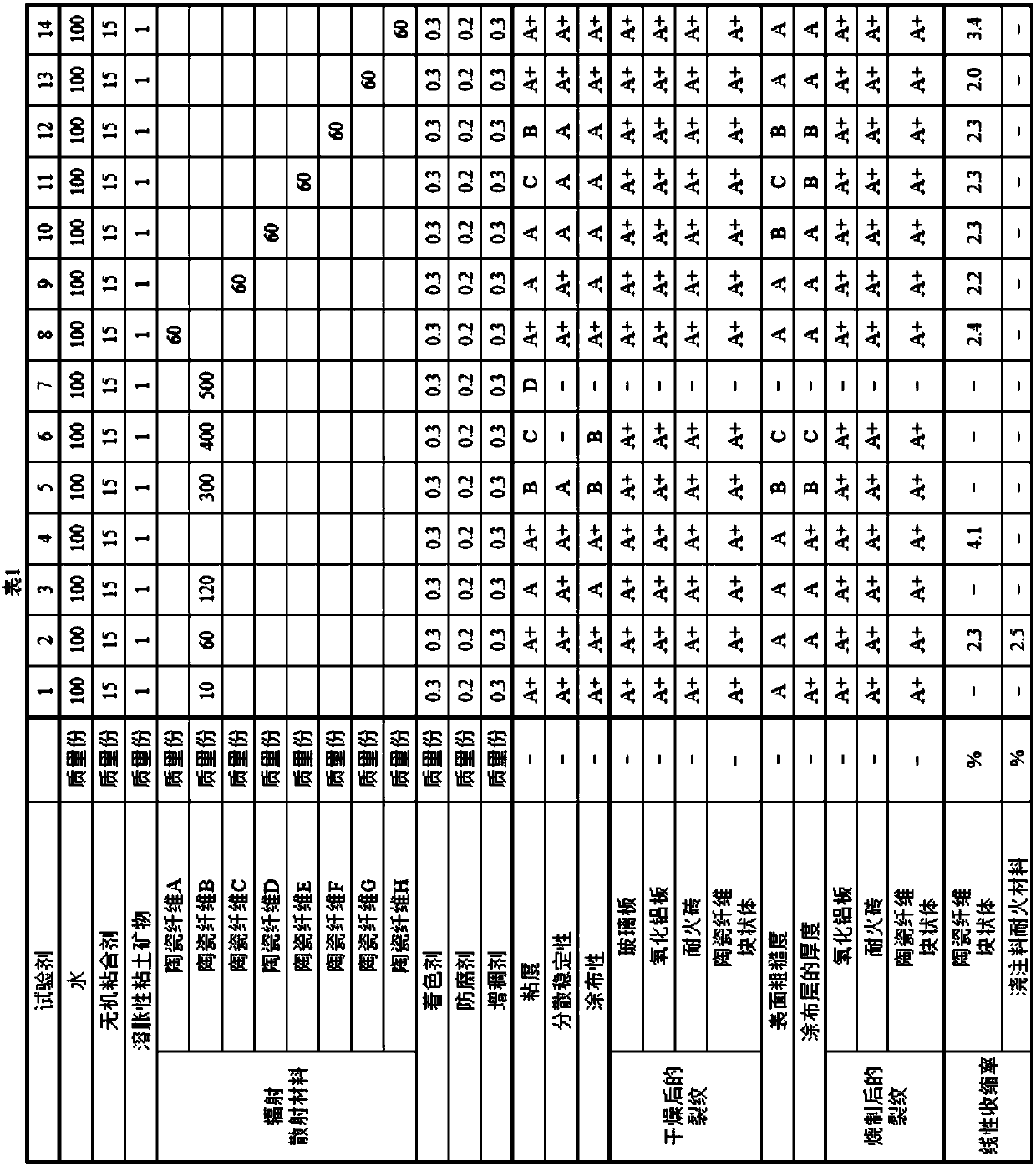
[0121] This example is an example of a coating liquid containing a ceramic fiber as a radiation scattering material. In this example, as shown in Table 1, the types and contents of ceramic fibers were changed to prepare 14 kinds of coating liquids (test agents 1-14). After that, the characteristics of the obtained coating liquid were evaluated.
[0122]
[0123] First, while stirring the water, the swelling clay mineral is added several times to disperse the swelling clay mineral in the water. While stirring the solution, an inorganic binder, a radiation scattering material, a coloring agent, a preservative, and a thickening agent were sequentially added to prepare test agents 1-14. In addition, the inorganic binder is mixed with the above-mentioned solution in the state of a colloidal silica solution.
[0124]
[0125] ·Viscosity
[0126] The viscosity of each test agent at 20°C was measured using a viscometer ("Viscotester VT-04E" manufactured by RION Corporation). The results ...
experiment example 2
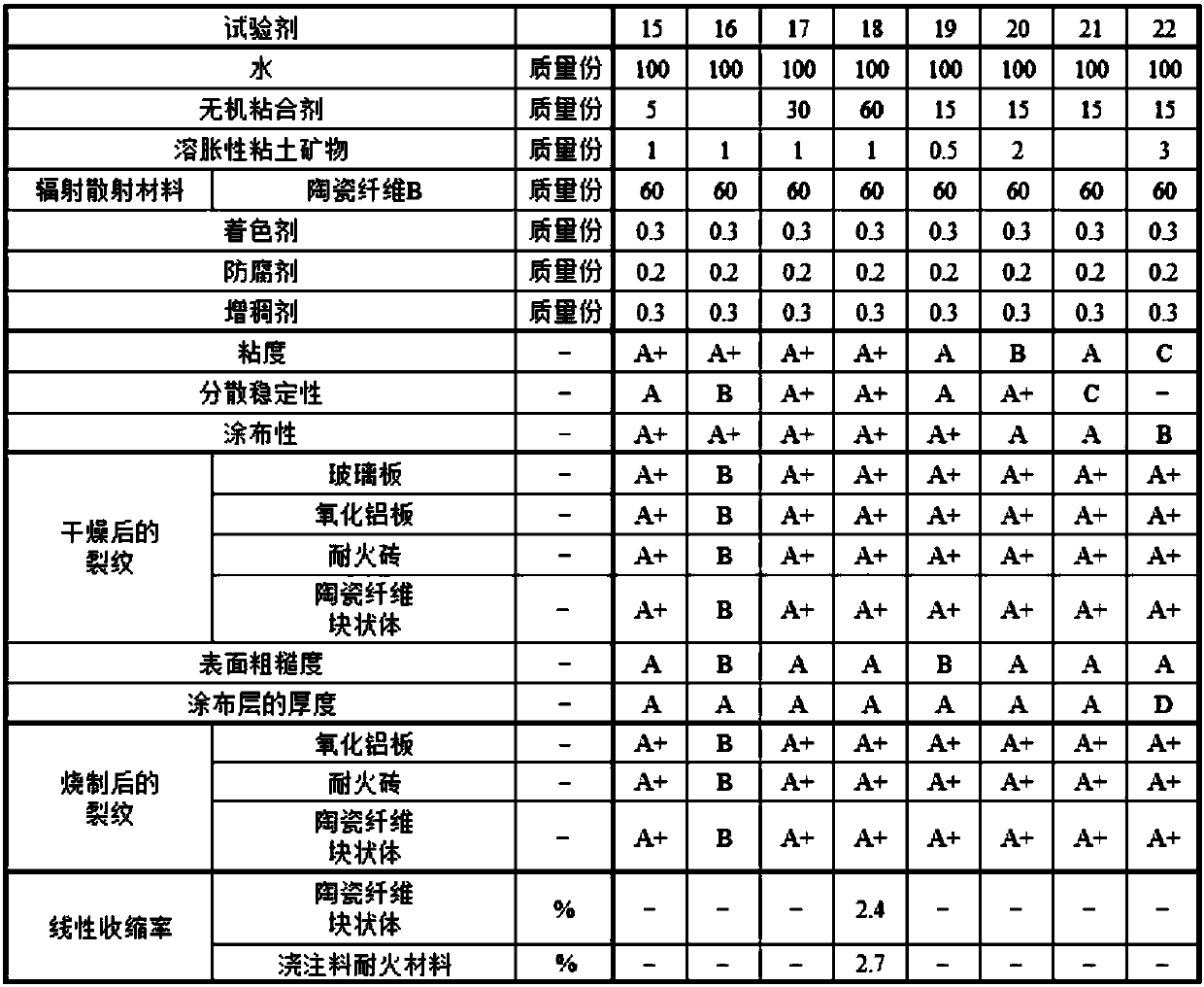
[0181] This example is an example of a coating liquid in which the contents of the inorganic binder and the swellable clay mineral are changed. As shown in Table 2, in this example, 8 kinds of coating liquids (test agents 15-22) in which the contents of the inorganic binder and the swellable clay mineral were changed were prepared in the same manner as in Experimental Example 1. Then, various characteristics were evaluated by the same method as in Experimental Example 1. The results are shown in Table 2.
[0182] Table 2
[0183]
PUM
| Property | Measurement | Unit |
|---|---|---|
| particle size | aaaaa | aaaaa |
| diameter | aaaaa | aaaaa |
| diameter | aaaaa | aaaaa |
Abstract
Description
Claims
Application Information
 Login to View More