
Optical polarizer capable of dynamically adjusting AT (asymmetric transmission) signal and using method of optical polarizer
An asymmetric transmission and dynamic adjustment technology, applied in the direction of the polarizing element, can solve the problem that the relative size of the polarization conversion of polarized light cannot be adjusted, and achieve the effect of simple structure, fast speed and high efficiency
- Summary
- Abstract
- Description
- Claims
- Application Information
AI Technical Summary
Problems solved by technology
Method used
Image

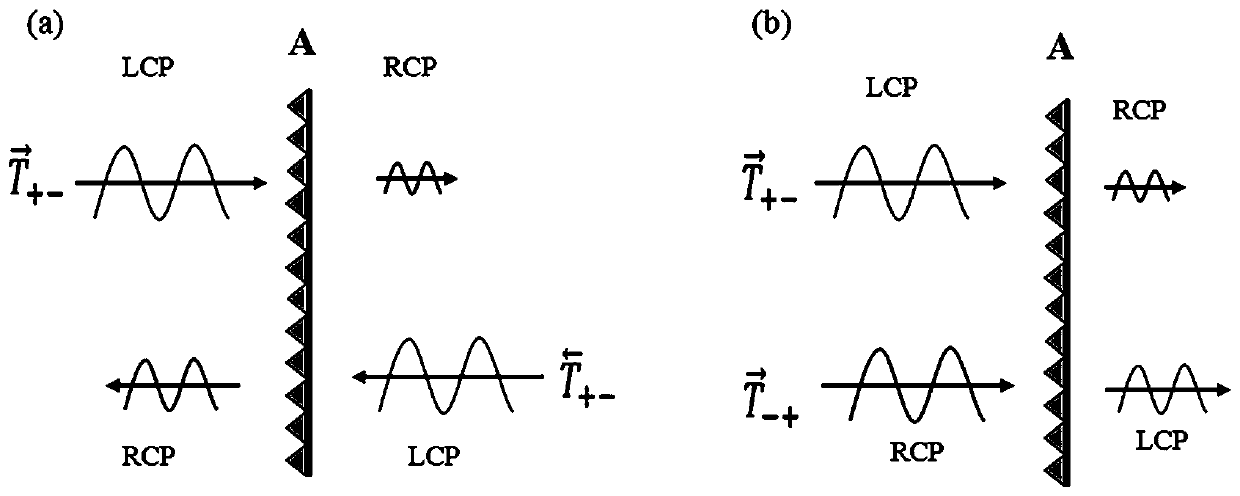

Examples
Embodiment 1
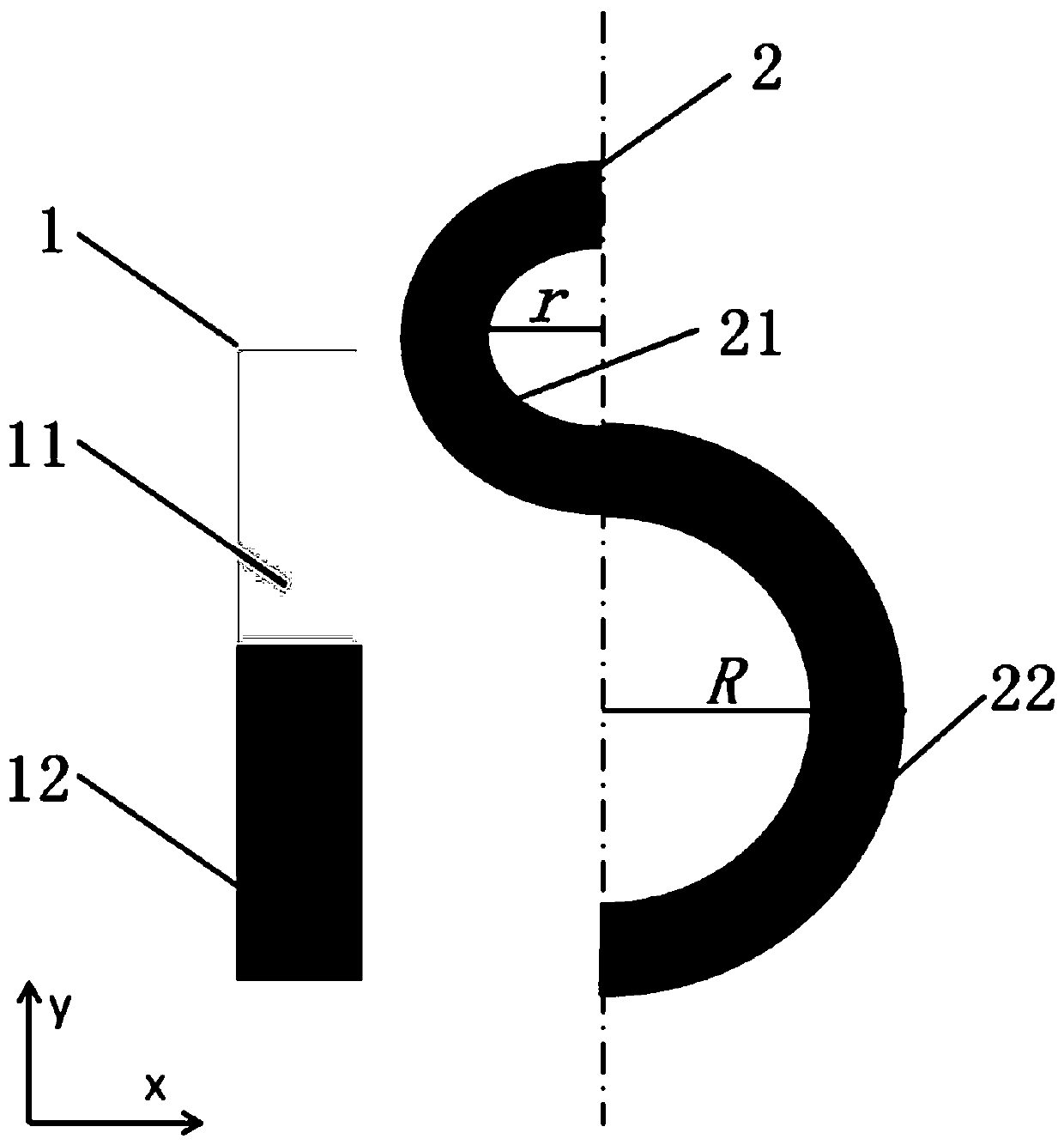
[0044] like figure 2 and image 3 The shown optical polarizer that can dynamically adjust asymmetric transmission signals includes a single-layer chiral structure composed of multiple periodic units with the same structure arranged in a rectangular periodic array, and each periodic unit contains a metal nanostructure unit, The metal nanostructure unit is composed of a metal nanorod 1 and an "S"-shaped metal nanostructure 2 connected through ports, the metal nanorod 1 and the "S"-shaped metal nanostructure 2 are located on the same plane, and the metal nanorod 1 is composed of the first The block 11 and the second component block 12 are connected, the first component block 11 is made of metal magnesium material, the second component block 12 and the "S" shaped metal nanostructure 2 are made of noble metal material.
[0045] In this embodiment, the optical polarizer is a planar periodic structure composed of two simple structural metal nanorods and an "S"-shaped metal nanostru...
Embodiment 2
[0047] like figure 2 As shown, the metal nanorod 1 is located beside the "S"-shaped metal nanostructure 2, and the long sides of the metal nanorod 1 and the long axis of the "S"-shaped metal nanostructure 2 are parallel to each other. The "S"-shaped metal nanostructure 2 is composed of a third component block 21 and a fourth component block 22 connected through ports, and the third component block 21 and the fourth component block 22 are in the shape of a semicircle. The outer diameter of the ring of the third component block 21 r Smaller than the outer diameter of the ring of the fourth component block 22 R , the width of the metal nanorod 1, the third component block 21 semicircle and the fourth component block 22 semicircle w equal.
[0048] In this embodiment, the transmission coefficient of the planar chiral gold nanoarray is numerically simulated using the electromagnetic simulation software COMSOL Multiphysics, and the parameters are set: the side length in the x di...
Embodiment 3
[0059] like Figure 7 As shown, on the basis of the structure of Example 1 and Example 2, the length of the nano-metal rods in the optical polarizer of the present invention changes, and the chirality of the structure will also change accordingly, changing the asymmetric transmission effect, and its AT effect The intensity of the "S"-shaped nanoarrays increased significantly from 5% to over 18%.
[0060] like Figure 7 As shown in the asymmetric transmission conversion spectrum, other parameters are fixed as in Example 1, Px=300nm, Py=380 nm. The width and thickness of the metal nanorod and the "S"-shaped nanostructure are equal, the width w = 40 nm, the thickness t = 50 nm, the distance g = 60 nm, and the outer diameters of the two semicircular rings of the S-shaped nanostructure are r = 60nm and R = 100nm. nanorod length l At 160 nm, 170 nm, 180 nm, 190 nm, 200 nm respectively: from Figure 7 (a) It can be seen that under the irradiation of LCP, when the length of the n...
PUM
 Login to View More
 Abstract
Description
Claims
Application Information
 Login to View More