
A fringe illumination Fourier domain iteration updating super-resolution microscopic imaging method based on total internal reflection
An iterative update and microscopic imaging technology, applied in the field of optical super-resolution microscopic imaging, can solve problems such as difficult application of in vivo imaging
- Summary
- Abstract
- Description
- Claims
- Application Information
AI Technical Summary
Problems solved by technology
Method used
Image

Examples
Embodiment 1
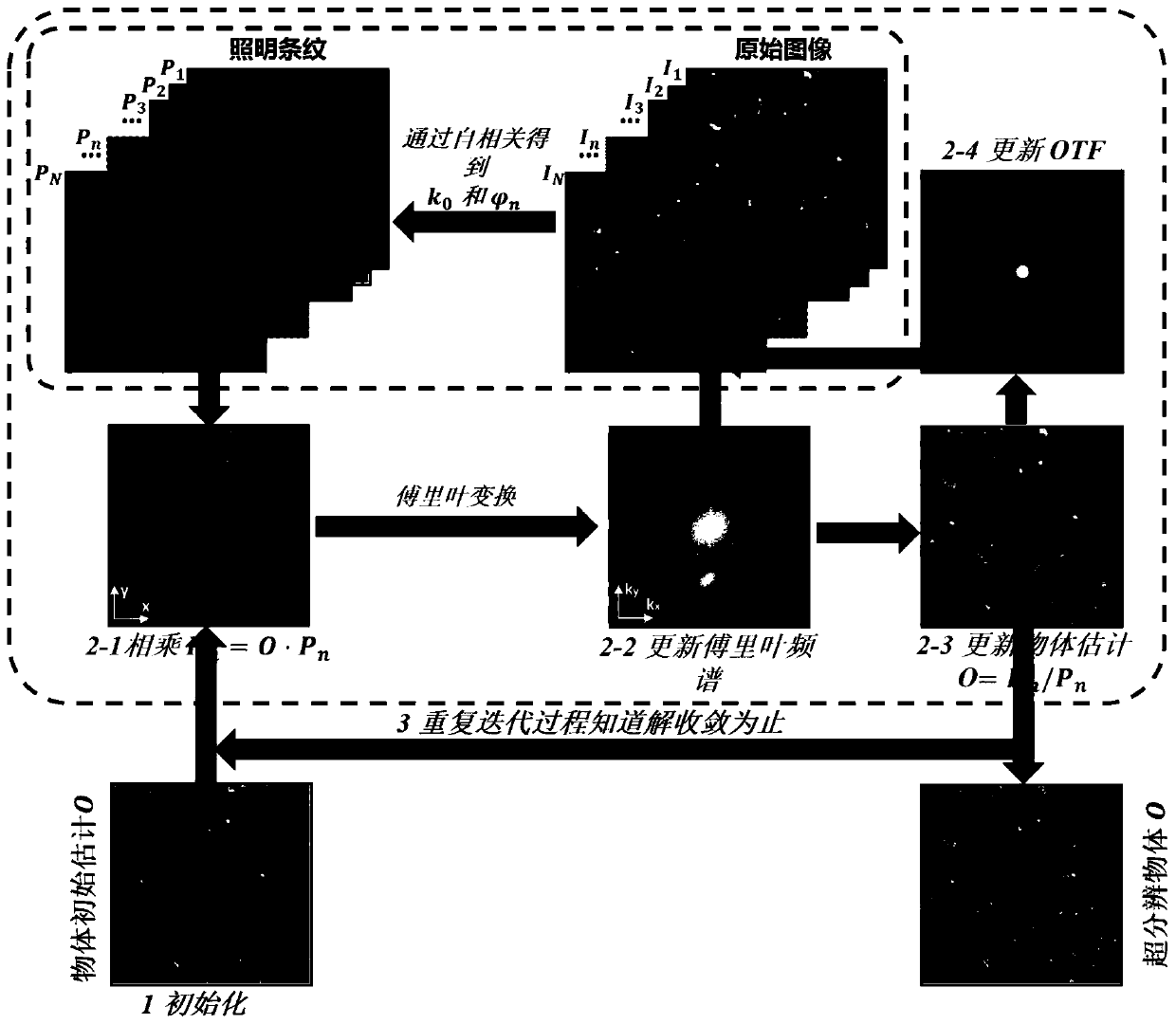
[0059] Such as figure 1 As shown, this embodiment provides a fringe-illuminated Fourier-domain iterative update super-resolution microscopy imaging method based on total internal reflection, including the following steps:
[0060] (1) Split a parallel-illuminated laser beam into two parallel beams with equal intensity and the same polarization direction, converge on the entrance pupil surface of the objective lens, and then pass through the objective lens to become two parallel beams. The surface excites two evanescent waves propagating in opposite directions to interfere, and produce fine evanescent wave fringes to illuminate the fluorescent sample. After the fluorescent sample is modulated by the non-uniform illumination light field, the spectrum shifts; after receiving the fluorescent signal from the fluorescent sample by the objective lens , Use a detector to receive the fluorescence signal on the imaging image plane to obtain a low resolution image mixed with high and low fr...
Embodiment 2
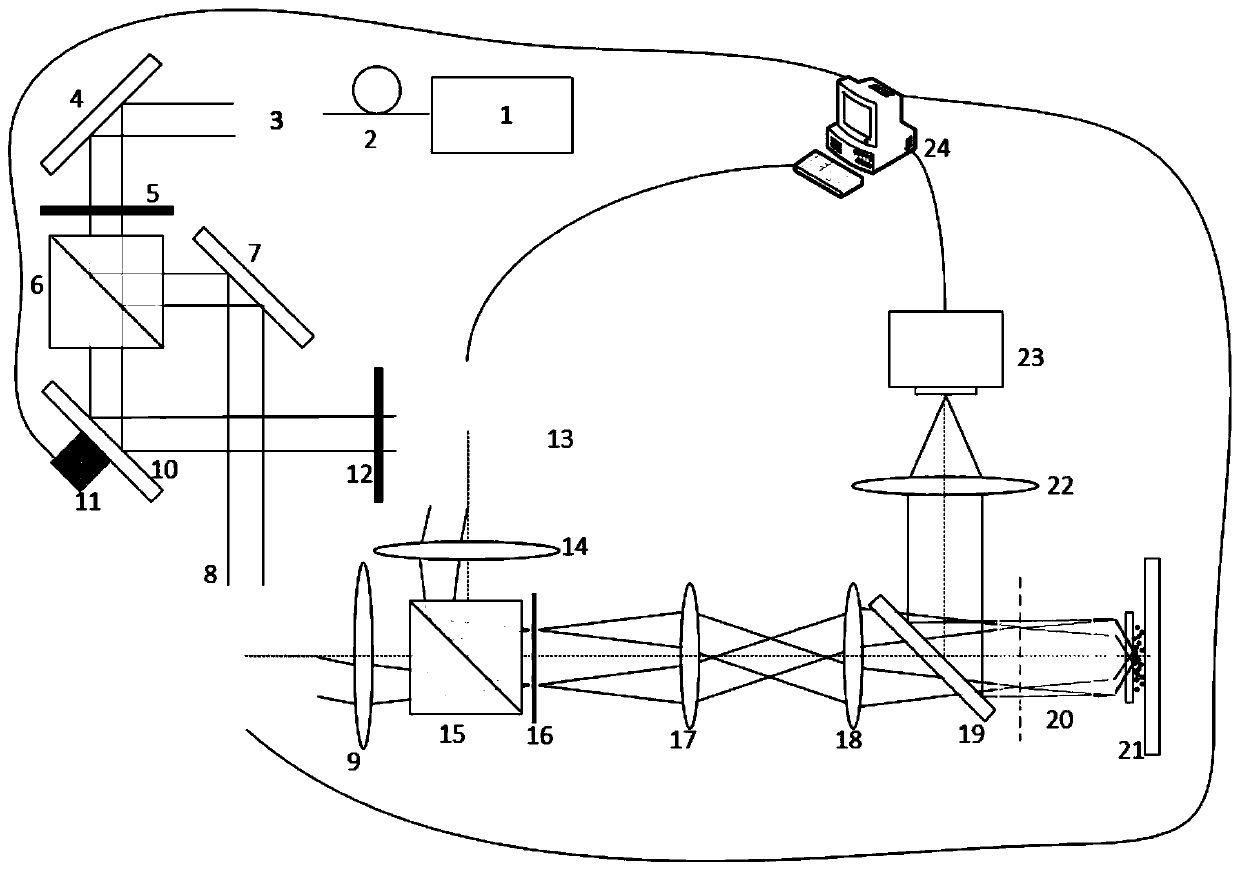
[0102] Such as figure 2 A super-resolution microscopic imaging device for implementing the method of the present invention is given, but not limited to figure 2 The device shown.
[0103] The fringe illumination Fourier domain iteratively updated super-resolution microscopic imaging device based on total internal reflection in this embodiment includes a laser 1, a polarization-maintaining single-mode fiber 2, a beam collimator 3, a first mirror 4, and a first bisection One-wave plate 5, polarization beam splitter 6, second mirror 7, first galvanometer module 8, first scanning lens 9, third mirror 10, piezoelectric ceramic 11, second half-wave plate 12. The second galvanometer module 13, the second scanning lens 14, the beam combiner 15, the polarization converter 16, the first field lens 17, the second field lens 18, the dichroic lens 19, the microscope objective lens 20, the sample 21 , The third field lens 22, EMCCD 23, computer 24.
[0104] use figure 2 The process of wide-f...
PUM
 Login to View More
 Abstract
Description
Claims
Application Information
 Login to View More