
Low-dielectric high-Q lithium magnesium phosphate dielectric material and preparation method thereof
A lithium-magnesium-phosphorus-based, dielectric material technology, applied in the field of ceramic materials, can solve the problem of low Q×f value of dielectric materials, and achieve the effects of simple preparation process, excellent microwave dielectric properties, and low cost
- Summary
- Abstract
- Description
- Claims
- Application Information
AI Technical Summary
Problems solved by technology
Method used
Image

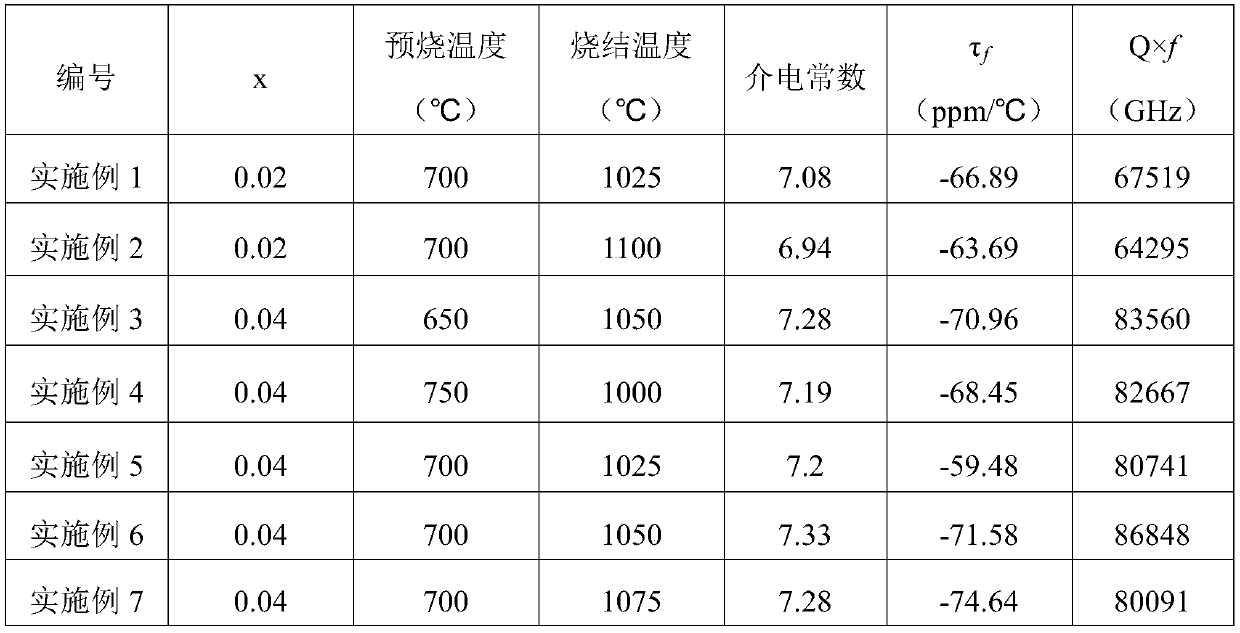
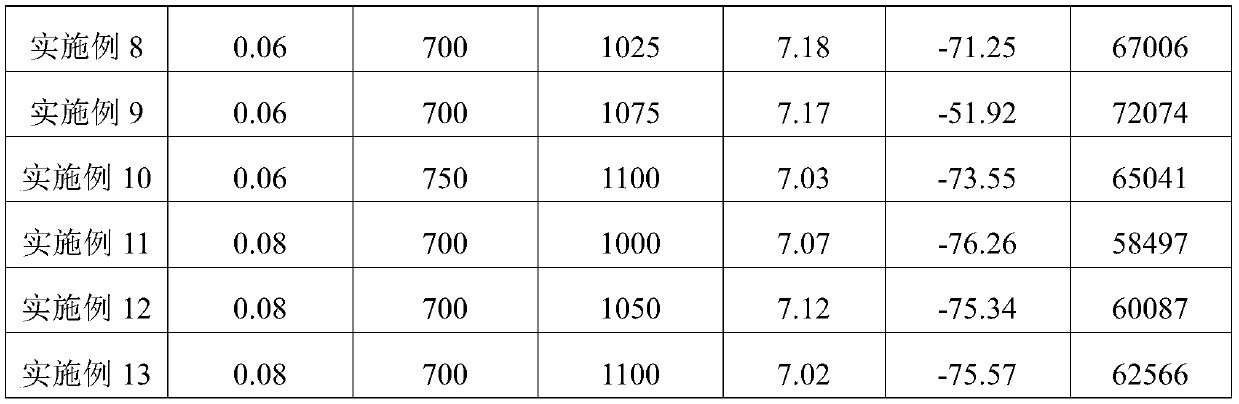
Examples
Embodiment 1
[0028] 1. According to LiMg(P 0.98 Nb 0.02 )O 4 , called Li 2 CO 3 -5.7538g, MgO-6.2769g, NH 4 h 2 PO 4 -17.5554g, Nb 2 o 5 -0.4140g of ingredients, 30g in total; the mixed powder is added to a polyester tank, after adding 180ml of deionized water and 160g of zirconium balls, ball milled on a planetary ball mill for 3 hours, and the speed of the ball mill is 250 rpm;
[0029] 2. Place the ball-milled raw materials in a drying oven to dry and pass through a 40-mesh sieve to obtain a powder with uniform particles;
[0030] 3. First heat the powder to 550°C for 1 hour, and then continue to heat up to 700°C for 4 hours;
[0031] 4. Put the calcined powder into a polyester tank, ball mill it for 6 hours for the second time, dry it after discharge, and pass through a 40-mesh sieve; then add 7% paraffin wax as a binder for granulation, and Pass through an 80-mesh sieve; then press a powder tablet press with a pressure of 4MPa to form a green body with a diameter of 10mm and...
Embodiment 2
[0035] 1. According to LiMg(P 0.98 Nb 0.02 )O 4 , called Li 2 CO 3 -5.7538g, MgO-6.2769g, NH 4 h 2 PO 4 -17.5554g, Nb 2 o 5 -0.4140g of ingredients, 30g in total; the mixed powder is added to the polyester tank, after adding 180ml of deionized water and 160g of zirconium balls, ball mill on a planetary ball mill for 1 hour, and the speed of the ball mill is 250 rpm;
[0036]2. Place the ball-milled raw materials in a drying oven to dry and pass through a 40-mesh sieve to obtain a powder with uniform particles;
[0037] 3. First heat the powder to 500°C for 2 hours, and then continue to heat up to 700°C for 5 hours;
[0038] 4. Put the calcined powder into a polyester tank, ball mill it for the second time for 7 hours, dry it after discharge, and pass through a 40-mesh sieve; then add 8% paraffin wax as a binder for granulation, and Pass through an 80-mesh sieve; then press a powder tablet press with a pressure of 4MPa to form a green body with a diameter of 10mm and ...
Embodiment 3
[0042] 1. According to LiMg(P 0.96 Nb 0.04 )O 4 , called Li 2 CO 3 -5.7431g, MgO-6.2652g, NH 4 h 2 PO 4 -17.1653g, Nb 2 o 5 -0.8264g of ingredients, 30g in total; the mixed powder was added to a polyester tank, after adding 180ml of deionized water and 160g of zirconium balls, ball milled on a planetary ball mill for 2 hours, and the speed of the ball mill was 250 rpm;
[0043] 2. Place the ball-milled raw materials in a drying oven to dry and pass through a 40-mesh sieve to obtain a powder with uniform particles;
[0044] 3. First heat the powder to 550°C for 3 hours, and then continue to heat up to 650°C for 6 hours;
[0045] 4. Put the calcined powder into a polyester tank, ball mill it twice for 8 hours, dry it after discharge, and pass through a 40-mesh sieve; then add 8% paraffin wax as a binder for granulation, and Pass through an 80-mesh sieve; then press a powder tablet press with a pressure of 4MPa to form a green body with a diameter of 10mm and a thicknes...
PUM
 Login to View More
 Abstract
Description
Claims
Application Information
 Login to View More