
3D printing integrated radiator and application thereof in phased-array antenna
A technology for radiators and heat exchange containers, applied to antennas, antenna arrays, antenna parts, etc., can solve the problem of uneven heat exchange of heat exchange devices, large heat exchange dead volume of heat exchange containers, and no heat exchange uniformity effect and other problems, to achieve the effect of large number of partitions, small spacing, and pressure pulsation suppression
- Summary
- Abstract
- Description
- Claims
- Application Information
AI Technical Summary
Problems solved by technology
Method used
Image

Examples
Embodiment 1
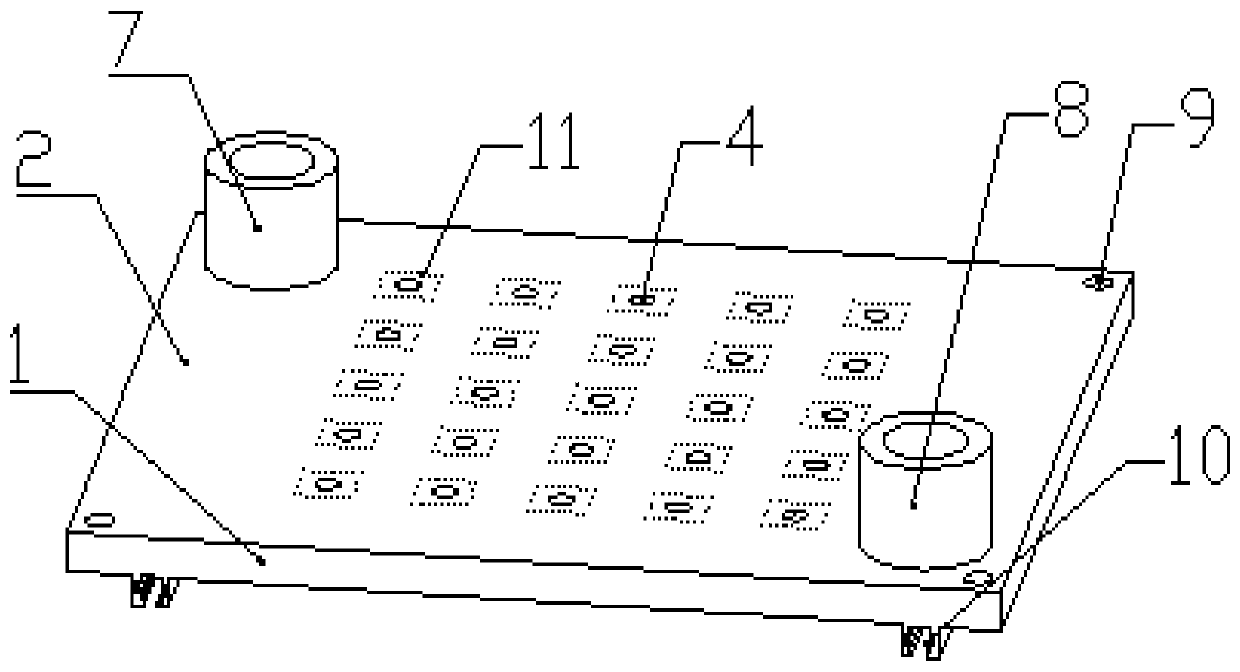
[0041] A radiator, including a heat exchange container for heat exchange and conduction with a heat source, and a liquid injection port 7 and a liquid outlet 8 for the heat exchange liquid to flow into and out of the heat exchange container, and the inside of the heat exchange container is provided with a gradually increasing The flow channel for reducing the fluid pressure drop and performing heat exchange, the liquid injection port 7 is located at the largest end of the flow channel in the heat exchange container, and the liquid outlet 8 is located at the smallest end of the flow channel in the heat exchange container.
[0042] Description of the heat exchange container: The heat exchange container is the same as the existing technology, which can ensure that the heat exchange container can isolate the heat source and the heat exchange heat body. For the heat exchange tubes used in the shell-and-tube heat exchangers and tube-sheet heat exchangers in the prior art, it is only ...
Embodiment 2
[0045] The difference between this embodiment and Embodiment 1 is that: 1) a structure of a heat exchange container is provided; 2) a specific structure is provided in which the circulation channel in the heat exchange container is gradually enlarged; The specific heat dissipation scene of the channel is optimized to design the heat dissipation structure; 4) optimize the design of the location of the liquid injection port 7 and the liquid outlet port 8 so that the heat exchange liquid can fully flow through the heat exchange container.
[0046] The repeated parts of this embodiment and Embodiment 1 will not be repeated, and only the differences are pointed out here:
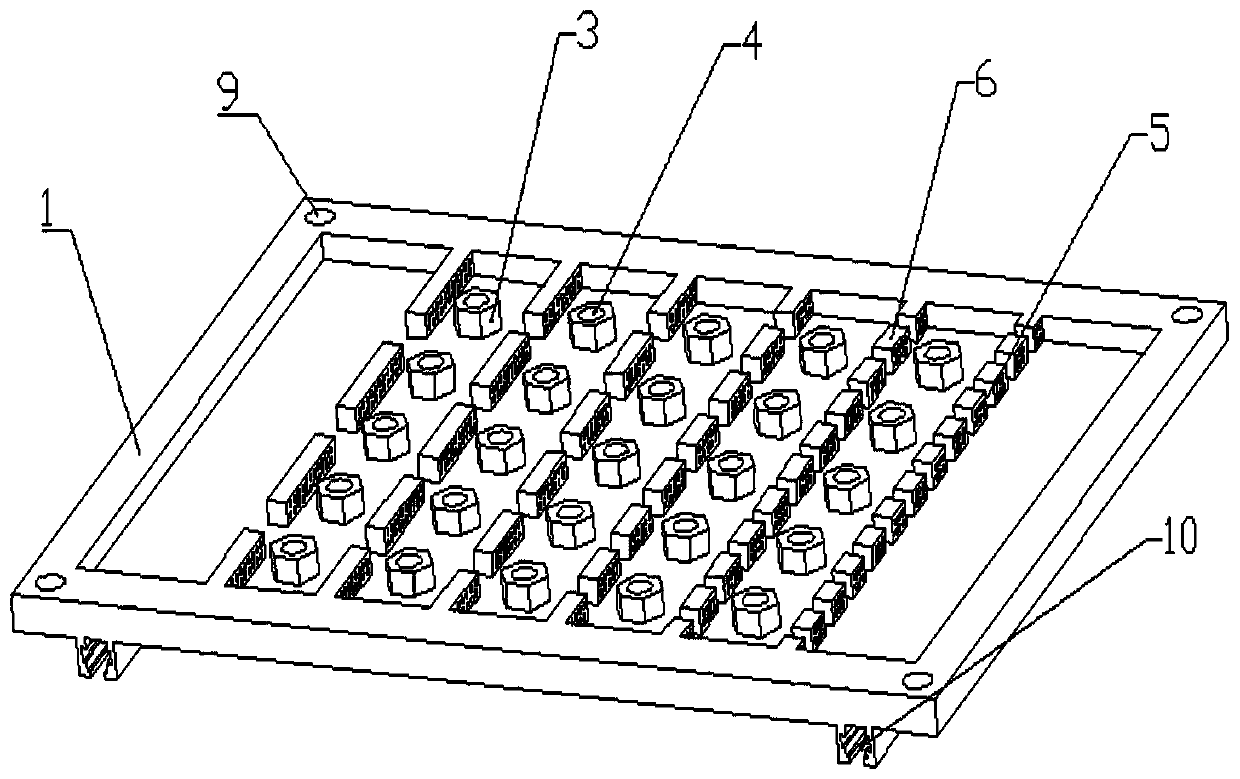
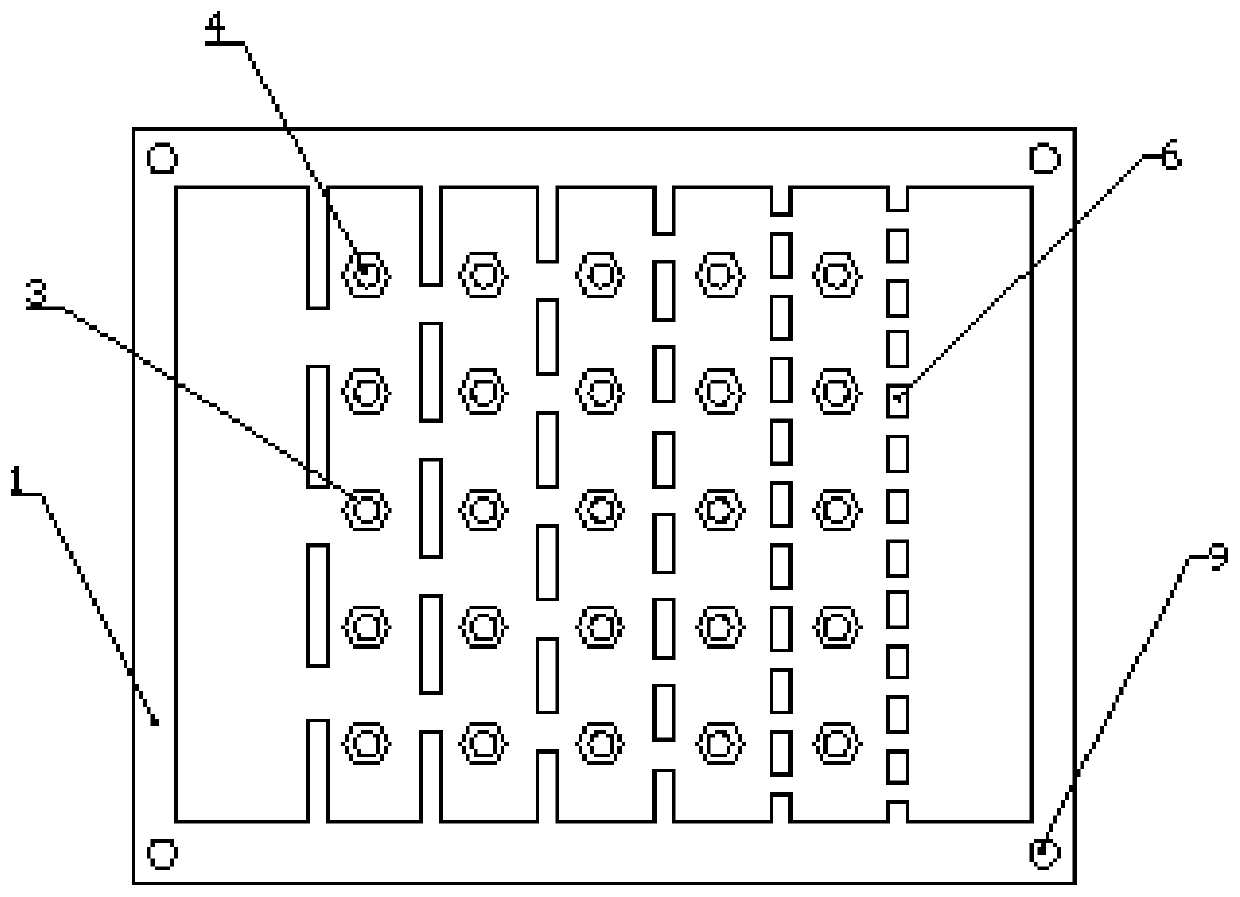
[0047] 1) In order to specifically provide a structural form of a heat exchange container, see figure 1 and figure 2 In this embodiment, the heat exchange container is plate-shaped and consists of a cold plate 1 and a cover plate 2 which are combined with each other to form a closed space, and the closed space ...
Embodiment 3
[0054] The difference between this embodiment and Embodiment 2 is: Embodiment 2 is for heat dissipation for a 5×5 phased array antenna, while this embodiment is for heat dissipation for an 8×8 phased array antenna. See Figure 5 However, the difference between this embodiment and Embodiment 2 is only that the number of partitions 6 and the number of heat exchange units have been adjusted correspondingly with respect to Embodiment 2.
[0055] By analogy, the present invention can not only be used for 5×5 phased array antennas or 8×8 phased array antennas to dissipate heat, but also can be used for more types of phased array antennas to dissipate heat. This time, they will not be described in detail. As long as the heat sink structure of the present invention is used to dissipate heat from the phased array antenna, it should be included in the protection scope of the present application.
PUM
 Login to View More
 Abstract
Description
Claims
Application Information
 Login to View More