System and method for researching bioelectrical effect of high-frequency electromagnetic radiation on in-vitro excitable cells

A technology of electromagnetic radiation and bioelectricity, applied in the field of biomedicine, can solve problems such as difficult integration, complex equipment, limited space, etc., and achieve the effect of convenient system operation

CN111239134AActive Publication Date: 2020-06-05FOURTH MILITARY MEDICAL UNIVERSITY
8 Cites 2 Cited by

Patent Information

Authority / Receiving Office
CN · China
Patent Type
Applications(China)
Current Assignee / Owner
Publication Date
2020-06-05

Smart Images

  • Figure 1
    Figure 1
  • Figure 2
    Figure 2
  • Figure 3
    Figure 3
Patent Text Reader

Abstract

The invention relates to a system and a method for researching the bioelectricity effect of high-frequency electromagnetic radiation on in-vitro excitable cells. Terahertz waves are designed and constructed from top to bottom by utilizing an electrophysiological recording system and a microscope observation system for adherent growth culture cells, synchronous detection of real-time irradiation terahertz and electrophysiological characteristics of adherent growth in-vitro culture neurons and other excitable cells can be realized, and the system is simple to operate and high in repeatability. On one hand, a terahertz source is integrated into an electrophysiological recording system and is fixed on an electric three-dimensional micromanipulator, so that the terahertz source can be moved freely and accurately; meanwhile, terahertz waves invisible to naked eyes are combined with the visible light laser positioning sighting device, and the irradiation position of the terahertz waves is determined. And on the other hand, the attenuation degree of terahertz waves in the liquid is reduced by controlling the liquid level height of the electrophysiological recording chamber, namely the culture dish, so that the neurons are irradiated in real time, and electrophysiological indexes are recorded in real time.
Need to check novelty before this filing date? Find Prior Art

Description

technical field

[0001] The invention relates to the field of biomedicine, in particular to a system and method for studying the bioelectric effect of high-frequency electromagnetic radiation on excitable cells in vitro. Background technique

[0002] Terahertz (THz) waves refer to the electromagnetic spectrum region between millimeter waves and infrared light with a frequency range of 0.1 to 10 THz and a wavelength of 3 mm to 30 μm. It is the only last spectrum interval in the electromagnetic spectrum that has not been fully studied and well utilized. It is a "blank" area of ​​the electromagnetic spectrum that has not been fully developed by humans. In terms of energy, terahertz waves are between photons and electrons, and it has many unique properties: ①High permeability, THz has good penetration to many dielectric materials and non-polar substances, such as ceramics and carbon plates , plastics, etc.; ②Low energy, THz photon energy is 4.1meV (millielectron volts), only 10 ...

Examples

Embodiment Construction

[0034] The present invention will be further described in detail below in conjunction with specific embodiments, which are explanations of the present invention rather than limitations.

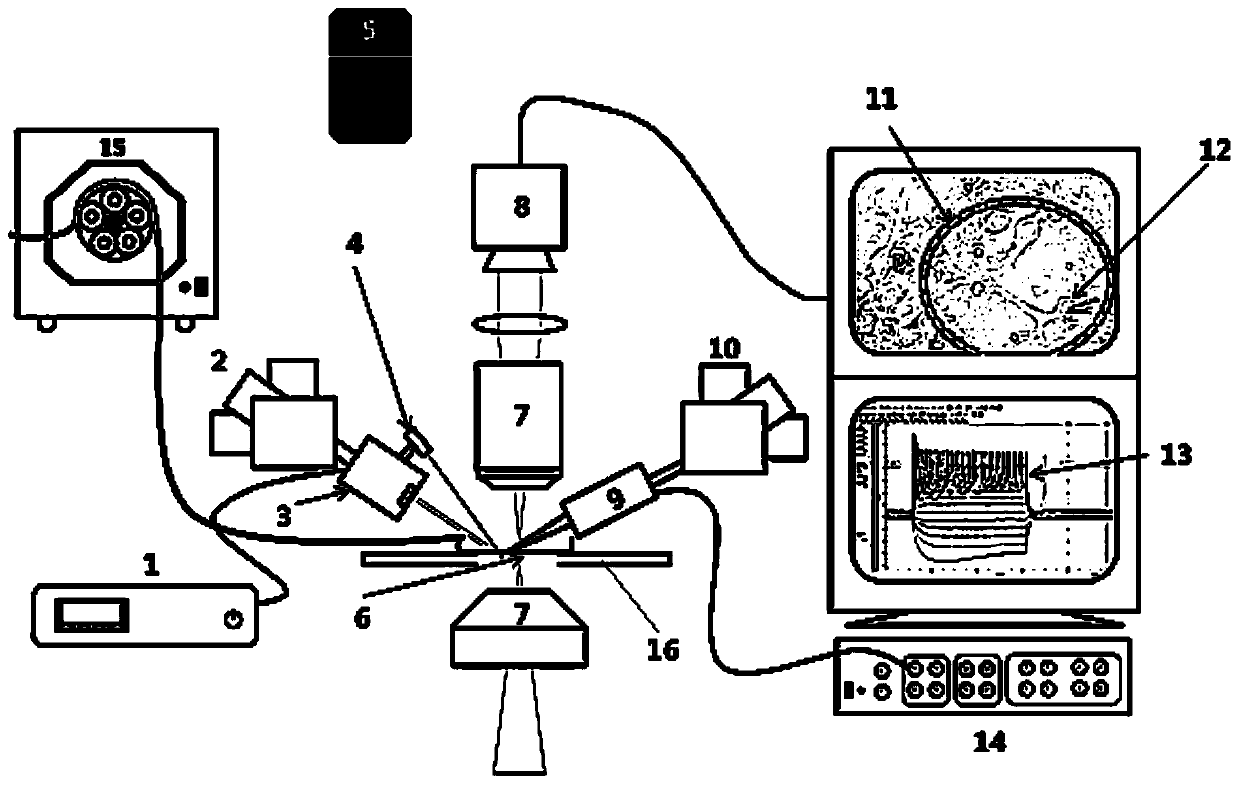
[0035] Such as figure 1 As shown, the system of the present invention for studying the bioelectric effect of high-frequency electromagnetic radiation on excitable cells in vitro consists of the following four parts, which can realize real-time terahertz irradiation and synchronous electrophysiological recording of neurons cultured in vitro.

[0036] The THz transmitting system includes a pulse current source 1 and a THz source 3 for supplying power to the THz source, wherein the THz irradiation parameters of the THz source 3 are controlled by the pulse current source 1;

[0037]The THz source visual displacement control system includes an electric three-dimensional micromanipulator 2, a laser positioning sight 4 and an infrared radiation observation card 5, which are used to precisely control...