Unlock instant, AI-driven research and patent intelligence for your innovation.

Non-specific nucleases from the genus pseudomonas

A non-specific, nuclease technology, applied in enzyme stabilization, hydrolytic enzymes, instruments, etc., can solve problems such as increasing solution viscosity and clogging

Pending Publication Date: 2021-02-26
ミルテニイビオテックベーファーウントコーカーゲー
View PDF5 Cites 0 Cited by
  • Summary
  • Abstract
  • Description
  • Claims
  • Application Information

AI Technical Summary

Problems solved by technology

However, damaged or lysed cells may release contaminating nucleic acids into the cell culture fluid, which may increase the viscosity of the solution and / or may cause, for example, breakdown of channels, matrices, and pores in cell culture, cell sorting, and cell separation devices. Blockages, such as microfluidic channels and filter pores

Method used

the structure of the environmentally friendly knitted fabric provided by the present invention; figure 2 Flow chart of the yarn wrapping machine for environmentally friendly knitted fabrics and storage devices; image 3 Is the parameter map of the yarn covering machine
View more

Image

Smart Image Click on the blue labels to locate them in the text.
Viewing Examples
Smart Image
  • Non-specific nucleases from the genus pseudomonas
  • Non-specific nucleases from the genus pseudomonas
  • Non-specific nucleases from the genus pseudomonas

Examples

Experimental program
Comparison scheme
Effect test

Embodiment approach

[0127] In one embodiment of the invention, a polypeptide having NSN activity disclosed herein is used to degrade and thereby remove nucleic acids from solution. These solutions may contain proteins, cells, tissues or other biological material. In one example, a polypeptide having NSN activity is used to degrade nucleic acids, such as DNA and / or RNA, present in crude cell extracts prepared for isolation and purification of recombinant or native proteins from host cells. Since nucleic acids contaminate the target protein, it is of interest to remove as much nucleic acid as possible. Cells including the protein of interest are lysed using a buffer containing a polypeptide having NSN activity (eg, pH 7-8 based phosphate buffer). The buffer may contain a cationic complexing agent. This solution is incubated at a defined temperature for a defined time (eg, at about 37°C for 10 min or at about 4°C for 2 hours). During incubation, nucleic acids are degraded. The protein is then is...

Embodiment 1

[0163] Example 1: Non-specific nucleic acids from Pseudomonas syringae and from phylogenetically related Pseudomonas Identification of the enzyme PsNuc

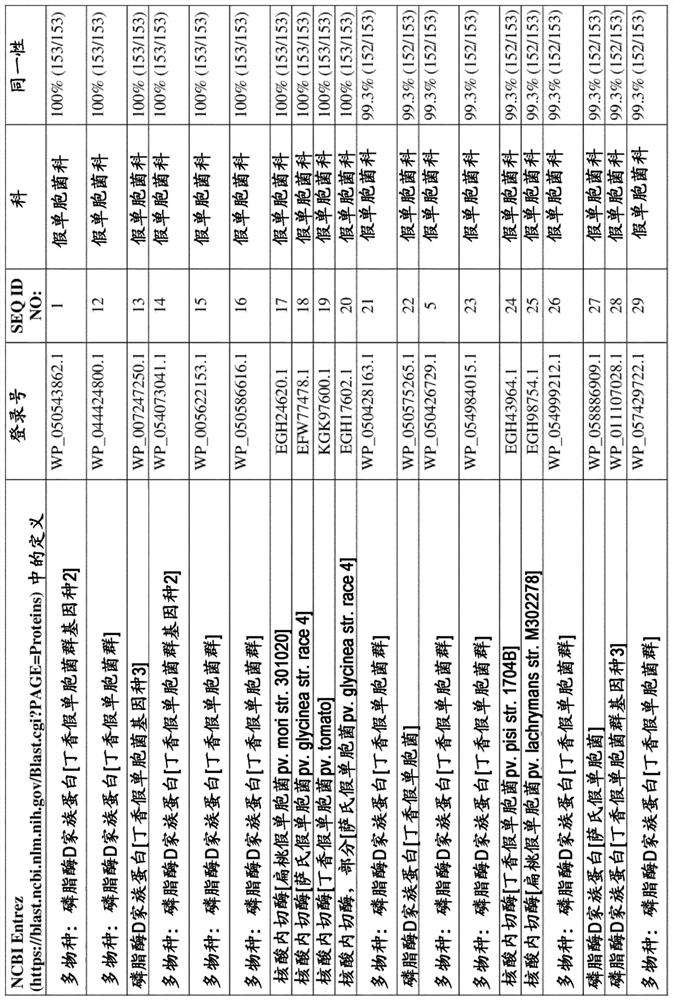
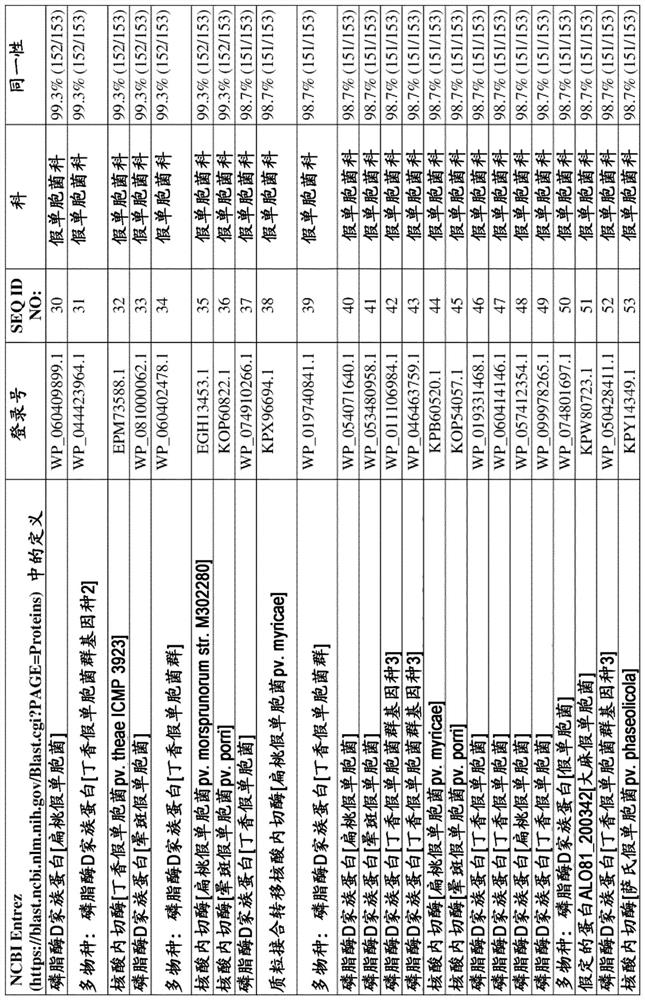
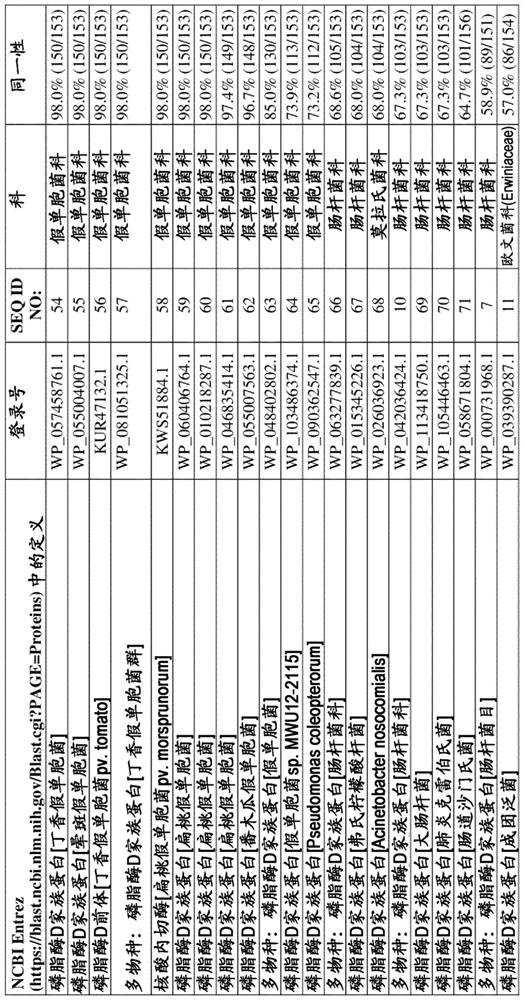
[0164] To identify putative non-specific bacterial endonucleases, BLAST analysis was performed using StNuc from Salmonella entericasubsp. enterica serovar Typhimurium as interrogator sequence (NCBI entry WP_000731968.1, SEQ ID NO:7). NCBI Entrez's BLASTP server (https: / / blast.ncbi.nlm.nih.gov / Blast.cgi?PAGE=Proteins) was used to screen putative endonucleases derived from cold-active bacterial species. A putative endonuclease from the PLD family of Pseudomonas syringae genomosp. 2 (WP_050543862.1, SEQ ID NO: 1 ) was retrieved which, in a local alignment omitting the putative secretion signal, was shown to be compatible with 57.2% amino acid sequence identity compared to StNuc (WP_000731968.1, SEQ ID NO:7). The gene encoding PsNuc consists of 552 nucleotides, including a stop (STOP) codon sequence, and the deduced amino ac...

Embodiment 2

[0165] Example 2: Cloning of genes encoding PsNuc and PsNuc variants and transformation of E. coli

[0166] The DNA sequences were derived from the mature amino acid sequences of PsNuc and its variants without predicted signal peptide sequences (SEQ ID NO:2, SEQ ID NO:3, SEQ ID NO:4, SEQ ID NO:5 and SEQ ID NO: 6) Derivation. The gene was synthesized as a codon-optimized sequence for expression in Escherichia coli (ATUM, Inc.) and cloned into the pET24d(+) vector (Merck Millipore) as a fusion protein containing an N-terminal affinity tag, which and tags allow affinity purification of recombinant PsNuc proteins ( image 3 ). E. coli DH5α cells (Thermo Fisher Scientific) were transformed with the corresponding pET24d:: / JvNuc plasmids by heat shock. Therefore, cells were thawed on ice for 10 min and supplemented with 10-100 ng of plasmid DNA. After an additional 20 min incubation on ice, a heat shock of 42 °C was applied for 45 sec. Thereafter, the cells were incubated on i...

the structure of the environmentally friendly knitted fabric provided by the present invention; figure 2 Flow chart of the yarn wrapping machine for environmentally friendly knitted fabrics and storage devices; image 3 Is the parameter map of the yarn covering machine
Login to View More

PUM

PropertyMeasurementUnit
purityaaaaaaaaaa
Login to View More

Abstract

The present invention provides a composition comprising an isolated polypeptide having non-specific nuclease (NSN) activity for degrading nucleic acids comprising or consisting of at least 70% amino acid sequence identity to SEQ ID NO:2, wherein said polypeptide has NSN activity in a solution of about 4 DEG C, and a cation complexing agent such as EDTA. Said composition may have preferentially a neutral to basic pH. A kit comprising said composition and a method using said composition are also disclosed.

Description

technical field [0001] The invention belongs to the field of enzyme technology, in particular the invention relates to the use of microbial non-specific nucleases active in solutions at temperatures as low as about 4°C, preferably with cationic complexing agents (such as EDTA) and / or neutral to alkaline Sexual pH binding. Background technique [0002] Nucleases are nucleic acid degrading enzymes involved in natural processes including replication, recombination, repair, and restriction (Rangarajan and Shankar (2001) FEMS Microbiol Rev. 25:583-613). They are ubiquitous in all organisms and localized in different tissues and cellular subcompartments such as the nucleus and organelles, they can be localized in the cytoplasm, attached to the cell membrane or secreted extracellularly. Nucleases act in a sequence-specific (eg, restriction enzymes) or sequence-independent type of action (non-specific nucleases). Nonspecific nucleases (NSNs) are of biotechnological importance for ...

Claims

the structure of the environmentally friendly knitted fabric provided by the present invention; figure 2 Flow chart of the yarn wrapping machine for environmentally friendly knitted fabrics and storage devices; image 3 Is the parameter map of the yarn covering machine
Login to View More

Application Information

Patent Timeline
no application Login to View More
Patent Type & Authority Applications(China)
IPC IPC(8): C12N9/22C07K14/21
CPCC12N9/22C12N9/96G01N1/4044
Inventor S·埃勒尤彻S·施米茨S·米尔泰伊V·诺尔
Owner ミルテニイビオテックベーファーウントコーカーゲー
Features
  • R&D
  • Intellectual Property
  • Life Sciences
  • Materials
  • Tech Scout
Why Patsnap Eureka
  • Unparalleled Data Quality
  • Higher Quality Content
  • 60% Fewer Hallucinations
Social media
Patsnap Eureka Blog
Learn More