Check patentability & draft patents in minutes with Patsnap Eureka AI!

Method for detecting polymerization degree of sodium alginate oligosaccharide

A technology of sodium alginate and oligosaccharide, applied in the field of carbohydrate analysis, can solve the problems of complicated operation, large error, high detection cost, etc., and achieve the effect of simplifying the detection process

Active Publication Date: 2021-04-20
DALIAN INST OF CHEM PHYSICS CHINESE ACAD OF SCI
View PDF1 Cites 0 Cited by
  • Summary
  • Abstract
  • Description
  • Claims
  • Application Information

AI Technical Summary

Problems solved by technology

The degree of polymerization is another form of molecular mass. The methods for measuring the degree of polymerization include specific rotation method, ultracentrifugation method, high-pressure electrophoresis method, gel chromatography, mass spectrometry, nuclear magnetic method, etc. The first four methods have large errors Or the operation is cumbersome. The degree of polymerization determined by mass spectrometry and NMR is more accurate, but it needs to know the relevant structural information of the sugar in advance and the detection cost is relatively expensive.

Method used

the structure of the environmentally friendly knitted fabric provided by the present invention; figure 2 Flow chart of the yarn wrapping machine for environmentally friendly knitted fabrics and storage devices; image 3 Is the parameter map of the yarn covering machine
View more

Image

Smart Image Click on the blue labels to locate them in the text.
Viewing Examples
Smart Image
  • Method for detecting polymerization degree of sodium alginate oligosaccharide
  • Method for detecting polymerization degree of sodium alginate oligosaccharide
  • Method for detecting polymerization degree of sodium alginate oligosaccharide

Examples

Experimental program
Comparison scheme
Effect test

Embodiment 1

[0031] (1) Prepare DNS (3,5-dinitrosalicylic acid) reagent: add 45.5g potassium sodium tartrate to 125ml hot water to dissolve, add 1.575g DNS and 65.5ml 2mol / L NaOH; then add 1.25g Distill phenol and 1.25g of sodium sulfite, stir to dissolve, after cooling, dilute to 250ml with distilled water and store in a brown bottle, set aside for 7 days before use;

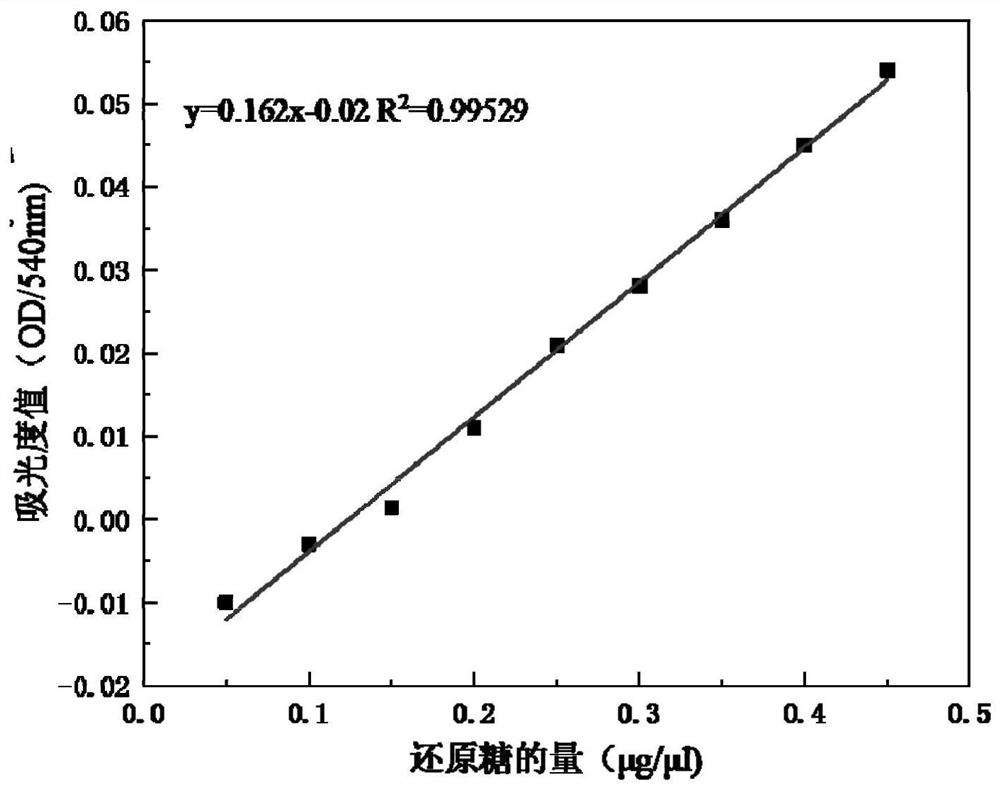
[0032] (2) drawing of standard curve: configure the glucose solution of different concentrations, adopt DNS method to measure its absorbance value at 540nm, obtain different glucose concentration and absorbance curve figure, as standard curve figure; Figure 4 Shown: the standard curve is y=0.16x-0.02

[0033] (3) Configuration of a series of oligosaccharide solutions: take oligomeric sodium alginate, both of which are mixed fragments of mannuronic acid and guluronic acid, and prepare a solution with a concentration of 1 mg / ml;

[0034] (4) Pipette 128 μl of the solution into the test tube, add 96 μl of DNS reagent to deve...

Embodiment 2

[0038] Other steps of the present invention are with embodiment 1

[0039] (3) Take oligomeric sodium alginate, all of which are guluronic acid fragments, and configure it into a solution with a concentration of 1 mg / ml;

[0040] (4) Pipette 128 μl of the solution into the test tube, add 96 μl of DNS reagent to develop color at 100°C for 10 minutes, take it out to room temperature 25°C, add 1.376ml of water once, then draw 200 μl of the solution into a cuvette, and measure the reduction of 540nm Sugar absorbance value. The percent content of reducing sugar calculated by standard curve is 10.96%,

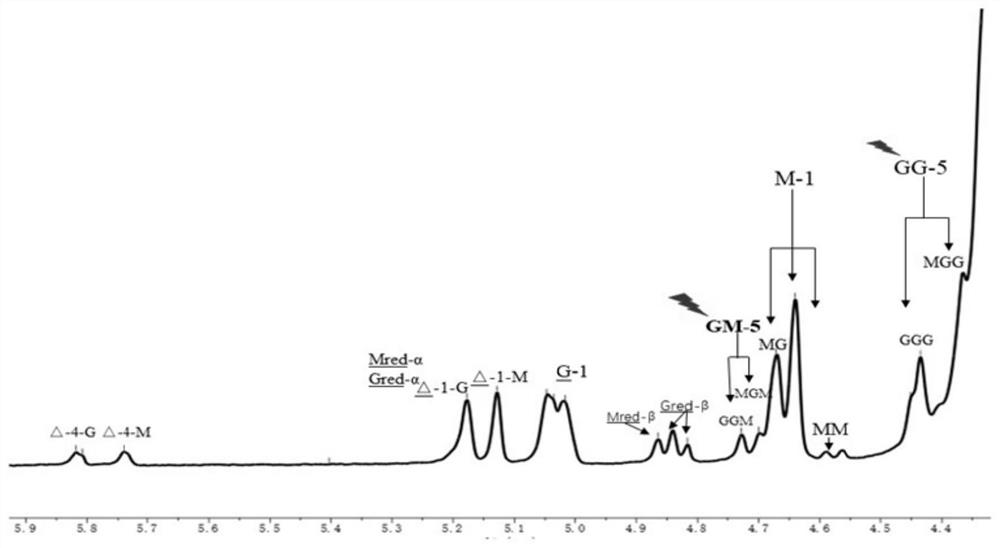
[0041] (5) Substituting into the equation y=1.085x-0.136, the corresponding average degree of polymerization is 9.67; the average degree of polymerization detected by NMR is 9.8.

Embodiment 3

[0043] Other steps of the present invention are with embodiment 1

[0044] (3) Take oligomeric sodium alginate, which is a mixed fragment of mannuronic acid and guluronic acid, and configure it into a solution with a concentration of 1 mg / ml;

[0045] (4) Pipette 128 μl of the solution into the test tube, add 96 μl of DNS reagent to develop color at 100°C for 10 minutes, take it out to room temperature 25°C, add 1.376ml of water once, then draw 200 μl of the solution into a cuvette, and measure the reduction of 540nm Sugar absorbance value. The percent content of reducing sugar calculated by standard curve is 29.57%,

[0046] (5) Substituting into the equation y=1.085x-0.136, the corresponding average degree of polymerization is 3.61; the average degree of polymerization detected by NMR is 3.6. Detection by ESI-MS again, as Figure 5 , it can be seen that the oligosaccharide mixture contains disaccharides, trisaccharides, and tetrasaccharides, and the content of disaccharid...

the structure of the environmentally friendly knitted fabric provided by the present invention; figure 2 Flow chart of the yarn wrapping machine for environmentally friendly knitted fabrics and storage devices; image 3 Is the parameter map of the yarn covering machine
Login to View More

PUM

PropertyMeasurementUnit
Concentrationaaaaaaaaaa
Login to View More

Abstract

The invention provides a method for detecting polymerization degree of sodium alginate oligosaccharide. The average polymerization degree of the sodium alginate oligosaccharide is measured by utilizing an absorption spectrophotometry method, and the polymerization degree of the oligosaccharide can be directly obtained through an absorbance value after an error is corrected through NMR, so that the detection process of the average polymerization degree of the algal oligosaccharide is greatly simplified, the method is suitable for determination of average polymerization degree in industrial production and separation and purification processes of algal oligosaccharide.

Description

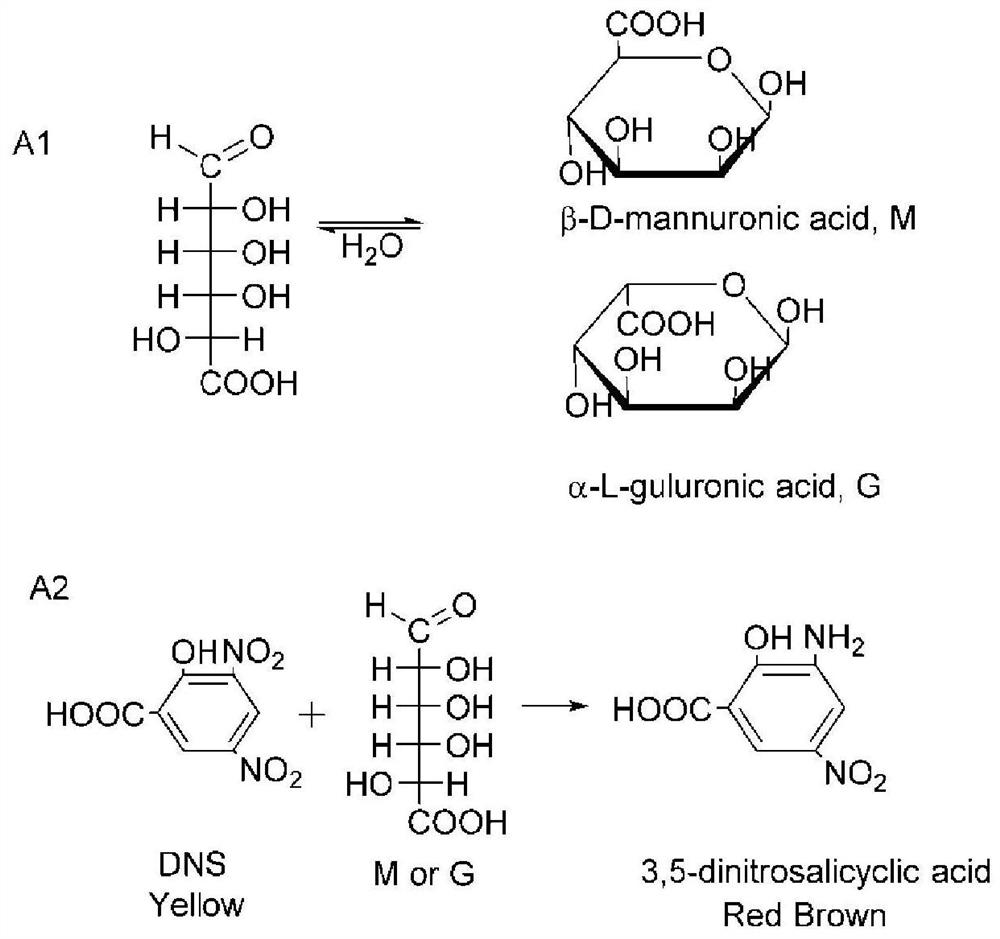
technical field [0001] The invention belongs to the technical field of sugar analysis, in particular to a method for measuring the degree of polymerization of sodium alginate oligosaccharides. Background technique [0002] Oligosaccharides are a general term for a class of sugars with straight or branched chains formed by connecting 2-30 monosaccharide units through glycosidic bonds. They can also be called oligosaccharides, such as alginic acid oligosaccharides and chitosan oligosaccharides. , Pectin oligosaccharides, etc. The oligosaccharides that humans eat daily, such as sucrose, maltose, and lactose, are just additives used in food processing, and are generally considered to have no specific regulatory function. However, the oligosaccharides used in agriculture are oligosaccharides with one or a certain type of specific functions, such as seaweed oligosaccharides. Sodium alginate is an anionic linear carbohydrate composed of β-D-mannuronic acid (M) and α-L-guluronic a...

Claims

the structure of the environmentally friendly knitted fabric provided by the present invention; figure 2 Flow chart of the yarn wrapping machine for environmentally friendly knitted fabrics and storage devices; image 3 Is the parameter map of the yarn covering machine
Login to View More

Application Information

Patent Timeline
no application Login to View More
IPC IPC(8): G01N21/78G01N21/31
Inventor 尹恒孙明
Owner DALIAN INST OF CHEM PHYSICS CHINESE ACAD OF SCI
Features
  • R&D
  • Intellectual Property
  • Life Sciences
  • Materials
  • Tech Scout
Why Patsnap Eureka
  • Unparalleled Data Quality
  • Higher Quality Content
  • 60% Fewer Hallucinations
Social media
Patsnap Eureka Blog
Learn More