Check patentability & draft patents in minutes with Patsnap Eureka AI!

Construction method and application of CD3e transgenic mouse model for tracing tumor T lymphocyte infiltration

A technology of transgenic mice and lymphocytes, applied in the direction of receptor/cell surface antigen/cell surface determinant, application, genetic engineering, etc., can solve problems such as inflammatory response, low success rate of transplantation, and inability to evaluate tumor immune drugs, etc. To achieve the effect of short observation period and high tumor formation rate

Active Publication Date: 2021-05-28
FUJIAN PROVINCIAL HOSPITAL
View PDF9 Cites 2 Cited by
  • Summary
  • Abstract
  • Description
  • Claims
  • Application Information

AI Technical Summary

Problems solved by technology

However, there are some limitations and defects. For example, ① using in vitro serially passaged tumor cell lines for transplantation, because the tumor cell lines lack the tumor microenvironment in the in vitro culture environment and lose the characteristics and growth characteristics of the primary tumor, it cannot be objectively It reflects the situation of the primary tumor. ②The transplantation method is often local subcutaneous injection. Local injection of a large number of tumor cells may cause local inflammation and may also limit the microenvironment of the tumor. ③Because the host animal is an immunodeficient animal, it is impossible to evaluate the following Tumor Immunopharmaceuticals Targeting the Immune System
Three humanized animal models currently used for tumor immunotherapy research (reconstructed human immune system animal model, reconstituted human immune system + human tumor tissue xenograft animal model, and genetically modified humanized animal model), (1) Reconstruct the human immune system Humanized mice will develop fatal GVHD at different times after modeling, and the endogenous immune system of mice will limit the expansion of transplanted human cells, etc.
(2) Reconstructing the human immune system + human tumor tissue xenograft animal model Directly transplant fresh human tumor tissue into immunodeficient mice, which has good clinical predictability. It can not only rebuild the tumor immune microenvironment of cancer patients, but also can It can more accurately reflect the tumor status of tumor patients, and has unique advantages in the study of tumor physiology and the preclinical evaluation of targeted drugs, but there are still some limiting factors. Human tumors used for transplantation must be surgically removed fresh tumors, the success rate of transplantation is low, and it takes a long time for tumors to survive after transplantation

Method used

the structure of the environmentally friendly knitted fabric provided by the present invention; figure 2 Flow chart of the yarn wrapping machine for environmentally friendly knitted fabrics and storage devices; image 3 Is the parameter map of the yarn covering machine
View more

Image

Smart Image Click on the blue labels to locate them in the text.
Viewing Examples
Smart Image
  • Construction method and application of CD3e transgenic mouse model for tracing tumor T lymphocyte infiltration
  • Construction method and application of CD3e transgenic mouse model for tracing tumor T lymphocyte infiltration
  • Construction method and application of CD3e transgenic mouse model for tracing tumor T lymphocyte infiltration

Examples

Experimental program
Comparison scheme
Effect test

Embodiment 1

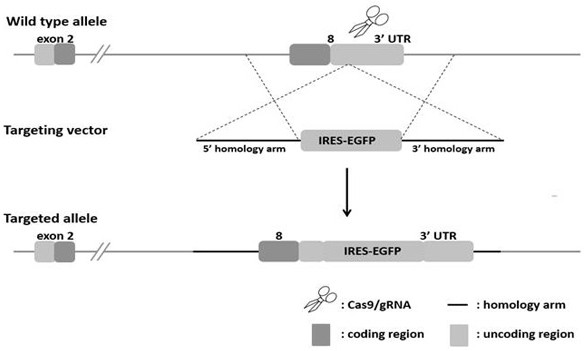
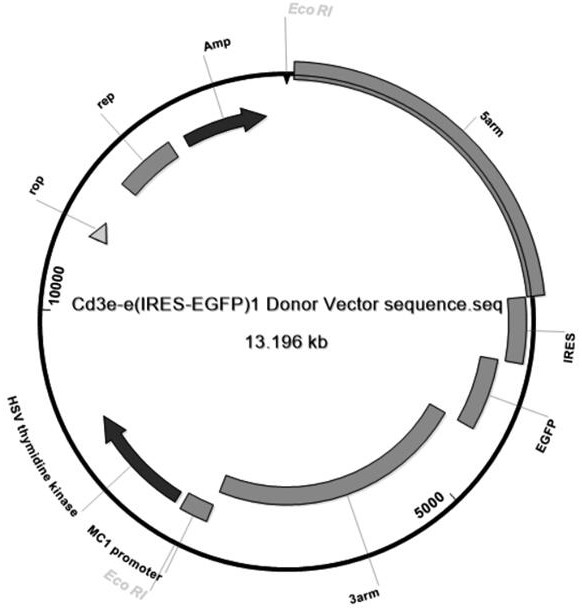
[0033] 1. Using CRISPR / Cas9 technology, through homologous recombination, knock in the IRES-EGFP expression cassette at the 3'UTR site of the Cd3e gene.

[0034] 2. The basic information of knockout gene

[0035] Target gene name (MGI number): Cd3e (88332).

[0036] Target gene MGI website link: http: / / www.informatics.jax.org / marker / MGI:88332.

[0037] Target gene Ensembl website link: http: / / asia.ensembl.org / Mus_musculus / Gene / Summaryg=ENSMUSG00000032093;r=9:44998740-45009627.

[0038] Transcript targeted by the protocol (Ensembl number): Cd3e-201 (ENSMUST00000102832.2).

[0039] Knock-in position: 3'UTR;

[0040] Type in the fragment name: IRES-EGFP;

[0041] 3. The upstream and downstream sequence information of the knock-in site, as shown in the table below.

[0042]

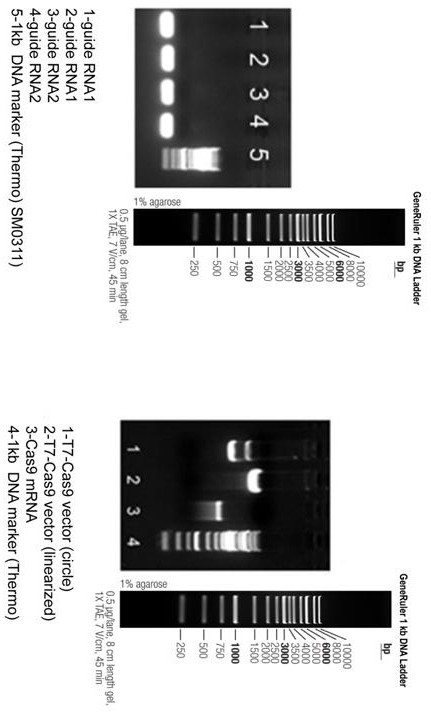
[0043] 4. Determine the specific target sites sgRNA1 and sgRNA2 of mouse Cd3e gene knock-in IRES-EGFP, prepare circular Cas9 nucleosome (sequence shown in SEQ ID NO.1), use MEGAclear Transcription Clean...

the structure of the environmentally friendly knitted fabric provided by the present invention; figure 2 Flow chart of the yarn wrapping machine for environmentally friendly knitted fabrics and storage devices; image 3 Is the parameter map of the yarn covering machine
Login to View More

PUM

No PUM Login to View More

Abstract

The invention provides a construction method and application of a CD3e transgenic mouse model for tracing tumor T lymphocyte infiltration. SgRNA is designed, Cas9 plasmid is taken as a template, the Cas9 plasmid and the sgRNA form homologous recombinant vector plasmid, F0-generation mice are obtained after the homologous recombinant vector plasmid is subjected to fertilized egg micro-injection, F0-generation positive mice are obtained through sequencing, the F0-generation positive mice and wild C57BL / 6J mice are mated, and breeding is carried out to obtain F1-generation heterozygous mice; and selfing of the female F1-generation heterozygous mouse and the male F1-generation heterozygous mouse is carried out to obtain a homozygous progeny, namely the mouse animal model. The humanized animal in which the IRES-EGFP is inserted into the CD3 at the fixed point carries human DNA and carries green fluorescence, so that the infiltration condition of tumor T lymphocytes can be traced, and a research model is provided for tumor micro-environment change of tumor metastasis.

Description

technical field [0001] The invention belongs to the field of biotechnology, and in particular relates to a construction method and application of a CD3e transgenic mouse model for tracing tumor T lymphocyte infiltration. Background technique [0002] The prokaryote-derived CRISPR-Cas gene editing system has transformed the ability to manipulate, detect, image, and annotate specific DNA and RNA sequences in living cells of different species. The ease and robustness of the technology has revolutionized genome editing for research from basic science to translational medicine. Based on the principle of the CRISPR / Cas system, relevant personnel artificially synthesized sgRNA sequences in vitro to mediate the recognition and editing of target genes by Cas proteins. Under the guidance of sgRNA, Cas9 is located on a specific deoxyribonucleic acid sequence to cut the double-strand of deoxyribonucleic acid to achieve targeted editing of the genome. The gene editing technology is sim...

Claims

the structure of the environmentally friendly knitted fabric provided by the present invention; figure 2 Flow chart of the yarn wrapping machine for environmentally friendly knitted fabrics and storage devices; image 3 Is the parameter map of the yarn covering machine
Login to View More

Application Information

Patent Timeline
no application Login to View More
IPC IPC(8): C12N15/85C12N15/65C12N15/55C12N15/12A01K67/027
CPCC12N15/8509C12N15/65C12N9/22C07K14/7051A01K67/0278C12N2800/107C12N2840/203A01K2207/15A01K2217/072A01K2217/15A01K2227/105A01K2267/0393
Inventor 李鸿茹陈愉生许能銮潘军帆
Owner FUJIAN PROVINCIAL HOSPITAL
Features
  • R&D
  • Intellectual Property
  • Life Sciences
  • Materials
  • Tech Scout
Why Patsnap Eureka
  • Unparalleled Data Quality
  • Higher Quality Content
  • 60% Fewer Hallucinations
Social media
Patsnap Eureka Blog
Learn More