
High-power alloy foil resistor and manufacturing method
A manufacturing method and alloy foil technology, applied in the direction of resistance manufacturing, non-adjustable metal resistors, resistors, etc., can solve the problems of accelerating product failure and increasing heat accumulation, so as to achieve a smooth path for heat diffusion, improve heat overflow, The effect of ensuring firmness
- Summary
- Abstract
- Description
- Claims
- Application Information
AI Technical Summary
Problems solved by technology
Method used
Image



Examples
Embodiment 1
[0032] This embodiment is an embodiment of a resistor.
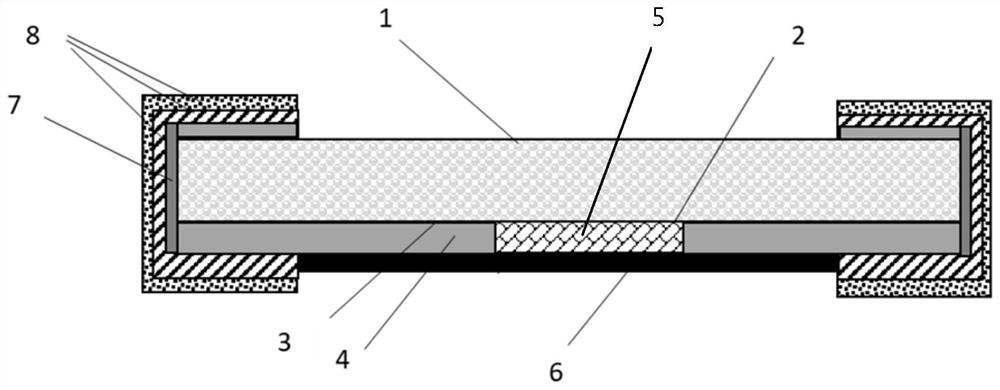
[0033] refer to figure 1 As shown, this embodiment provides a high-power alloy foil resistor, which is suitable for automobiles, industrial control and other precision electronic products or equipment.
[0034] The high-power alloy foil resistor includes: a substrate 1, a metal layer 2, an adhesive layer 3, a resistance element 4, an intermediate material 5, a protective layer 6, a side metal bottom layer 7 and an electrode terminal 8. The substrate 1 can be Soft insulating and heat-conducting materials such as alumina or aluminum nitride ceramics or polyimide after pre-cutting, the metal layer 2 can be a material that can be used for film growth processes such as deposition and sputtering, such as copper alloy, nickel-chromium alloy , one of titanium-tungsten alloys, the adhesive 3 can be applied on the surface of the substrate 1 by pressing, coating, etc. and combined with the resistance element, and the resistance el...
Embodiment 2
[0036] This embodiment is an embodiment of the manufacturing method for manufacturing the resistor in the first embodiment.
[0037] The manufacturing method of this resistor comprises the following steps:
[0038] Paste the glue 3 on the surface of soft insulating and heat-conducting materials 1 such as aluminum oxide or aluminum nitride ceramics or polyimide with cutting grooves, such as figure 2 As shown; in this step, the substrate is cut by laser to form a cutting groove on the substrate, the cutting depth is 30% to 60% of the thickness of the substrate, the laser power is 200 to 400W, the cutting speed is 500 to 1500mm / s, and the laser frequency is 40% to 90%. The width of the cutting blade used is 0.05-0.3 mm, the rotation speed of the cutting blade is 500-1800 rpm, and the material of the blade can be diamond or other hard alloy materials. Then stick the adhesive layer on the substrate with the cutting groove.
[0039] The resistance alloy piece and the intermediat...
PUM
| Property | Measurement | Unit |
|---|---|---|
| thickness | aaaaa | aaaaa |
Abstract
Description
Claims
Application Information
 Login to View More