Supercharge Your Innovation With Domain-Expert AI Agents!

Multiple host materials and organic electroluminescent device comprising same

A host material, an unreplaced technology, applied in the field of organic electroluminescent devices, can solve the problems of not specifically disclosing a variety of host materials, and achieve the effects of good life characteristics, high luminous efficiency, and low driving voltage

Pending Publication Date: 2021-07-16
ROHM & HAAS ELECTRONICS MATERIALS LLC
View PDF0 Cites 6 Cited by
  • Summary
  • Abstract
  • Description
  • Claims
  • Application Information

AI Technical Summary

Problems solved by technology

However, these references do not specifically disclose the various subject materials of the present disclosure

Method used

the structure of the environmentally friendly knitted fabric provided by the present invention; figure 2 Flow chart of the yarn wrapping machine for environmentally friendly knitted fabrics and storage devices; image 3 Is the parameter map of the yarn covering machine
View more

Image

Smart Image Click on the blue labels to locate them in the text.
Viewing Examples
Smart Image
  • Multiple host materials and organic electroluminescent device comprising same
  • Multiple host materials and organic electroluminescent device comprising same
  • Multiple host materials and organic electroluminescent device comprising same

Examples

Experimental program
Comparison scheme
Effect test

Synthetic example 1

[0102] Synthesis Example 1: Preparation of Compound H1-147

[0103]

[0104] Compound A (CAS: 2085325-18-2, 4.0 g, 9.5 mmol), 2-chloro-3-phenylquinoxaline (2.8 g, 11.4 mmol), tetrakis (triphenylphosphine) palladium (0) ( Pd(PPh 3 ) 4 ) (0.5g, 0.5mmol), potassium carbonate (K 2 CO 3 ) (2.0 g, 19 mmol), toluene (30 mL), EtOH (7 mL) and water (10 mL) were added to the reaction vessel and stirred at reflux for one day. After the reaction was completed, followed by cooling to room temperature, the reaction mixture was filtered with dichloromethane (MC) through a celite filter and then distilled under reduced pressure. The residue was separated by column chromatography using dichloromethane / hexane (MC / Hex) to obtain compound H1-147 (2.7 g, yield: 57%).

[0105] compound MW melting point H1-147 499.6 266℃

Synthetic example 2

[0106] Synthesis Example 2: Preparation of Compound H1-146

[0107]

[0108] Compound A (23.8g, 56.6mmol), 2-chloro-4-(naphthalene-1-yl)-6-benzene-1,3,5-triazine (15.0g, 47.2mmol), Pd(PPh 3 ) 4 (2.72g, 2.36mmol), K 2 CO 3 (16.3 g, 118 mmol), toluene (240 mL), EtOH (60 mL) and purified water (60 mL) were added to the reaction vessel and stirred at reflux for 2 hours. After the reaction was completed, the reaction mixture was cooled to room temperature, and the organic layer was separated through a silica filter. The organic layer was distilled under reduced pressure, and recrystallized with toluene, to obtain compound H1-146 (13.8 g, yield: 51%).

[0109] compound MW melting point H1-146 576.6 231℃

Synthetic example 3

[0110] Synthesis Example 3: Preparation of Compound H1-157

[0111]

[0112] Compound A (4.0g, 9.5mmol), 2-([1,1'-biphenyl]-3-yl)-4-chloro-6-phenyl-1,3,5-triazine (3.9g , 11.4mmol), Pd(PPh 3 ) 4 (0.5g, 0.5mmol), K 2 CO 3 (2.6 g, 19 mmol), toluene (30 mL), EtOH (7 mL) and purified water (10 mL) were added to the reaction vessel and stirred at reflux for 6 hours. After the reaction was completed, followed by cooling to room temperature, the reaction mixture was stirred at room temperature, and methanol (MeOH) was then added thereto. The resulting solid was filtered under reduced pressure, and separated with MC by column chromatography to obtain compound H1-157 (4.6 g, yield: 80%).

[0113] compound MW melting point H1-157 602.7 227℃

the structure of the environmentally friendly knitted fabric provided by the present invention; figure 2 Flow chart of the yarn wrapping machine for environmentally friendly knitted fabrics and storage devices; image 3 Is the parameter map of the yarn covering machine
Login to View More

PUM

PropertyMeasurementUnit
melting pointaaaaaaaaaa
thicknessaaaaaaaaaa
thicknessaaaaaaaaaa
Login to View More

Abstract

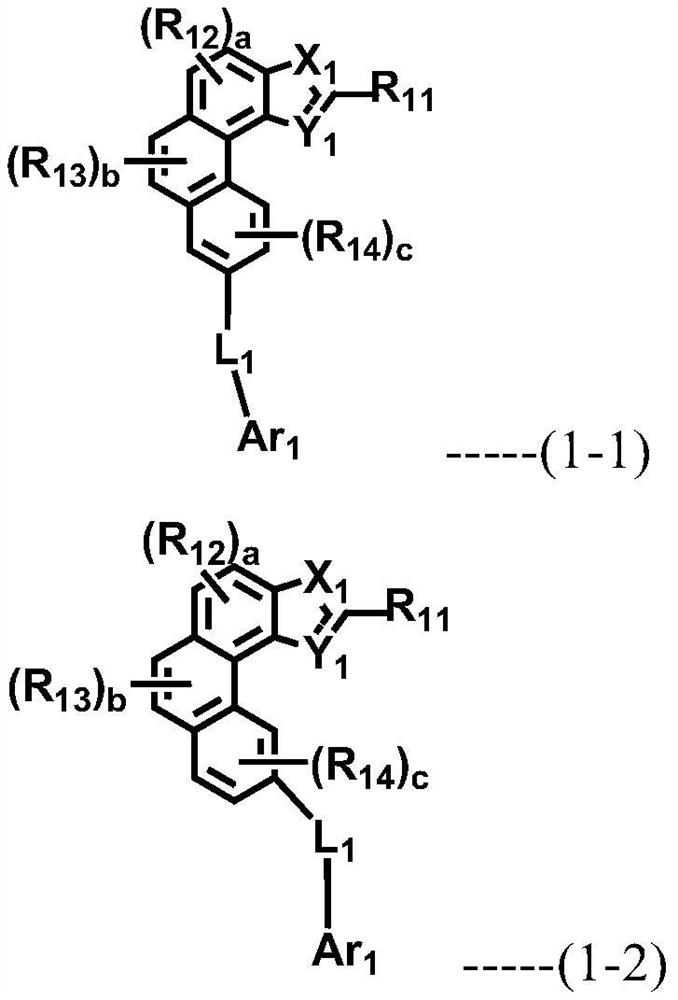
The present disclosure relates to a multiple host materials comprising a first host material comprising a compound represented by Formula 1 and a second host material comprising a compound represented by Formula 2, and an organic electroluminescent device comprising the plurality of host materials. By including a specific combination of compounds as a host material, it is possible to provide an organic electroluminescent device having a lower driving voltage, higher luminous efficiency, higher power efficiency, and / or better lifespan characteristics than conventional organic electroluminescent devices.

Description

technical field [0001] The present disclosure relates to various host materials and an organic electroluminescent device comprising the same. Background technique [0002] Small-molecule green organic electroluminescent devices (OLEDs) were first developed by Tang et al. at Eastman Kodak in 1987 by using a TPD / ALq3 bilayer consisting of an emissive layer and a charge transport layer. Since then, the development of OLEDs has been rapidly affected and OLEDs have been commercialized. Currently, OLEDs mainly use phosphorescent materials having excellent luminous efficiency in panel realization. OLEDs characterized by high luminous efficiency and / or long lifetime are required for long-time use and high-resolution displays. [0003] In order to enhance luminous efficiency, driving voltage, and / or lifetime characteristics, various materials or concepts for organic layers of organic electroluminescent devices have been proposed. However, they are not satisfactory in practical use...

Claims

the structure of the environmentally friendly knitted fabric provided by the present invention; figure 2 Flow chart of the yarn wrapping machine for environmentally friendly knitted fabrics and storage devices; image 3 Is the parameter map of the yarn covering machine
Login to View More

Application Information

Patent Timeline
no application Login to View More
Patent Type & Authority Applications(China)
IPC IPC(8): H01L51/54H01L51/50
CPCH10K85/623H10K85/624H10K85/615H10K85/622H10K85/631H10K85/636H10K85/626H10K85/633H10K85/654H10K85/657H10K85/6576H10K85/6574H10K85/6572H10K50/00H10K85/342H10K50/11H10K2101/10H10K2101/90H10K85/649H10K50/12C07D413/04C07D413/14C07D263/52C07D403/10H10K85/6565
Inventor 郑昭永李琇炫李美子文斗铉赵相熙
Owner ROHM & HAAS ELECTRONICS MATERIALS LLC
Features
  • R&D
  • Intellectual Property
  • Life Sciences
  • Materials
  • Tech Scout
Why Patsnap Eureka
  • Unparalleled Data Quality
  • Higher Quality Content
  • 60% Fewer Hallucinations
Social media
Patsnap Eureka Blog
Learn More