Supercharge Your Innovation With Domain-Expert AI Agents!

Electrocatalyst for acidic media and method of making an electrocatalyst for acidic media

a technology of electrocatalysts and acidic media, which is applied in the field of electrocatalysts, can solve the problems of oer being extremely slow, affecting the stability of acidic media, and oer catalysts currently known to suffer from a lack of stability in acid

Active Publication Date: 2019-03-05
THE BOARD OF TRUSTEES OF THE UNIV OF ILLINOIS
View PDF4 Cites 0 Cited by
  • Summary
  • Abstract
  • Description
  • Claims
  • Application Information

AI Technical Summary

Benefits of technology

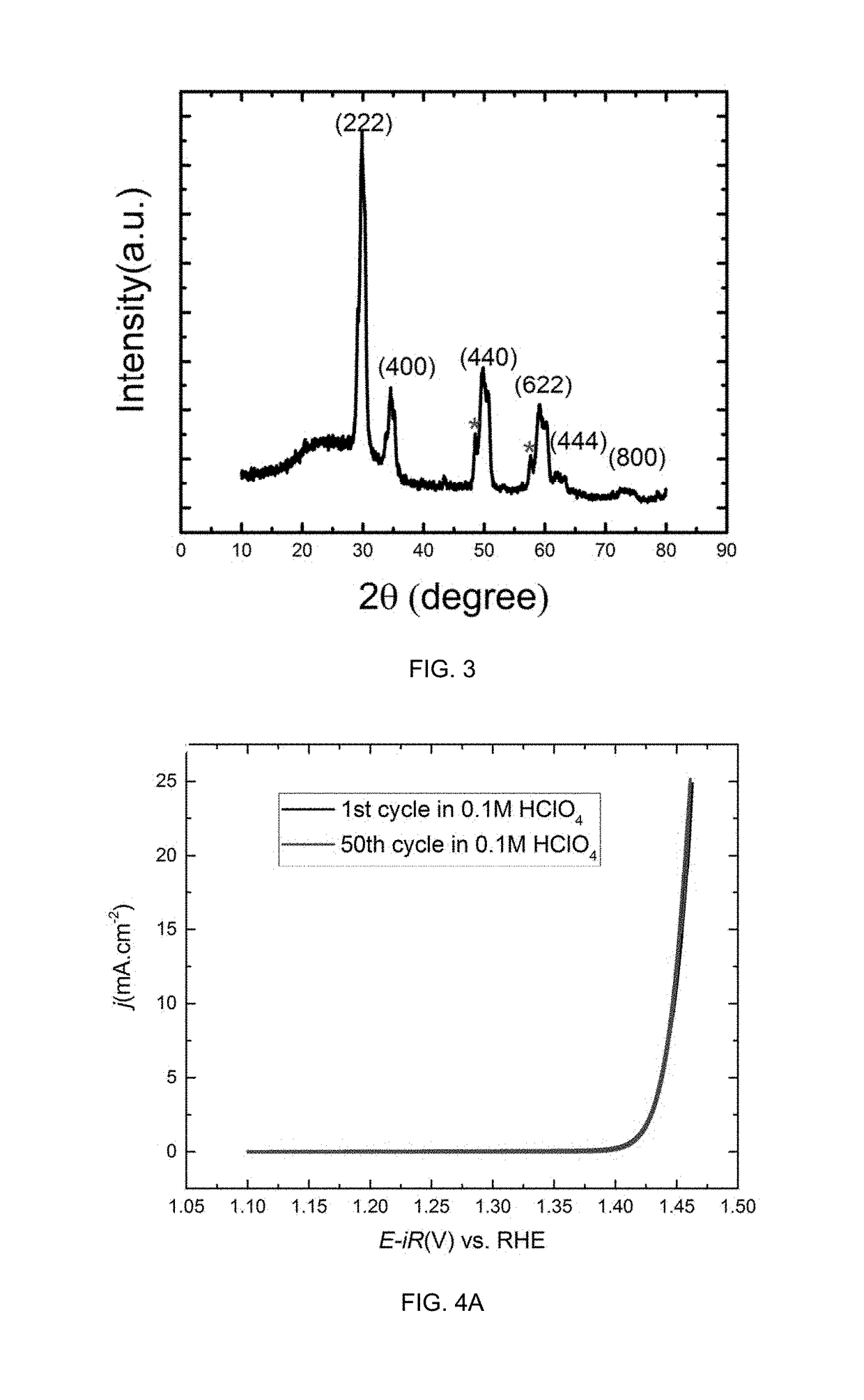
The pyrochlore-based electrocatalyst achieves exceptional stability and high OER activity in acidic media, maintaining performance over 1000 potential cycles without degradation, surpassing the stability and activity of previous catalysts, with a mass current density of up to 88.8 A / g at 0.22 V in 0.1 M HClO4.

Problems solved by technology

Partial replacement or doping at these sites is relatively straightforward and may result in a change of chemical, electronic, and physical properties.
In acidic media, the OER may be extremely slow due to a sluggish reaction process, which poses a technological hurdle for producing hydrogen fuel from water.
In addition, the currently known OER catalysts also suffer from a lack of stability in acid.
Thus, the catalyst loses its electrocatalytic activity substantially during the water splitting reaction.
Thus, industrial application of solar-water splitting devices continues to be hindered by the lack of stable electrocatalysts having an OER activity similar to or better than that of RuO2.

Method used

the structure of the environmentally friendly knitted fabric provided by the present invention; figure 2 Flow chart of the yarn wrapping machine for environmentally friendly knitted fabrics and storage devices; image 3 Is the parameter map of the yarn covering machine
View more

Image

Smart Image Click on the blue labels to locate them in the text.
Viewing Examples
Smart Image
  • Electrocatalyst for acidic media and method of making an electrocatalyst for acidic media
  • Electrocatalyst for acidic media and method of making an electrocatalyst for acidic media
  • Electrocatalyst for acidic media and method of making an electrocatalyst for acidic media

Examples

Experimental program
Comparison scheme
Effect test

example 1

and Characterization of Phase-Pure Porous Y2Ru2O7 Electrocatalyst

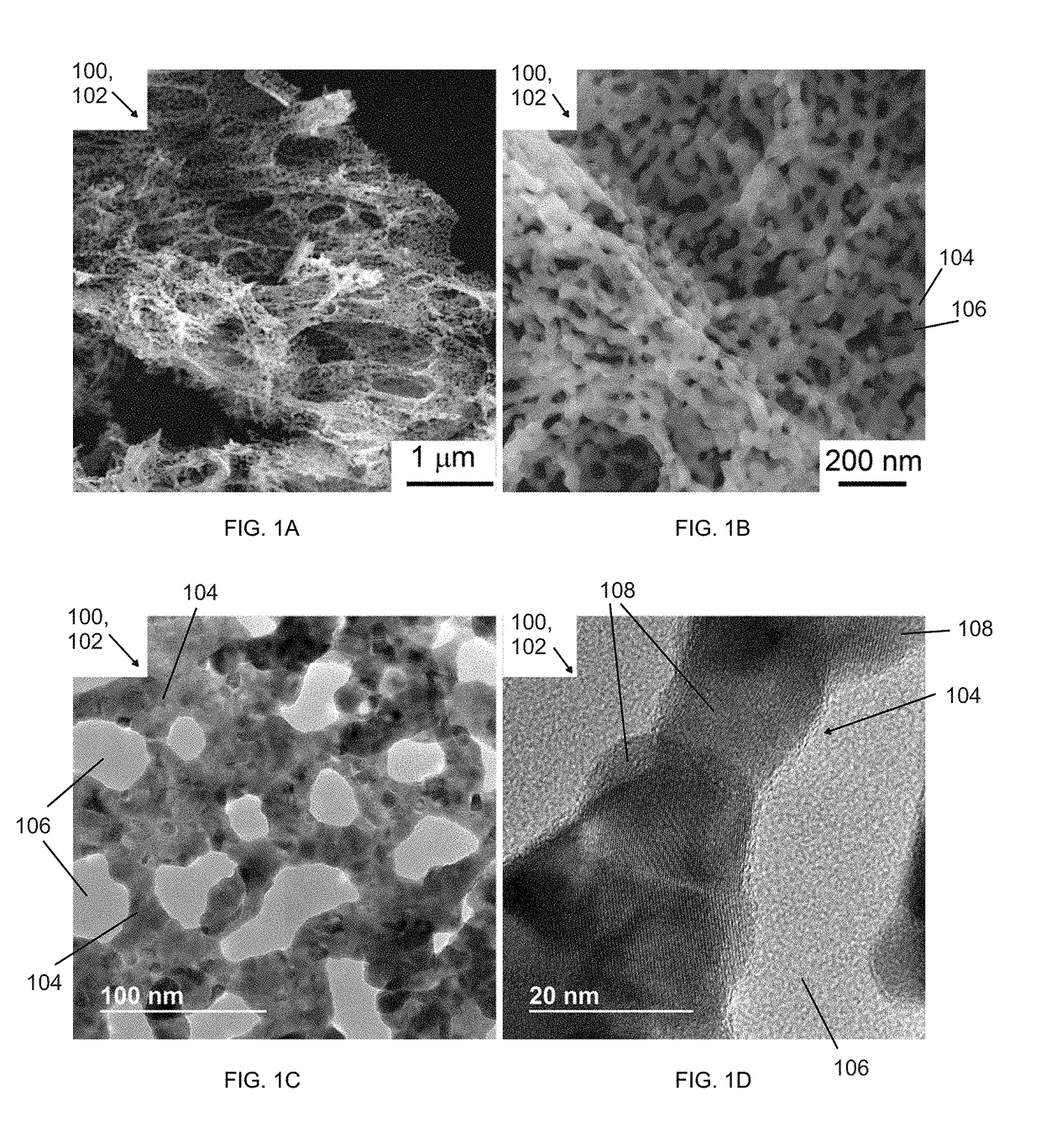
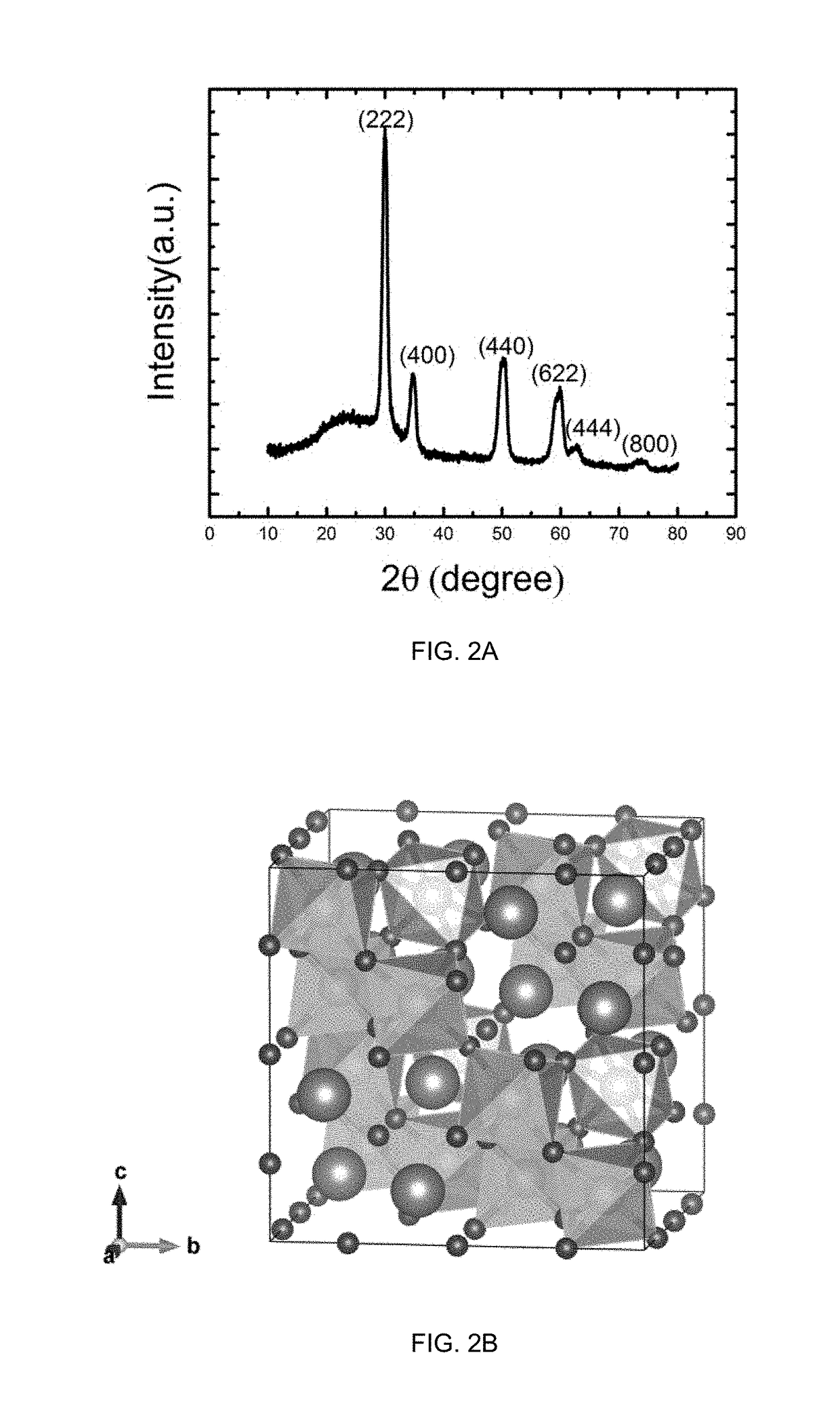
[0033]Stoichiometric amounts of Y(NO3)3•6H2O (99.9%; 0.0957 g) and Ru(NO)(NO3)x(OH)y, where x+y=3 (1.6515 g) are mixed in water (5 mL Millipore water), followed by addition of citric acid (99%, 0.2101 g) and perchloric acid (0.1445 g). The mixed solution is heated to 80° C. in about 10 min and cured for about 5 h for gelation. The water is evaporated overnight until a brown gel is formed. The gel is further heated to 600° C. at a rate of 5° C. / min and maintained at that temperature for 12 h to remove any organic compounds. The product is then heated to 960° C. in air at a rate of 5° C. / min, and maintained at this temperature for 12 h. All of the processing steps described above may be carried out in air. A porous metal oxide structure is thus formed.

[0034]Structure and crystal phase analyses of the porous metal oxide structure are conducted using a powder x-ray diffractometer with a Cu x-ray source. The experiment is p...

example 2

and Characterization of Porous Y2Ru2O7 Electrocatalyst Mixed with Small Amount of Y2O3

[0036]Stoichiometric amounts of Y(NO3)3•6H2O (99.9%; 0.0957 g) and Ru(NO)(NO3)x(OH)y, where x+y=3 (1.6515 g) are mixed in water (5 mL), followed by addition of citric acid (99%, 0.2101 g or 1 mmol) and perchloric acid (70%,veritas double distilled, 0.1445 g). The mixed solution is heated to 80° C. in about 10 min and cured for about 5 h for gelation. The water is evaporated for overnight until a brown gel is formed. The gel is further heated to 600° C. at a rate of 5° C. / min and maintained at that temperature for 12 h to remove any organic compounds. The product is then heated to 1000° C. in air at a rate of 5° C. / min, and maintained at this temperature for 12 h. All of the processing steps described above may be carried out in air. A porous metal oxide structure is thus formed.

[0037]Structure and crystal phase analyses of the porous metal oxide structure are conducted using a powder x-ray diffrac...

example 3

emical Testing of Porous Y2Ru2O7 Electrocatalyst in Acidic Media

[0038]Preparation of Carbon-Supported Catalyst Inks:

[0039]Vulcan Carbon XC-72 is used as the conducting support for the phase-pure Y2Ru2O7 porous metal oxide. 10 mg of Y2Ru2O7 prepared as described above is mixed with 2 mg of carbon black in 2 mL of tetrahydrofuran with 3 μL of Na+-Nafion, followed by sonication for 30 min to obtain a homogeneous solution.

[0040]Electrocatalytic Measurement:

[0041]A three-electrode cell configuration is used. The working electrode is a glassy carbon rotating disk electrode (RDE) with an area of 0.196 cm2. A platinum wire (0.5 mm diameter) connected to a platinum foil (1 cm2 area) is used as the counter electrode. A HydroFlex hydrogen electrode is used as the reference in a separate compartment. 5 μL of the catalyst ink is dropped on the RDE and slowly dried to make a thin film working electrode. The reference electrode is calibrated in H2 (99.999%)-saturated 0.1 M HClO4 (70%,veritas doubl...

the structure of the environmentally friendly knitted fabric provided by the present invention; figure 2 Flow chart of the yarn wrapping machine for environmentally friendly knitted fabrics and storage devices; image 3 Is the parameter map of the yarn covering machine
Login to View More

PUM

PropertyMeasurementUnit
sizeaaaaaaaaaa
sizeaaaaaaaaaa
crystallite sizeaaaaaaaaaa
Login to View More

Abstract

An oxygen evolution reaction (OER) electrocatalyst for acidic media comprises a metal oxide structure comprising a pyrochlore phase of chemical formula A.sub.2B.sub.2O.sub.n, wherein A comprises one or more A-site metals, B comprises one or more B-site metals, and 6.0.ltoreq.n.ltoreq.7.3. The metal oxide structure exhibits a mass current density of at least about 20 A / g at an over-potential of 0.22 V in 0.1 M HClO.sub.4. According to another embodiment, an electrocatalyst for acidic media comprises a porous metal oxide structure having particulate walls separating a plurality of pores, where each particulate wall comprises interconnected primary particles. The porous metal oxide structure comprises a pyrochlore phase of chemical formula A.sub.2B.sub.2O.sub.n, wherein A comprises one or more A-site metals, B comprises one or more B-site metals, and 6.0.ltoreq.n.ltoreq.7.3.

Description

RELATED APPLICATION[0001]The present patent document claims the benefit of the filing date under 35 U.S.C. § 119(e) of U.S. Provisional Patent Application Ser. No. 62 / 164,371, filed on May 20, 2015, and hereby incorporated by reference in its entirety.TECHNICAL FIELD[0002]The present disclosure is related generally to catalysts and more specifically to electrocatalysts for acidic media.BACKGROUND[0003]Electrocatalysts have been developed for various applications, such as hydrogen generation based on water splitting. Recently, oxides such as perovskites and other inorganic compounds have been studied for this application. Among the advantages of using perovskites and other oxides compared to noble metals such as platinum is reduced cost and structural flexibility. In an ABO3-type (perovskite) structure, both A- and B-sites can be varied by using metal cations with different valences or ionic radii. Partial replacement or doping at these sites is relatively straightforward and may res...

Claims

the structure of the environmentally friendly knitted fabric provided by the present invention; figure 2 Flow chart of the yarn wrapping machine for environmentally friendly knitted fabrics and storage devices; image 3 Is the parameter map of the yarn covering machine
Login to View More

Application Information

Patent Timeline
no application Login to View More
Patent Type & Authority Patents(United States)
IPC IPC(8): B01J23/00C30B5/00C25B1/04C30B29/22C01G55/00C25B11/04B01J21/00B01J25/00B01J29/00B01J23/10
CPCC25B11/0447C25B1/04C25B11/0405C25B11/0415C30B5/00C30B29/22C01G55/00Y02E60/366C01P2002/36C01P2002/72C01P2004/03C01P2004/04C01P2004/61C01P2004/62C01P2004/64C01P2006/16C01P2006/40C25B11/051C25B11/057C25B11/075Y02E60/36
Inventor YANG, HONGKIM, JAEMINSHIH, PEI-CHIEHQIN, YAO
Owner THE BOARD OF TRUSTEES OF THE UNIV OF ILLINOIS
Features
  • R&D
  • Intellectual Property
  • Life Sciences
  • Materials
  • Tech Scout
Why Patsnap Eureka
  • Unparalleled Data Quality
  • Higher Quality Content
  • 60% Fewer Hallucinations
Social media
Patsnap Eureka Blog
Learn More