Consequently, the overall costs of construction and costs of installation were considerable.
In fact, it has been recognized that at least fifty percent of the failures of most automatic pool cover systems is due to the inherent problem of
water damage.
Such passive force systems also have a
disadvantage in that the passive force must be overcome during retraction.
It should be understood that in the case of covers mounted in the pool bottom and in particular, the combination of buoyant upward force and the
resultant lever or moment arm from the cover drum diametrical buildup can result in
high torque requirements on the
motor drive system, adding considerable expense.
As with the American cable type automatic cover systems, it has been the experience with the European slat type cover systems, that as high as fifty percent of all automatic cover failure is attributable to
moisture damage of the
electrical drive and
control system.
Since planetary gears have no braking capability and will back drive, a friction
brake must be incorporated inside of the drum, with adequate braking capability, adding to the expense.
These arrangements are sold as waterproof systems, but there is little experience as to the durability and life of the seals of these systems and the manufacturers warranties are typically one to two years in duration.
In the case of leakage, damage and the replacement labor cost of these systems is expected to be extensive.
In the case of systems where the
electric drive motor is in the tube there will also be a shock
hazard when the
enclosure leaks and floods the motor.
A problem with low voltages is that the current
carrying capacity is low and therefore for long distances away from the pool the cable thickness requirements will be high, expensive and impractical.
Because it is often difficult for the operator to precisely see when to stop the cover movement, various forms of electric limit switches and sensors are used to precisely stop the cover automatically.
This means that rotary revolution counting limit switches, such as described in U.S. Pat. No. 3,718,215, coupled to the gear
motor shaft, are usually inaccurate and unreliable.
As a result this type of
limit switch is often very unreliable.
As with the cable type pool covers, slat covers will sometimes use sensor type of limit switches and generally experience the same problems with the environment as described above.
As described above, this is typically a problem in a swimming pool environment.
However, these devices are concerned primarily with high speed operation and low torque operation.
Little use has been made of hydraulic motors in the buoyant type of cover to date because of the following problems.
One problem with the slat cover, is that there is a constant
buoyant force or a gravity force on the cover in the covering direction.
These counterbalance hydraulic valves include normally closed valves which are opened only when a preset
pilot pressure is reached.
Although these
brake valves and
pilot valves can act as forms of check valves, they will not maintain a motor in a locked condition.
As a result, either a more expensive
hydraulic brake motor with additional control systems must be used, or the motor must be coupled with an additional cost worm gear
reducer to provide braking, as used with the
electric drive motors.
Adding a worm gear
reducer, for braking only, can add considerably to the cost of the drive system.
This further means that the pump must also put out a substantially higher volume of fluid, which generally increases the cost of the power pack.
Moreover, it becomes a rather costly component to serve as a brake when, indeed, it is not highly efficient for providing braking power.
Thus, the gear reducer can become a very costly component and merely function as a brake.
Consequently, use of the reducer is highly inefficient.
Since there is not a cable pulling the cover to a closed position, the cover cannot be used as a positive stopping means to activate a
hydraulic pressure relief valve.
This device is also complex in construction and uses a two part traveling nut with a pair of concentric jack screws to prevent jamming of this high speed
high torque device.
However, some travel limiting mechanism of the type described herein would necessarily have to be employed.
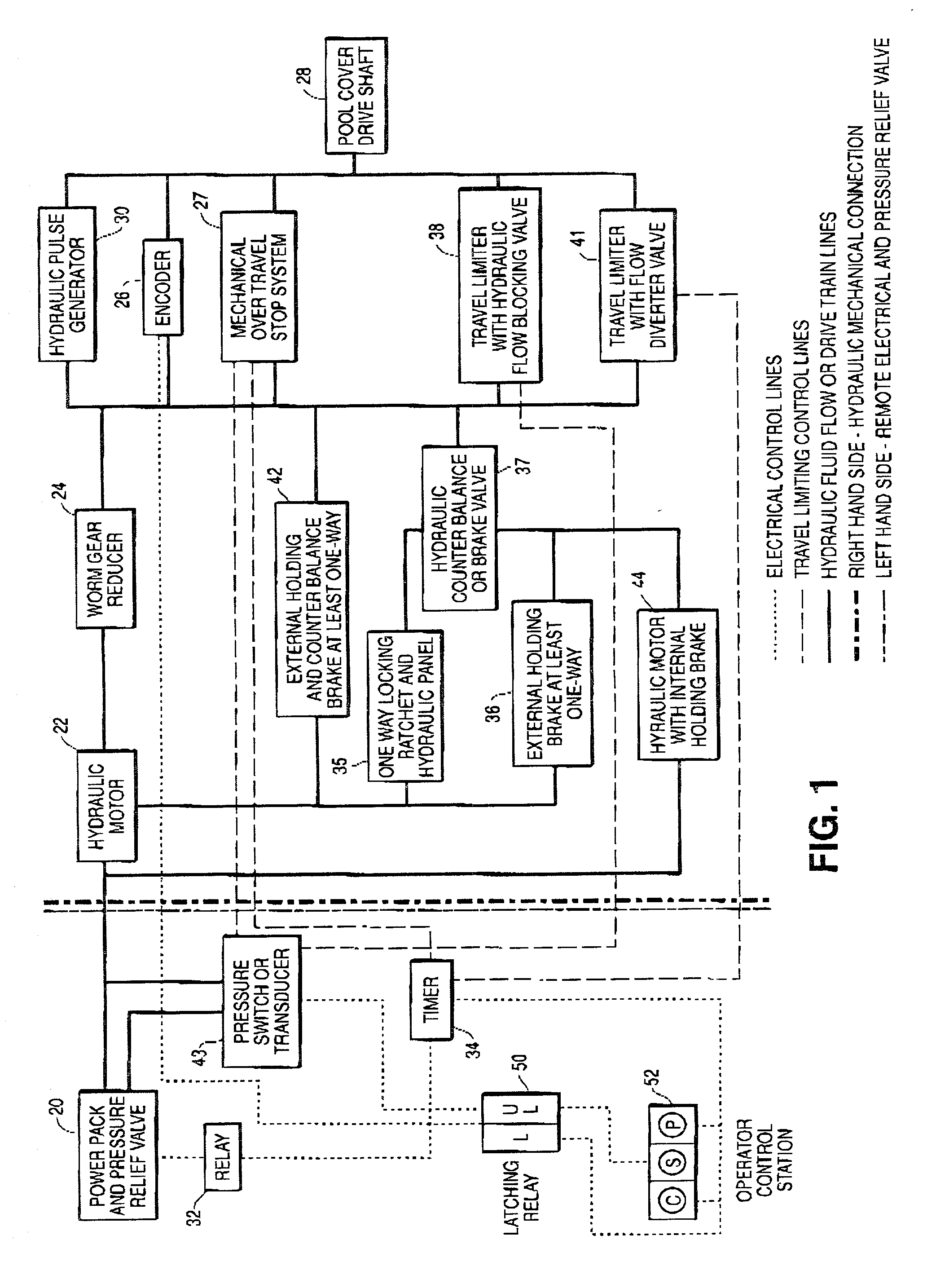
This would, in turn, cause cessation of the operation of the
hydraulic motor 22.


 Login to View More
  Login to View More