
Engraving sheet and method of engraving the same
- Summary
- Abstract
- Description
- Claims
- Application Information
AI Technical Summary
Benefits of technology
Problems solved by technology
Method used
Image

Examples
example 2
[0025] An undercoat paint (Acronal YJ2721D, Tradename of Mitsubishi Yuka Badische Co., Ltd.) was applied on an electron-beam cross-linked, biaxially oriented high-density polypropylene support layer having a thickness of 60 .mu.m, to a thickness of 1 g / m.sup.2 at dry weight, and a paint containing the following compositions was then applied on the undercoat paint, thereby forming an engraving layer.
1 Acrylic based emulsion 50 weight % (Acronal S-886S, Tradename of Mitsubishi Yuka Badische Co., Ltd.) Calcium carbonate 90 weight % Titanium white 10 weight % Dispersant 0.3 weight % Anti-foaming agent 0.1 weight % Mildew-proofing agent 0.2 weight % Ultraviolet absorber 0.3 weight %
[0026] The thickness of the engraving layer subsequent to a drying operation was 17 .mu.m. A basic pattern was printed in the area other than an engraved region and a signature region. The positive image and the negative image under the presence of the reflected light were obtained, resulting in an engraved im...
example 3
[0027] The thickness of the biaxially oriented high-density polypropylene sheet was varied to vary opacity of an engraving sheet having the same engraving layer as that of Example 2, as listed in Table 1. A card printing machine as an engraving device was used to engrave the same image, and resulting engraved sheets were compared to each other.
2 TABLE 1 SUPPORT LAYER ENGRAVING LAYER OPACITY TEST THICKNESS OPACITY THICKNESS OPACITY SHARP- DIFFER-No. .mu.m % .mu.m % NESS ENCE % 1 40 15 17 55 .largecircle. 40 2 45 18 17 55 .largecircle. 37 3 55 20 17 55 .largecircle. 35 4 60 25 17 55 .DELTA. 30 5 65 27 17 55 .DELTA. 28 6 70 30 17 55 .DELTA. 25 7 75 33 17 55 .DELTA. 22 8 80 35 17 55 .DELTA. 20 9 85 38 17 55 X 17 10 90 42 17 55 X 13 11 100 50 17 55 X 5 Notes .largecircle.: HIGH .DELTA.: MIDDLE X: LOW
[0028] As seen from Table 1, at the middle sharpness at which the opacity difference ranges from 20% to 30%, the reflected light image is slightly less sharp, but the resulting engraved image...
example 4
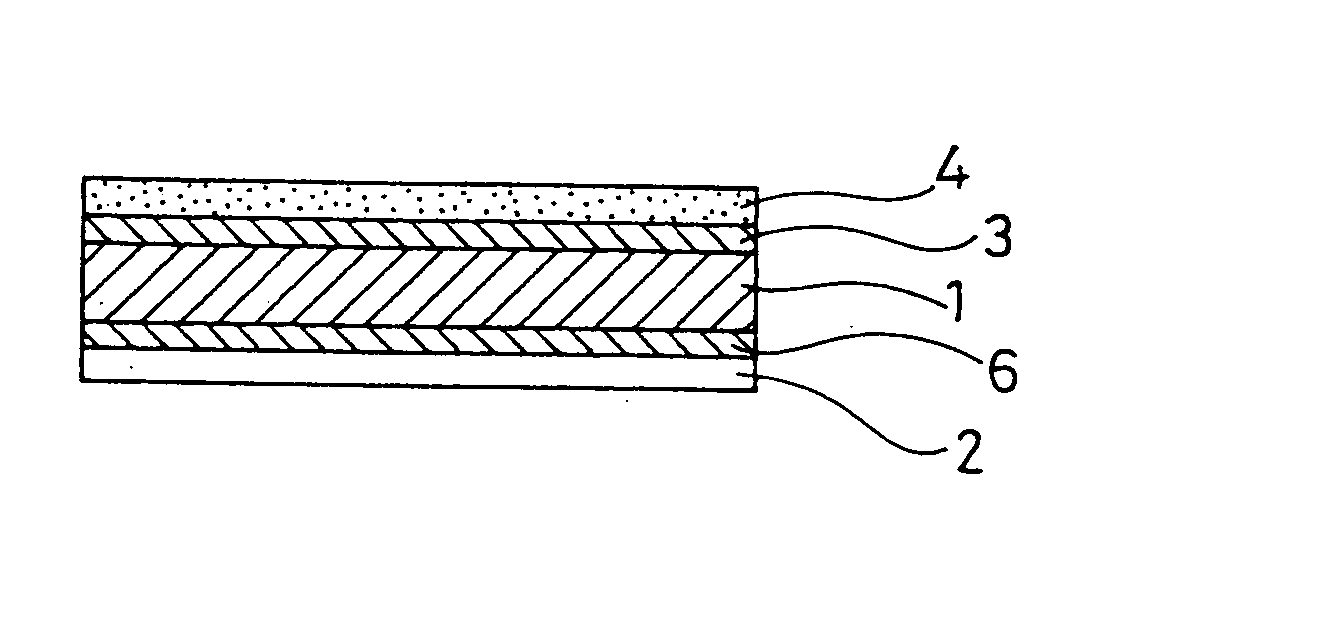
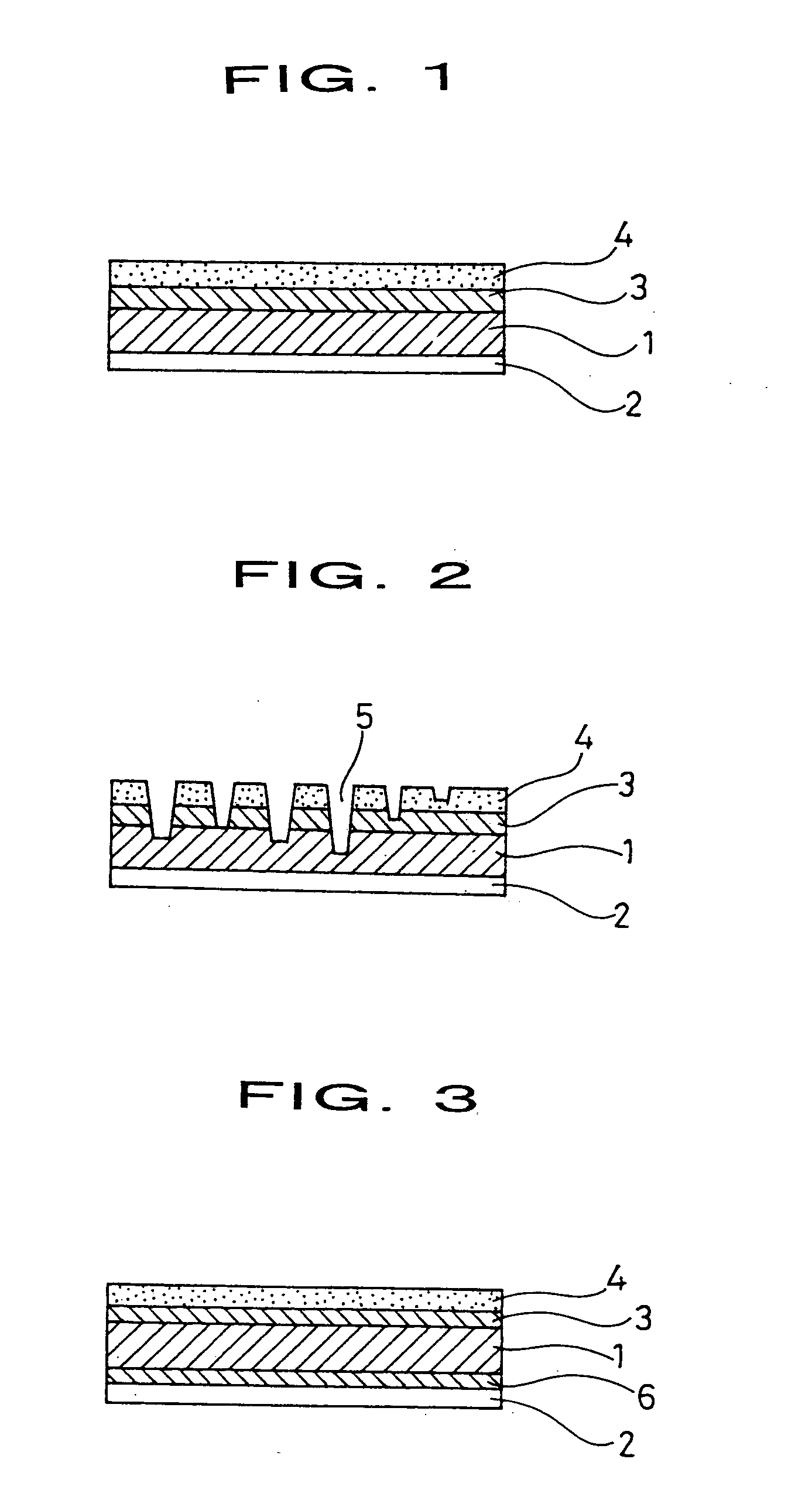
[0029] Referring to FIG. 1, a liner layer 2 was attached on the back side of the support layer 1 fabricated of the biaxially oriented high-density polypropylene sheet as thick as 60 .mu.m. An undercoat layer 3 is arranged on the support layer 1 by applying a white offset ink, and an engraving layer 4 was then deposited on the undercoat layer 3. The engraving sheet thus resulted. Referring to FIG. 2, by engraving the engraving sheet so deeply that a reversed picture signal becomes close to a black level, the engraved image becomes a positive image under the presence of the reflected light. The engraved image becomes a negative image under the presence of the transmitted light entering from behind. Referring to FIG. 3, a basic pattern printing layer 6 may be deposited beneath the support layer 1 using a white offset ink.
PUM
| Property | Measurement | Unit |
|---|---|---|
| Fraction | aaaaa | aaaaa |
| Fraction | aaaaa | aaaaa |
| Fraction | aaaaa | aaaaa |
Abstract
Description
Claims
Application Information
 Login to View More