
Novel methods and compositions for the treatment or prevention of dysmenorrhoea and menstrual side effects: the use of phospholipase inhibitors
- Summary
- Abstract
- Description
- Claims
- Application Information
AI Technical Summary
Benefits of technology
Problems solved by technology
Method used
Image

Examples
example 1
[0064] Known sPLA.sub.2 Inhibitors
[0065] There are several published X-ray crystal structures of human sPLA.sub.2 enzyme (type IIa) complexed with an inhibitor. Examples of such inhibitors include compounds 1-7 presented in FIG. 2. Each of compounds 1-7 bind the enzyme within the same hydrophobic cavity defined by enzyme residues Cys27, Tyr22, Ala18, Ile9, His6, Phe5, Phe24, Gly23, Val31, Leu2, Tyr52 and Cys44. Each inhibitor is coordinated to the active site calcium ion via two oxygen atoms. Compound 2 is an example of a substrate analogue having a phosphonate in place of the cleavable ester in the substrate. It possesses the same components as the substrate but no cleavable bond, and the phosphorous atom is a "transition state analogue" since it mimics the tetrahedral carbon formed during ester hydrolysis. Inhibitors 1-4 (Thunnissen, 1990 MM., et al. 1990, Nature 347(6294): 689-91; Scott, D. L. et al, 1991, Science, 254: 1007-110; Oh,B.-H., 1995, Acta Cryst, D51: 140-144; Pisabarr...
example 2
[0068] Inhibitors of Human sPLA.sub.2 are Inhibitors of Uterine Contractions
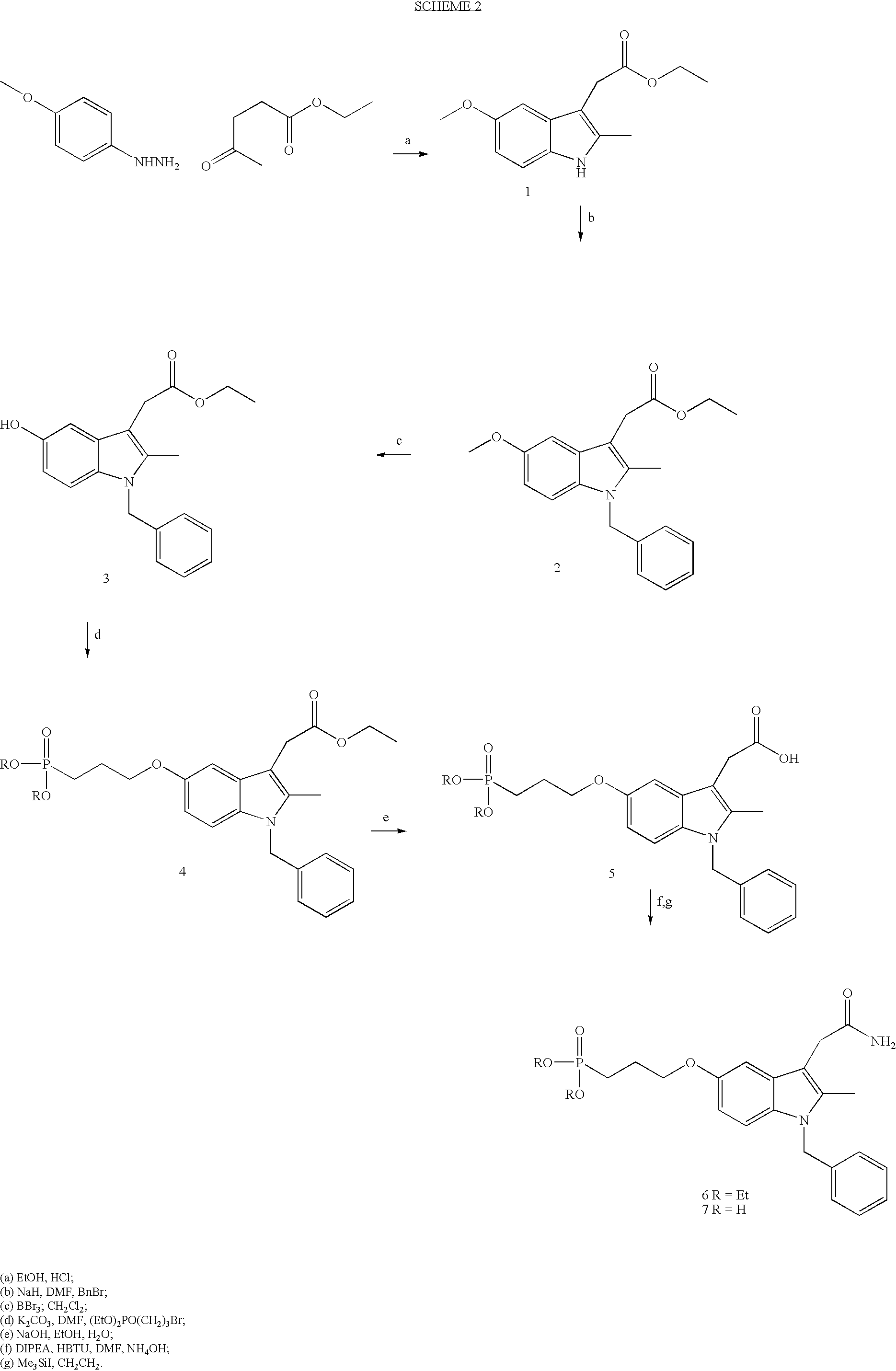
[0069] The present inventors have synthesised and tested compounds 5 and 9. Since many of the previously reported inhibitors of sPLA.sub.2 are now known not to inhibit human non-pancreatic secretory PLA.sub.2 (Balsinde J. et al, 1999, Annu Rev Pharmacol Toxicol, 39: 175-89), they first tested compounds 5 and 9 for their ability to inhibit human sPLA.sub.2 (type IIa) before testing them as inhibitors of rat uterine contractions. Compound 5 has been reported previously (Cha et al, 1996, J. Med. Chem., 39: 3878-81) as an inhibitor of human non-pancreatic sPLA.sub.2 (type IIa). Compound 9 is a derivative of compound 7, a known inhibitor (Schevitz, R. W. et al, 1995, Nature Structure Biology, 2(6): 458-465) of a human non-pancreatic sPLA.sub.2 (type IIa). Compound 9 contains the same indole ring as 7 and was recently reported (Chen, Y. et al, 1998, Biochim. Biophys Acta, 1394: 57-64) to inhibit type V human non-p...
example 3
[0079] Synthesis of Compound 5
[0080] (S)-5-(4-Benzyl-phenylsulfanyl)-4-(7-phenyl-heptanoylamino)-pentano-ic acid (5)
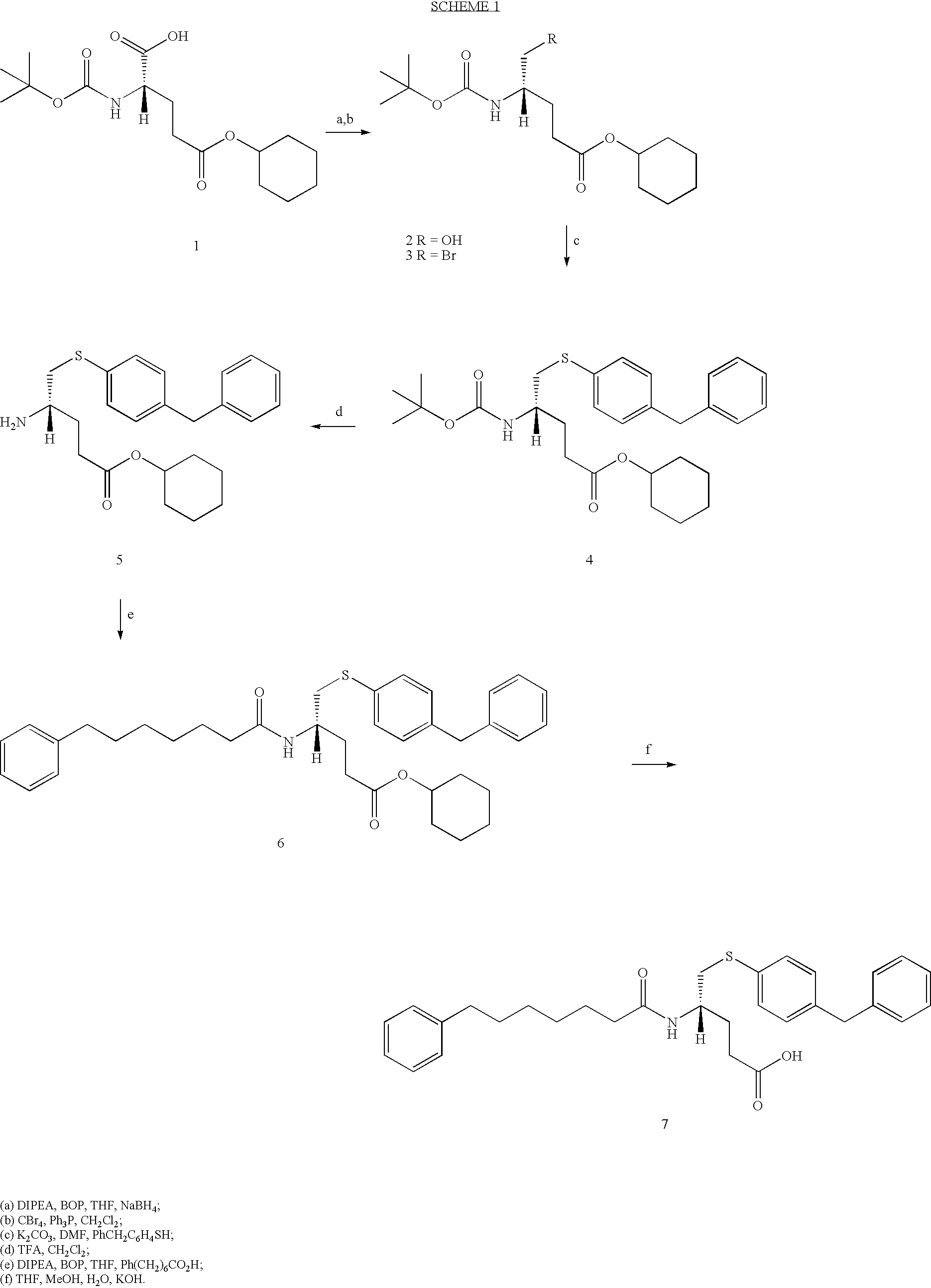
[0081] The synthesis of (5) is shown in Scheme 1. Commercially available 2-tert-butoxycarbonylamino-pentanedioic acid 5-cyclohexyl ester (10) was chosen as the starting material in the synthesis of (7). In contrast Dennis et al utilised the methyl ester. (Cha, S. S. et al, 1996, J. Med. Chem., 39: 3878-81) However the chemical transformations used in both syntheses are similar. 1
[0082] Reduction of (10) to the alcohol (11) was carried out via activation of (10) as the BOP ester and reduction with NaBH.sub.4 in THF.(Ref) The alcohol was transformed into the bromide (12) via standard conditions using Ph.sub.3P and CBr.sub.4 in CH.sub.2Cl.sub.2 in 47% yield. This contrasts with the method used by Dennis et al involving N,N'-dicyclohexylcarbodiimide methiodide which was unsuccessful in our hands.
[0083] Compound (12) was coupled with 4-benzyl-benzenethiol with K.sub.2CO.sub...
PUM
| Property | Measurement | Unit |
|---|---|---|
| Molar density | aaaaa | aaaaa |
| Molar density | aaaaa | aaaaa |
| Molar density | aaaaa | aaaaa |
Abstract
Description
Claims
Application Information
 Login to View More