

Porous microsphere resonators
a microsphere and resonator technology, applied in the field of optical devices, can solve problems such as lowering detection limits, and achieve the effect of increasing material amount and increasing optical interaction
- Summary
- Abstract
- Description
- Claims
- Application Information
AI Technical Summary
Benefits of technology
Problems solved by technology
Method used
Image

Examples
example 1
A sol-gel approach is used in which pore forming agents such as surfactants are included for forming a porous layer over a core. This permits control of the pore sizes that can provide some size discrimination, for example, unimodal pores with a diameter in the range of about 2 to about 50 nm diameter, with diameter control <10%. When Stober spheres are used, the diameter range is from about 2 nm to 1000 nm or more.
A simple system involves combining tetraethoxysilane, nonionic surfactant, acid, water, and ethanol to form a coating solution. This solution can be applied to the core spheres by dipping or spraying. The surfactant can be removed if desired by liquid extraction or heating. The walls of the pores can be functionalized via silane coupling agents.
example 2
Surfactant-templated silica films were dip-coated onto microsphere resonators and onto silicon substrates. The resonators and the silicon substrates were calcined at 400° C. for 15 minutes to remove the surfactant and leave nanometer diameter unimodal pores. Porosities of the films range from ˜25 to ˜50 volume percent, and refractive indices range from 1.21-1.34.
In this example, there are, by design, two sets of four samples (eight conditions). One set has film thicknesses that range from 40-55 nm; the second set has film thicknesses that range from 230-280 nm. Silica concentration in the coating solution is the key factor used to control thickness. Each set of four samples has two samples with small (˜3 nm) and two samples with large (˜10 nm) pore diameters. Surfactant formula weight is used to control pore diameter. Note that the pore diameters in both sets are much smaller than the wavelength of the probe light (>400 nm). It is anticipated that these porous coatin...
example 3
Experimental Results Using Porous Microresonators
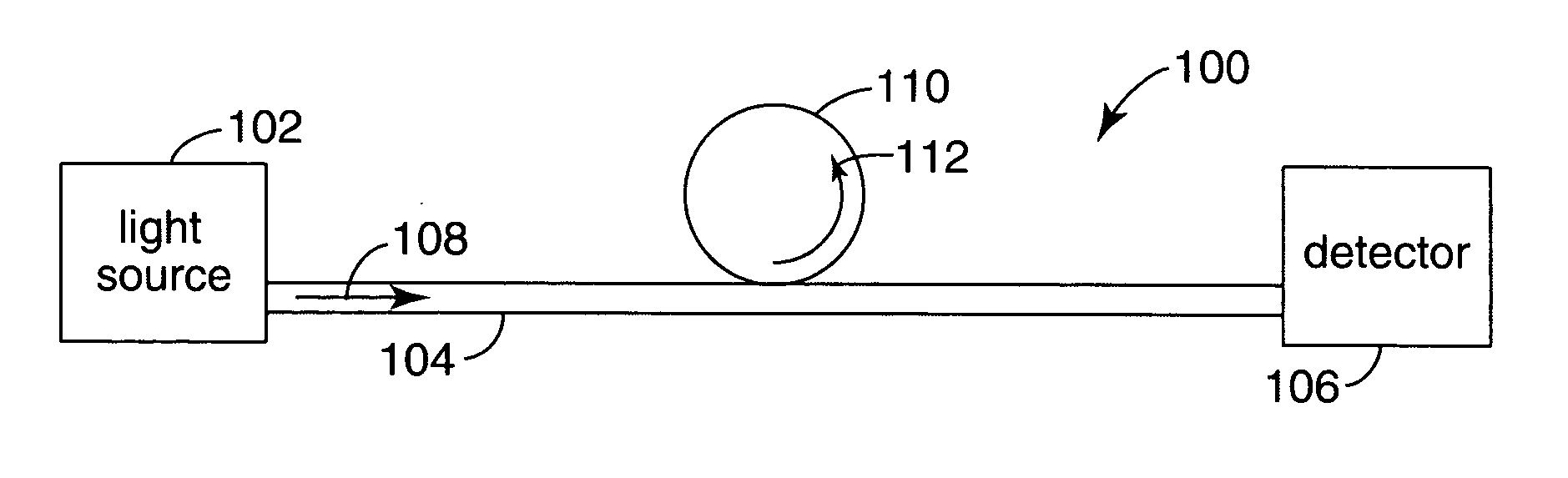
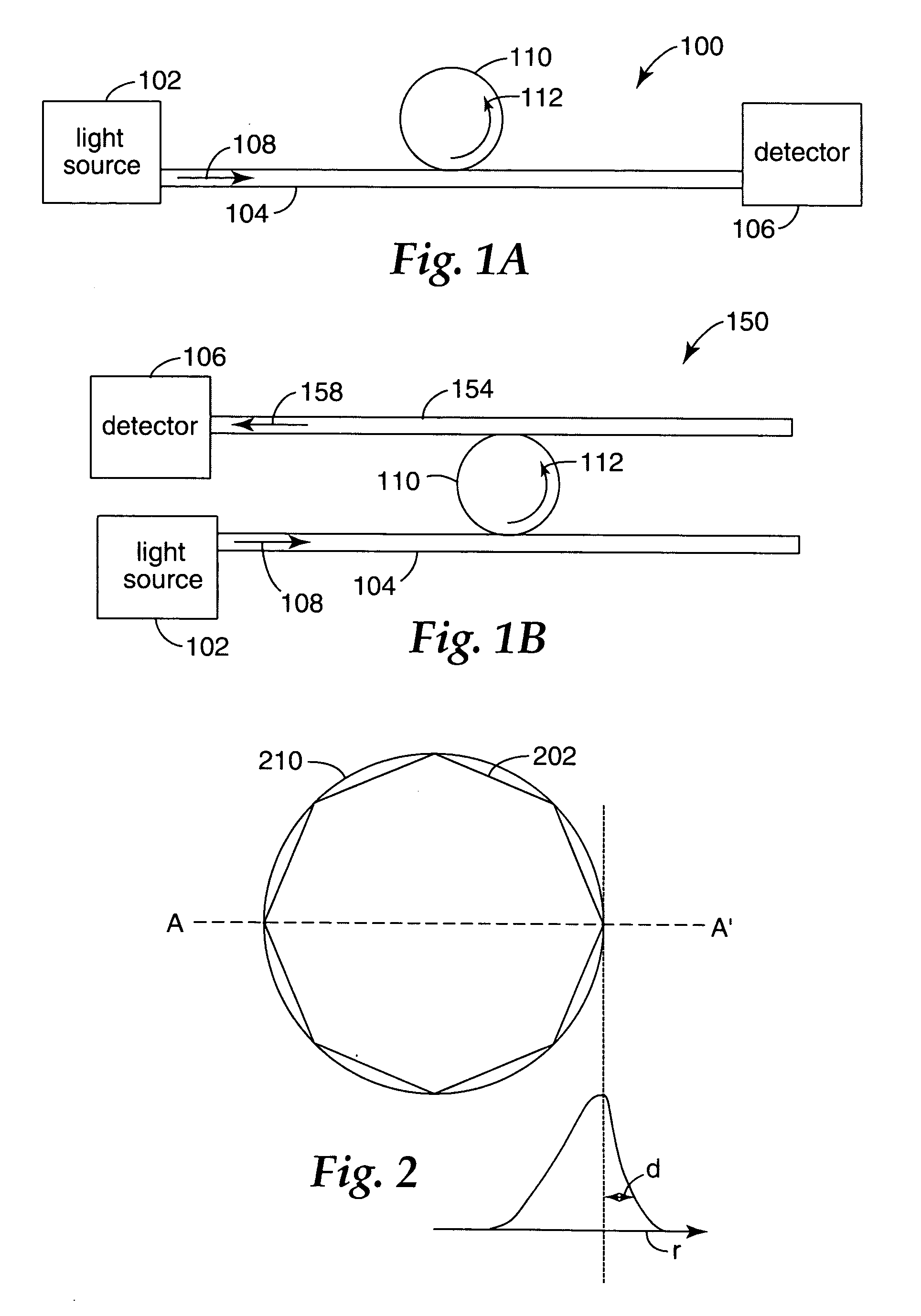
Experiments were carried out to determine the effective Q-factors of microresonators fabricated according to the procedure outlined in Example 2. The experimental arrangement was similar to that shown in FIG. 1A. In each experiment, a fiber 108 was placed in contact with the microresonator 110 and both were immersed in water. A tunable diode laser (Velocity 6304 from New Focus) was used as light source 102 with the wavelength centered at around 630 nm. The wavelength of the light emitted by the laser was tuned by varying the voltage that drives a piezo-actuator inside the laser. When the wavelength was on-resonance with one or more of the whispering gallery modes 112 of the microresonator, the amount of laser power coupled into the microresonator was increased, leading to a power drop at the detector 106.
FIG. 7 shows the detected signal at the detector as a function of laser tuning, where the microresonator was formed according to ...
PUM
| Property | Measurement | Unit |
|---|---|---|
| porosity | aaaaa | aaaaa |
| size | aaaaa | aaaaa |
| size | aaaaa | aaaaa |
Abstract
Description
Claims
Application Information
 Login to View More