[0017] The purpose of the present invention is to provide an improved emergency vehicle
traffic signal preemption system including autonomous operation, real-time phase monitoring and visual / audio signals to alert motorists and pedestrians of the approach of emergency vehicles.
[0024] It also calculates when to trigger the
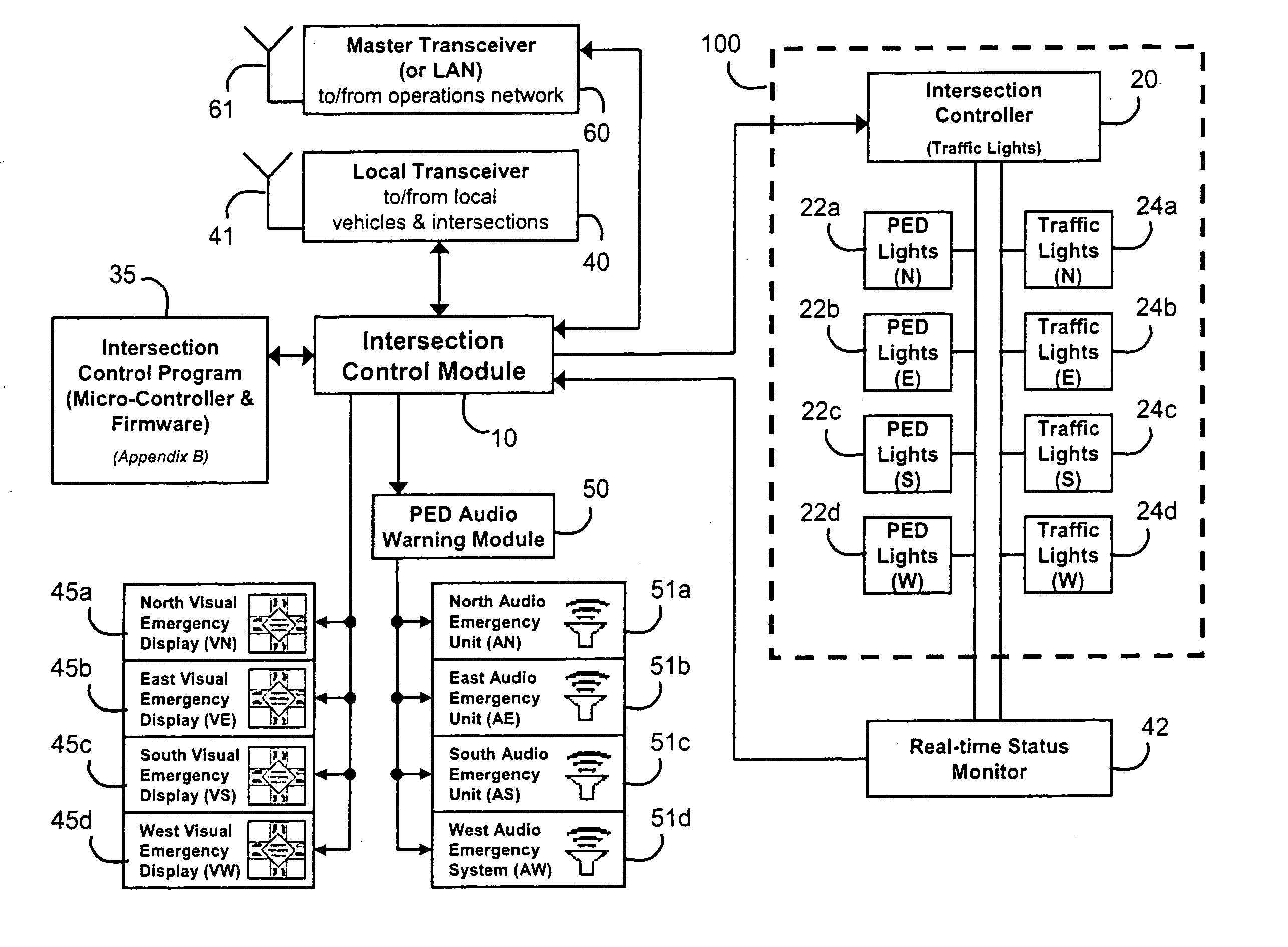
pedestrian-inhibit function to prevent clearance for crossing access. When preemption starts, intersection-based warning displays are sent coded commands via a
wireless or hard-line connection to light the proper icons. For each direction, the displays show all preempting emergency vehicles' direction and location, and light the appropriate emergency vehicle message (i.e. “Warning
Emergency Vehicle”). All this takes place in real time, in a manner appropriate to insure an intersection is preempted early enough for safe and clear access, and in such a way as to minimized
speed reduction for the emergency vehicles.
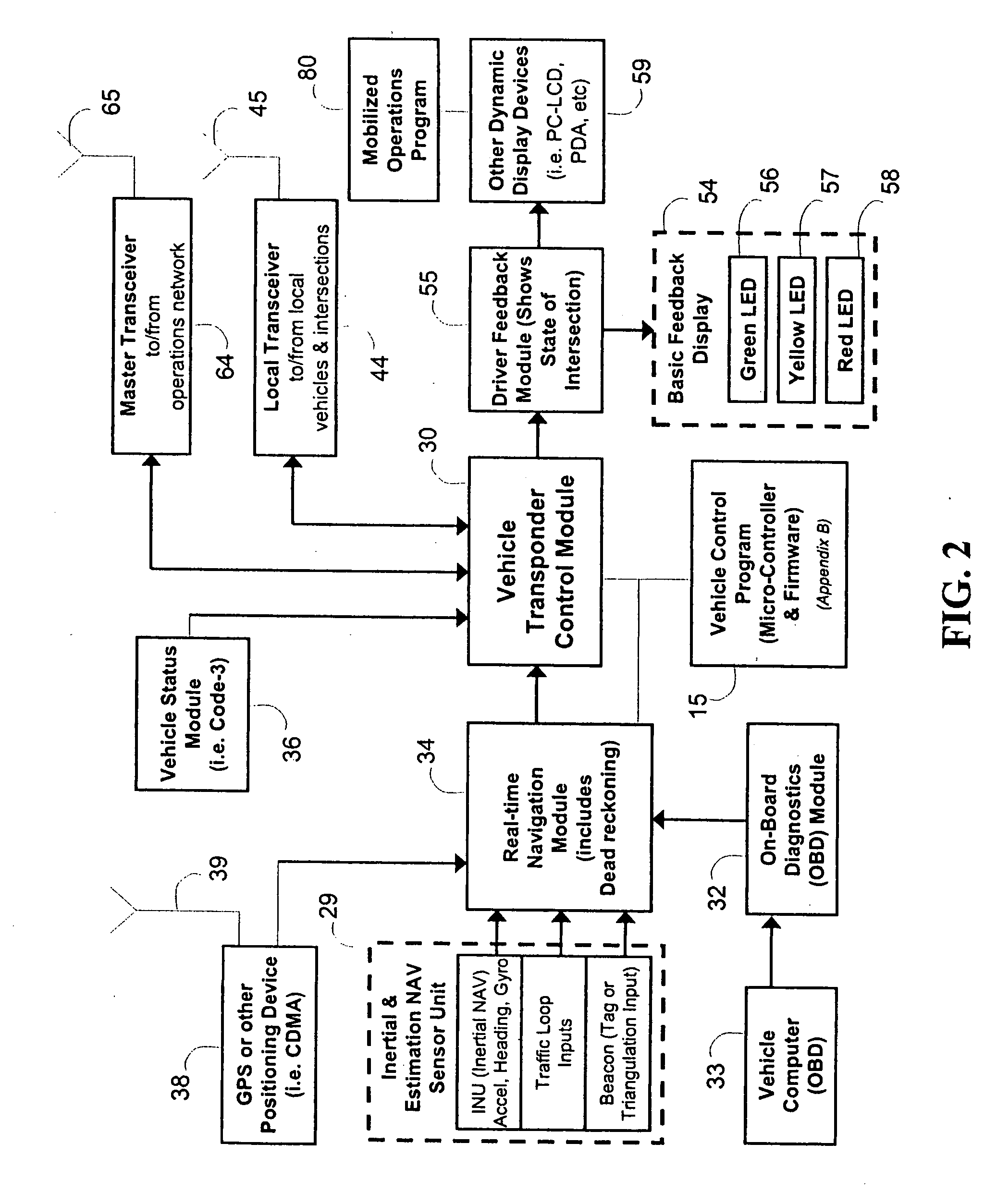
[0025] The system disclosed herein provides a number of improvements of the above-identified patent. It is an autonomous system that does not need involvement of emergency vehicle operator. It also includes expanded system capabilities using emergency vehicle on-board diagnostics (OBD), monitoring multiple emergency vehicles approaching the same intersection using
Global Positioning System (GPS), and speed and heading information for multiple emergency vehicles to determine the right of way. An intersection status is transmitted to emergency vehicle dashboards indicating when the intersection is safe to
traverse. A
dashboard display indicates to the vehicle operator the status of an intersection. The system is also capable of providing dynamic and customized displays via an interface to the vehicle-based PC (
personal computer) systems. This interface provides detailed, real-time positioning and status of all neighboring emergency vehicles and intersections. It allows e-operators to view maps with active vehicles and also allows for enhanced conflict detection notification. The system also includes a
wide area wireless RF communication links between emergency vehicles and intersections. This system is reliable and unaffected by weather, rain, or lack of
line of sight.
[0029] The system transmits a
signal causing all traffic lights at an intersection to switch to “red” thus stopping all traffic in all directions. In addition, the display panels flash a relatively large “emergency vehicle” therein with a graphic display indicating the lane and direction of traffic taken by an emergency vehicle. The range of the
infrared transmitter can be as much as 1,000 feet allowing
sufficient time to clear the intersection. The new improved system utilizes a
wide area wireless RF two-way
communication link between emergency vehicles and intersections. This method is more reliable and not affected by weather, lack of
line of sight, range limitation or obstructions.
[0030] Another
advantage of the two-way wireless RF communications link between the intersections and emergency vehicles is the ability to display much more useful data in the vehicles helping the vehicle operator maneuver his vehicle most efficiently and safely. This data includes (but is not limited to) emergency-code levels,
vehicle acceleration,
vehicle type, and vehicle health. This method also enables feedback communication to be sent from the intersections to the vehicles, providing vehicle-based warnings (or confirmation) of system activity. Intersection “green” status shows when an intersection has been preempted and priority is given to the receiving vehicle, allowing safe passage. If more than one emergency vehicle approaches an intersection, the system determines which vehicle should have the right of way depending on location information (GPS, traffic loop,
beacon, etc.), direction and speed sent to the intersection control. A proprietary control program determines the right of way and sends the result to emergency vehicles. The encrypted data
package transmitted over transceivers is tagged with the vehicle ID and time to insure proper and certified utilization.
[0032] Another goal of the improved system is creation of an autonomous system that is activated by reception of a priority-code (i.e. Code-3) status or alarm. The operator of the emergency vehicle can concentrate on his primary duty which is to arrive at the
sight of the emergency safely in the shortest time possible without worrying about the activation of the system. A priority-code starts the process of communication between an intersection that is being approached and the emergency vehicle and the system performs the functions described above. Also, both vehicle-based warnings and intersection-based warnings provide
positive feedback that an e-operator has secured an intersection. This directly translates into a reduction of emergency workers' stress levels.


 Login to View More
  Login to View More