
IGBT module
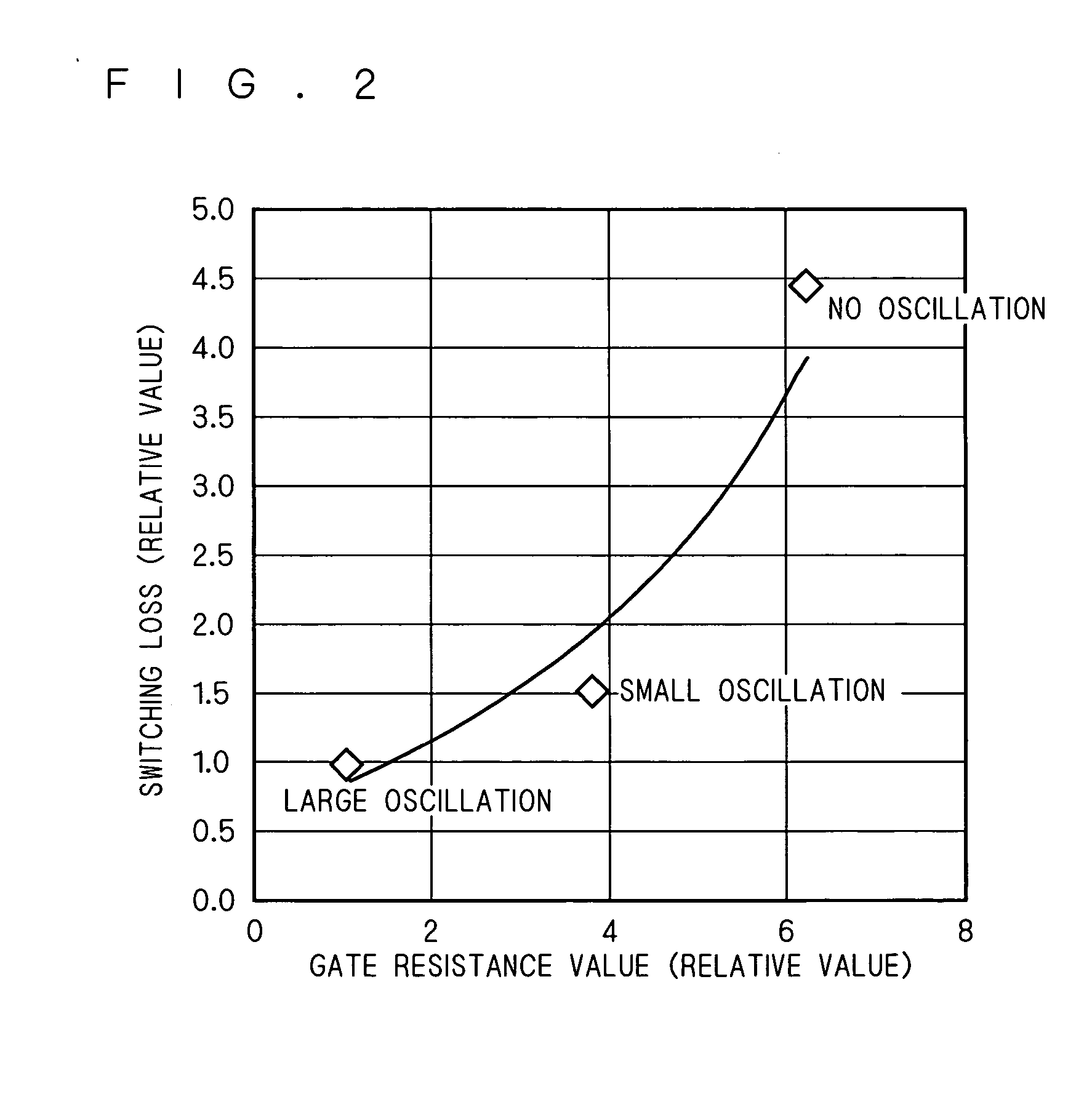
a technology of insulated gate bipolar transistor and module, which is applied in the direction of electrical apparatus, semiconductor devices, semiconductor/solid-state device details, etc., can solve the problems of gate voltage oscillation problem, short-circuit current disadvantageously increase, and igbt performance degradation, etc., to achieve significant increase in switching loss and suppress gate voltage oscillation
- Summary
- Abstract
- Description
- Claims
- Application Information
AI Technical Summary
Benefits of technology
Problems solved by technology
Method used
Image

Examples
first preferred embodiment
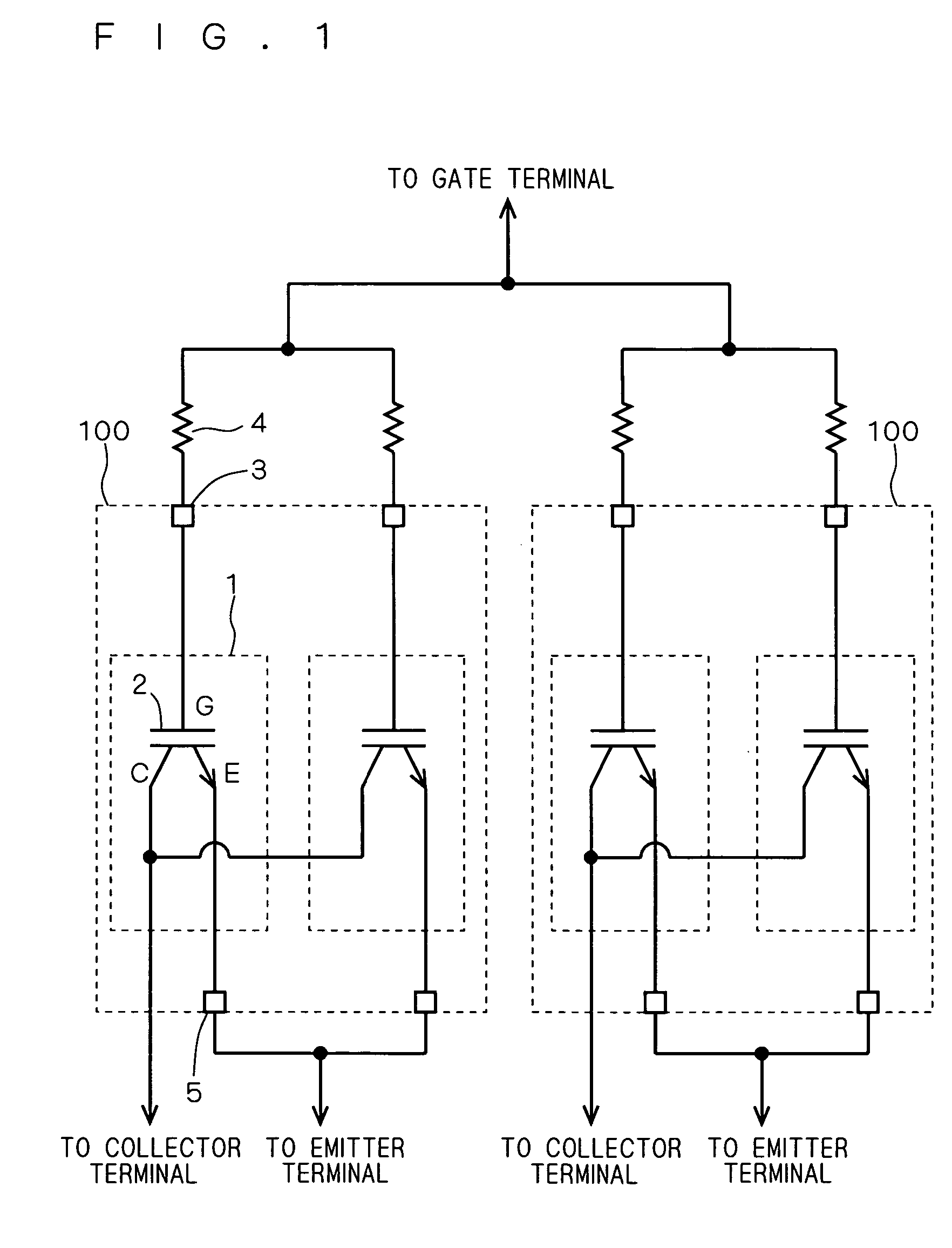
[0018]FIG. 1 is an equivalent circuit diagram of an IGBT module according to the present embodiment.
[0019] This IGBT module is configured with a plurality of IGBT chips (semiconductor chips) 100 (two IGBT chips 100 in FIG. 1) connected to each other. The IGBT chips 100 are each configured with a plurality of unit cells 1 (two unit cells 1 in FIG. 1) connected to each other.
[0020] The unit cells 1 each include one IGBT element 2. Gate voltage is applied to the gate G of the IGBT element 2 from a common gate terminal through a gate pad 3 and a gate resistor 4. Here, the gate G and gate pad 3 are connected to each other by an interconnect layer (not shown) within the IGBT chip 100. The gate pad 3 and gate resistor 4 are connected to each other by a bonding wire (not shown) provided outside the IGBT chip 100. That is, in FIG. 1, the resistor 4 has its first end connected to the gate pad 3 and its second end connected to the gate terminal.
[0021] Emitter voltage is applied to the emitt...
second preferred embodiment
[0029] In the IGBT module according to the first preferred embodiment, the gate resistor 4 is provided on the outer side with respect to the gate pad 3 (that is, outside the IGBT chip 100), however, the gate resistor 4 may be provided on the inner side with respect to the gate pad 3 (that is, within the IGBT chip 100).
[0030]FIG. 4 is an equivalent circuit diagram showing the configuration of an IGBT module according to a second preferred embodiment of the present invention. An IGBT chip 200 shown in FIG. 4 is configured by shifting the gate resistor 4 in the IGBT chip 100 shown in FIG. 1 from the outer side to the inner side with respect to the gate pad 3. For ease of illustration, FIG. 4 only shows one of a plurality of IGBT chips 200.
[0031] In FIG. 1, the gate resistor 4 is connected to the outer side with respect to the gate pad 3 by a bonding wire.
[0032] On the other hand, in FIG. 4, the gate resistor 4 is provided on the inner side with respect to the gate pad 3 (i.e., withi...
third preferred embodiment
[0041] In both the IGBT modules according to the first and second preferred embodiments, one gate pad 3 is provided for each gate resistor 4. In the IGBT module according to the second preferred embodiment, however, the gate resistor 4 is provided within the IGBT chip 200, and therefore, one gate pad 3 may be provided for each IGBT chip 200.
[0042]FIG. 6 is an equivalent circuit diagram showing the configuration of an IGBT module according to a third preferred embodiment. An IGBT chip 300 shown in FIG. 6 is configured by replacing the gate pads 3 in the IGBT chip 200 shown in FIG. 4 by a single gate pad 3. Specifically, in FIG. 6, the plurality of gate resistors 4 have their first ends connected to the gate G of a corresponding one of the IGBT elements 2 and their second ends connected to the gate pad 3 in common.
[0043] Therefore, the number of gate pads 3 can be reduced, which thus can reduce the IGBT chip 300 in area and can reduce the number of bonding wires connected to the gat...
PUM
 Login to View More
 Abstract
Description
Claims
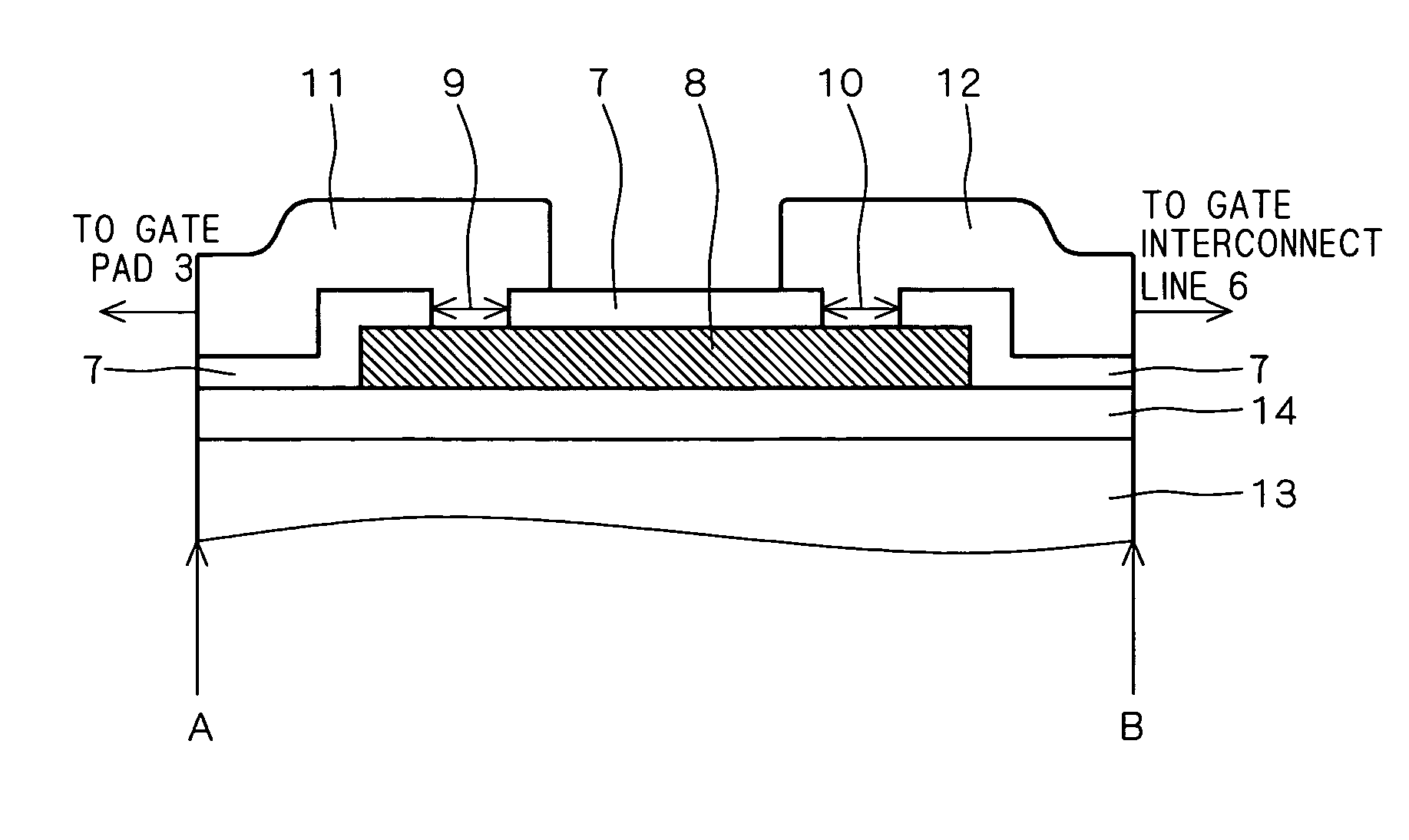
Application Information
 Login to View More