
Silica containing rubber composition
a technology of rubber composition and silica, which is applied in the direction of rolling resistance optimization, non-skid devices, transportation and packaging, etc., can solve the problems of high difficulty in dispersing silica, complex incorporation of silica and carbon black as reinforcing agents and/or fillers into rubbery elastomers, and high hydrophilic surface of silica, etc., to improve wet traction, improve snow/ice traction, and low rolling resistance
- Summary
- Abstract
- Description
- Claims
- Application Information
AI Technical Summary
Benefits of technology
Problems solved by technology
Method used
Image

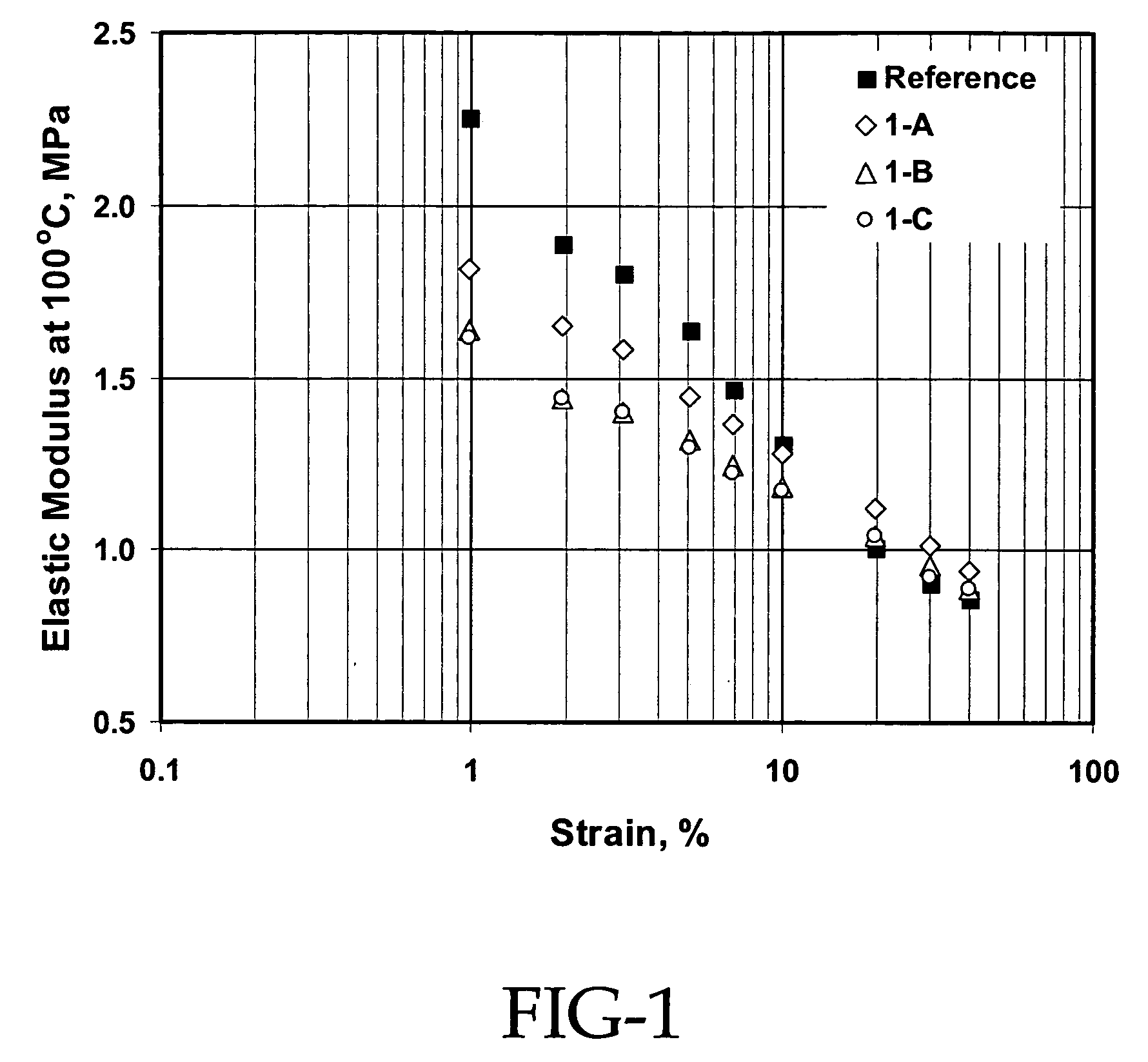
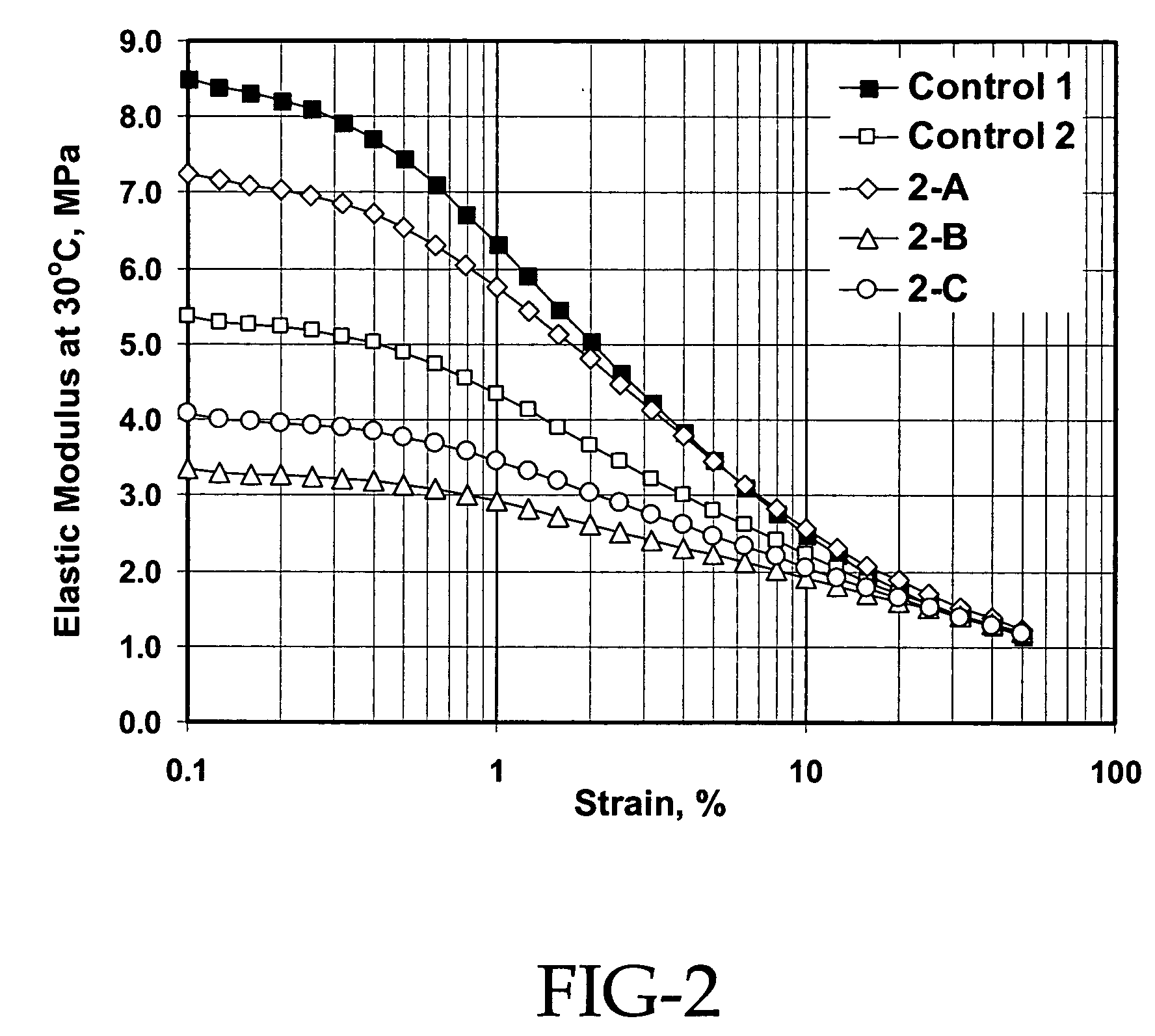
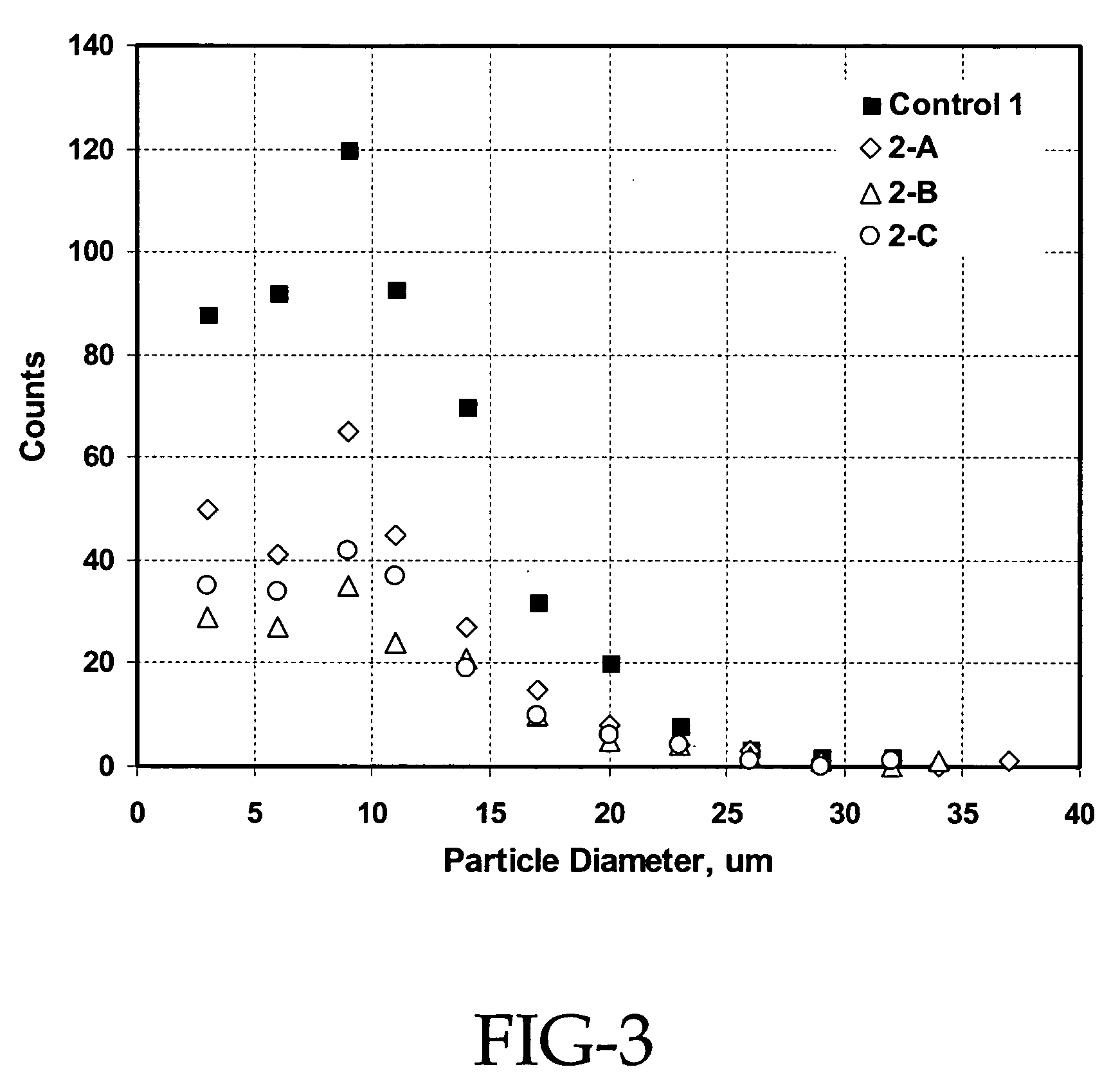
Examples
example 1
[0064] This example demonstrates the use of an organic solvent and mercaptosilane for preparing silica slurry and the introduction of mercaptosilane for enhanced compound performance. This example also illustrates the use of a combination of silica pellets and powder to create large silica masterbatch crumbs for excellent down stream operations.
[0065] In the procedure used, 520.16 g of hexane and 173.39 g of silica were charged into a 1-gallon reactor. The reactor was then heated. When the temperature of the hexane / silica slurry reaches 95° C.-100° C., silane coupling agents were introduced. After 1 hour of reaction, 1366.43 g of SLF 28×42 SBR cement in hexane (20.8% solid) was blended into the reactor while maintaining the temperature. The mixture was then steam stripped off the solvent and dewatered and dried through screens and the Rocket. Specifically, for Example 1-A, 100% of silica powder (Z1165P) and 13.73 g of Si266 were charged into the reactor. For Example 1-B, 100% of si...
example 2
[0074] This example demonstrates that using 100% silica pellets results in a dramatic increase in the crumb size and the elimination of fines that are critical for the down stream operations. This example also shows that very good silica dispersion is achieved and excellent compound properties obtained from the silica masterbatch approach even when 100% silica pellets are used for the preparation of the silica masterbatch.
[0075] In the procedure used, 3120 g of hexane and 1040 g of silica were charged into a 5-gallon reactor. The reactor was then heated. When the temperature of the hexane / silica slurry reached 95° C.-100° C., silane coupling agents were introduced. After 1 hour of reaction, 8196 g of SLF 28×42 SBR cement in hexane (20.8% solid) was blended into the reactor while maintaining the temperature. The mixture was then steam stripped off the solvent and dewatered and dried through screens and the Rocket.
[0076] Specifically, for Example 2-A, 100% of silica powder (Z1165P) ...
example 3
[0082] This example illustrates the use of a mercaptosilane with an ethoxyl functionality, rather than a methoxyl functionality as is used in Examples 1 and 2, for the preparation of the silica masterbatch. For the purpose of comparison, a compound containing a blocked silane coupling agent, NXT silane, was also mixed with a Banbury using a two-pass mixing procedure.
[0083] In the procedure used, 3040 g of hexane and 1014 g of silica were charged into a 5-gallon reactor. The reactor was then heated. When the temperature of the hexane / silica slurry reached 95° C.-100° C., silane coupling agents were introduced. After 1 hour of reaction, 8320 g of SLF 28×42 SBR cement in hexane (20.8% solid) was blended into the reactor while maintaining the temperature. The mixture was then steam stripped off the solvent and dewatered and dried through screens and the Rocket.
[0084] For Example 3-A, 50% Z1165 MP and 50% Z1165P with A1891 / Si266 (70.95 g of Si266 and 10.14 g of A1891) were charged into...
PUM
| Property | Measurement | Unit |
|---|---|---|
| glass transition temperature | aaaaa | aaaaa |
| particle size | aaaaa | aaaaa |
| particle size | aaaaa | aaaaa |
Abstract
Description
Claims
Application Information
 Login to View More