[0010] Therefore, the present invention has been made in view of the above-mentioned problems. We have found that when a carbonaceous material coated with a
metal and / or
metalloid compound by a conventional coating process is surface-treated under high-temperature /
inert atmosphere, a stable
carbide coating layer having minimized reactivity to lithium is formed on the surface of the carbonaceous material, thereby minimizing the initial irreversible capacity of an anode.
[0011] Therefore, it is an object of the present invention to provide an anode active material with improved electrochemical properties as described above and a method for preparing the same.
[0017] The anode active material according to the present invention can provide a battery with high capacity as well as high efficiency by virtue of the above-described characteristics. Such preferred effects of the present invention will be explained in detail hereinafter.
[0018] (1) In general, when a carbonaceous material is used as anode active material in a lithium secondary battery, there are problems in that
side reaction of the anode active material with an
electrolyte results in low charge capacity and that irreversible capacity is generated during the first charge /
discharge cycle, followed by degradation in cycle life characteristics. However, according to the present invention, it is possible to minimize the initial irreversible capacity of an anode by forming a coating layer of a stable compound obtained from an inorganic substance with carbon (for example, a stable metal- / metalloid-
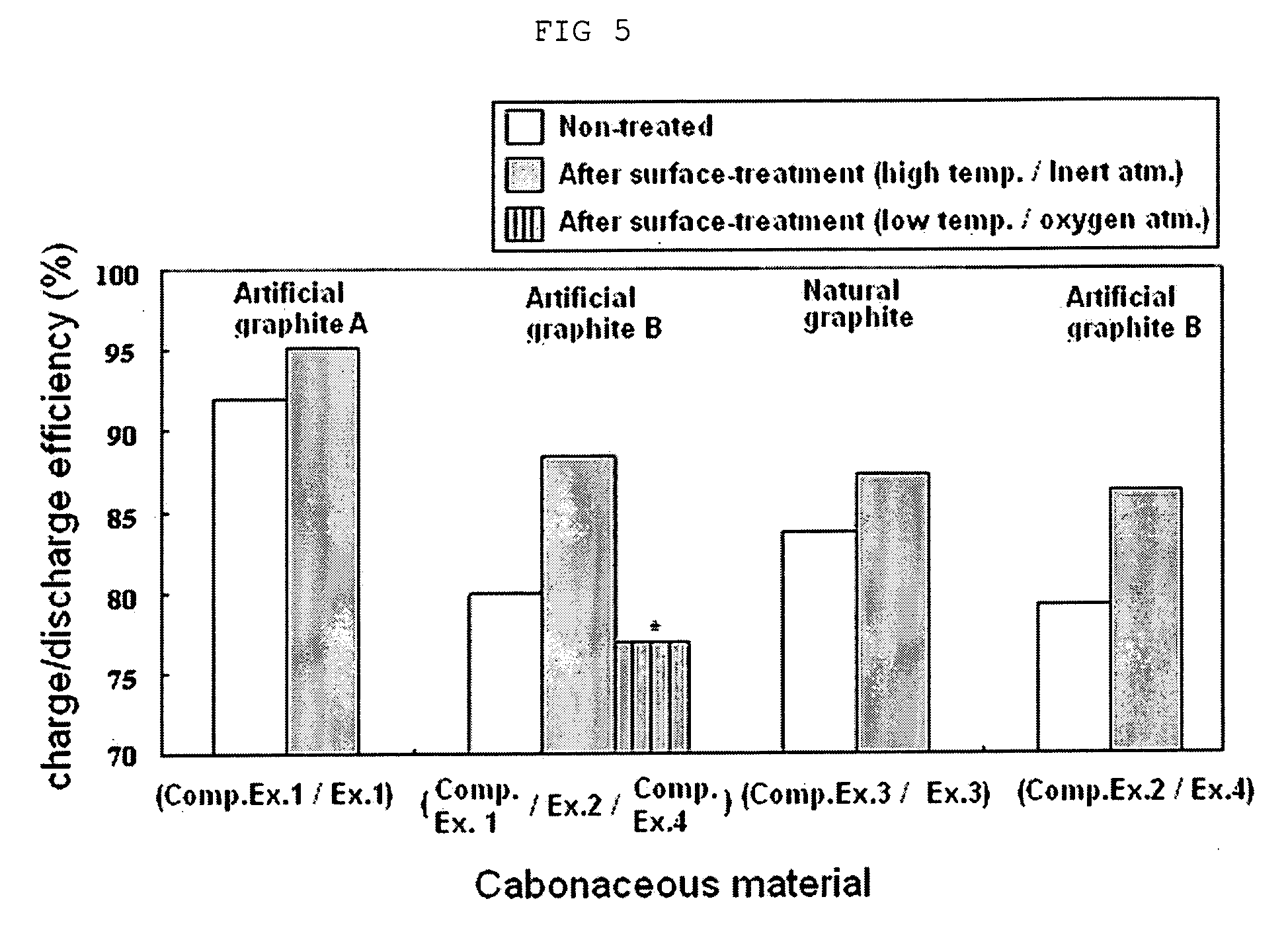
carbon coating layer having minimized reactivity to lithium), on the surface of carbonaceous material. In other words, it is possible to realize high capacity and high efficiency of a battery by minimizing the amount of reversible lithium needed for the formation of an SEI film on the surface of anode. In practice, after observing the charge /
discharge efficiency of a battery using, as anode active material, the carbonaceous material coated with the metal-
carbide coating layer according to the present invention, it can be seen that the anode active material according to the present invention provides an increase in charge /
discharge efficiency by about 3% to 10% or more (see, FIG. 5).
[0019] (2) Additionally, because the carbonaceous material surface-treated with metal- / metalloid-carbide has a polarity higher than that of a conventional carbonaceous material, it is possible to provide excellent
wetting effect when using an
carbonate-based electrolyte formed of a polar
solvent. Therefore, lithium ions can pass rapidly through the electrolyte, thereby improving rate characteristics of a battery.
[0038] The process of converting a metal- / metalloid-
oxide into a metal- / metalloid-carbide results from a
chemical reaction specific to each metal and can be seen from the
phase diagram of each metal element. For example, Co maintains its
oxide state at a temperature of up to 400° C. under reductive
atmosphere because
cobalt oxide is not decomposed or broken at the same temperature. However, at an elevated temperature of 400° C. or higher, Co is reduced by the reaction of the surrounding carbon, thereby forming a metal-carbide composite maintaining the form of Co-carbide. Additionally, Si maintains a metal oxide state at a temperature of up to about 1400° C. under reductive atmosphere in the presence of carbon. However, at an elevated temperature of 1400° C. or higher, Si is bonded with carbon and thus maintains a metal (metalloid)-carbide form. Because such metal (metalloid)-carbides generated by heat treatment are electrochemically inactive to Li, they can minimize the irreversible amount of lithium needed for the formation of an SEI film during the first
charge cycle and thus can realize high capacity and high efficiency of a battery.


 Login to View More
  Login to View More