

Method for making ceramic work piece and cermet work piece
- Summary
- Abstract
- Description
- Claims
- Application Information
AI Technical Summary
Benefits of technology
Problems solved by technology
Method used
Image

Examples
Embodiment Construction
[0038] Reference will now be made in detail to the preferred embodiments of the present invention, examples of which are illustrated in the accompanying drawings. Wherever possible, the same reference numbers used in the drawings and the description refer to the same or similar parts.
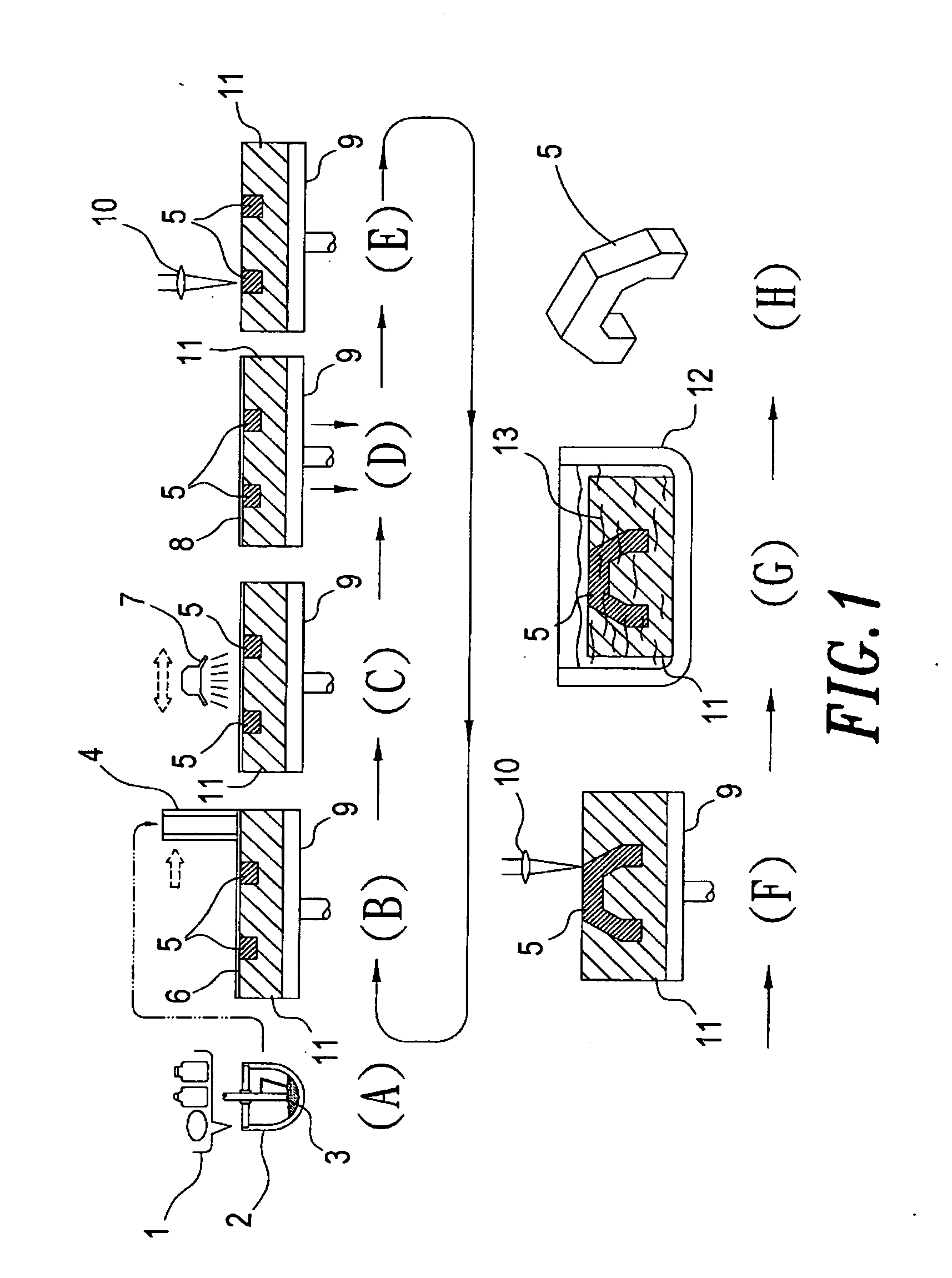
[0039] Referring to FIGS. 1(A) to 1(H), the present invention provides a process of making ceramic and cermet work piece. Following two embodiments are given respectively for ceramic work piece and cermet work piece:
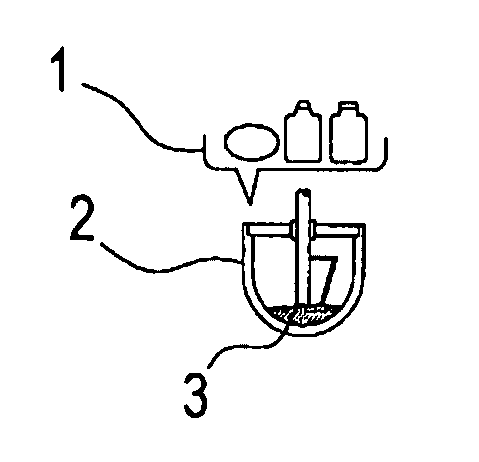
[0040] 1. Ceramic High Energy Beam Chemical Reaction: raw materials 1 (silicon dioxide, aluminum phosphate and dissolving agent) are mixed in a mixer 2 with proper proportion (FIG. 1(A)) to form slurry 3, where the dissolving agent can be water; the slurry 3 is poured into feeder 4 and then laid on top of the work piece 5 to form a thin green slurry layer 6 (as in FIG. 1(B)), which is heated to around 15020 C. by an infrared heater 7 (FIG. 1(C)); after the thin green slurry layer is dried ...
PUM
| Property | Measurement | Unit |
|---|---|---|
| Temperature | aaaaa | aaaaa |
| Heat | aaaaa | aaaaa |
Abstract
Description
Claims
Application Information
 Login to View More