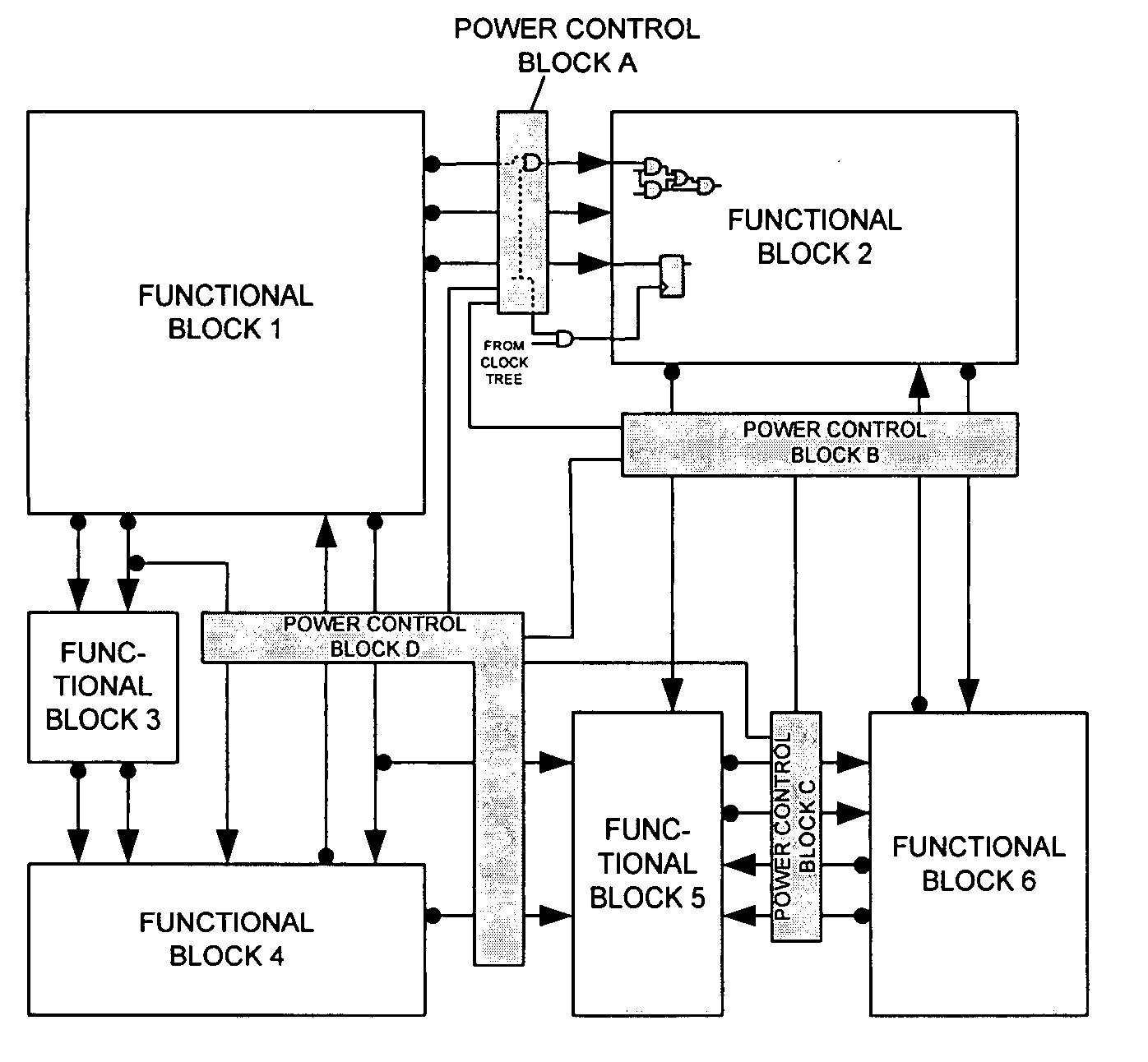
[0007] The present invention is directed to addressing the above need by way of an autonomous on-
chip power management system, which has power management circuitry distributed in an integrated circuit. An integrated circuit generally employs a multi-core or block
data processing structure on a
semiconductor chip. The term “core” designates pre-packaged design modules that a designer of an integrated circuit employs, usually without any changes. The
distributed power management circuitry is able to monitor activities of cores or other functional blocks, providing greater
visibility of the operation of cores or functional blocks, and thereby is able to manage power consumption of individual cores or functional blocks locally. The dynamic localized power management can be performed faster than centralized mechanism used in the prior art approaches, thus enabling more real-time applications of power management. The
power management system of the present invention is also able to determine an optimal setting in real-time for a particular
integrated circuit design to achieve most
effective power saving. It achieves this without any change to the
operating system of the device, and without any change to the
software application it supports. Hence, it is labeled as “autonomous
power management system”.
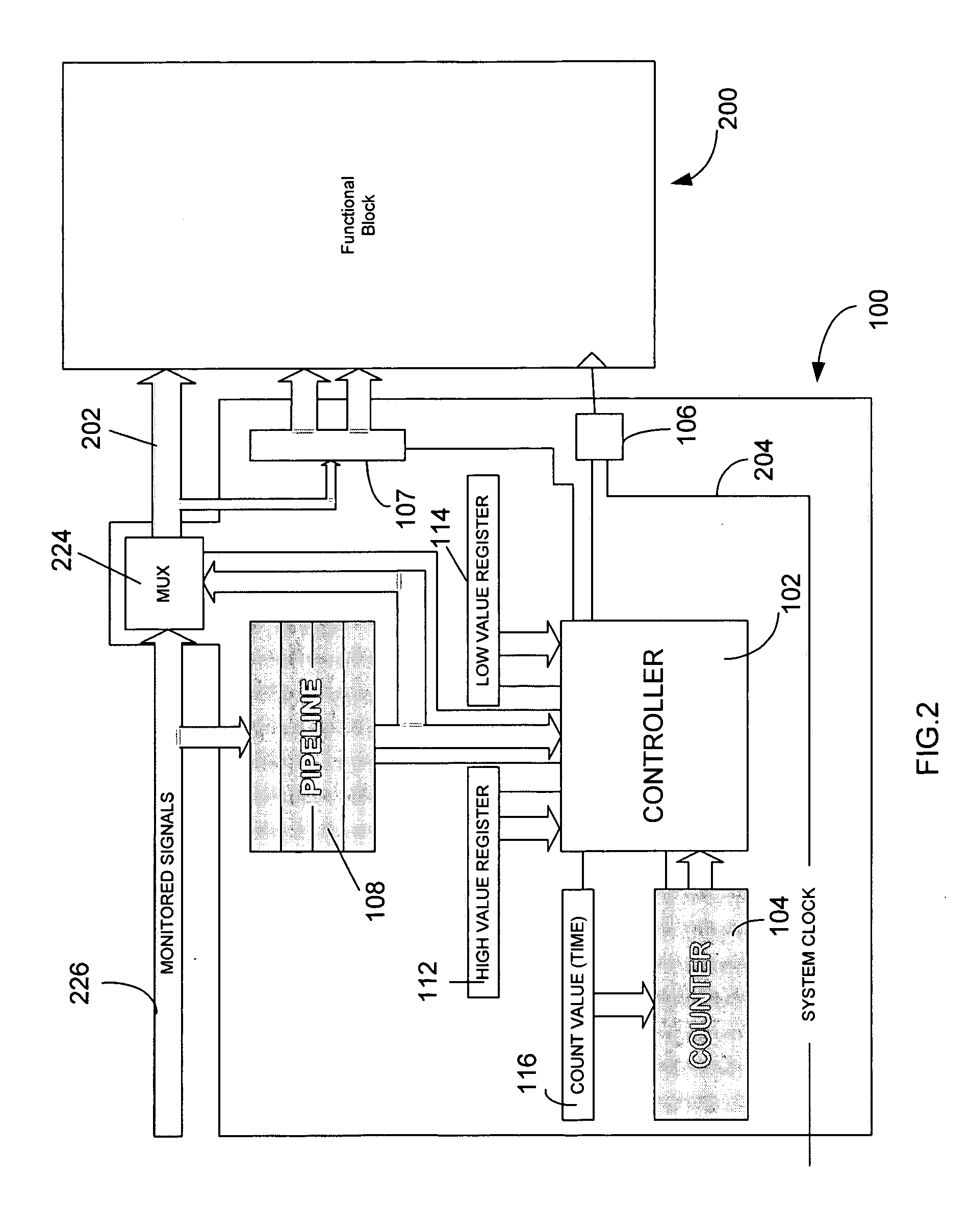
[0009] The power management circuitry may include fixed logic circuits, or alternatively, include at least partially reprogrammable or reconfigurable logic circuits, to observe signals transmitted in the integrated circuit, and based on certain conditions in the observed signals, to set the functional block to a
power saving mode. The power management circuitry including at least partially reprogrammable or reconfigurable logic circuits provides the user with the ability of dynamically changing the predetermined conditions under which the functional block should be set to the power saving mode. The reconfigurable circuits also enable the user to fix functional errors in the power management circuitry, as well as functional errors in the integrated circuit, after the integrated circuit has been fabricated.
[0010] Functional blocks generally include
sequential logic circuits and / or
combinational logic circuits. The power management circuitry, according to one aspect of the present invention, is adapted to reduce the clock speed of a
system clock associated with the
sequential logic circuits of a functional block, and / or to gate off the inputs to the
combinational logic circuits of the functional block, and thereby to reduce power consumption of said functional block.
[0014] According to another aspect of the present invention, the power management circuitry includes a
clock control circuit coupled to the controller and a
system clock of the functional block. In general, the system clock generates a
clock signal to drive the functional block. The
clock control circuit is adapted to decrease the speed of the
clock signal or disable the
clock signal to the functional block in response to instructions from the controller (in other words, the
clock rate is lowered or set to be zero), and thereby to set the functional block to a power saving mode.
[0016] In response to the reactivating conditions in the signals at the inputs and / or outputs of the functional block, the power management circuitry should reactivate the functional block by enabling the clock
signal and the input signals. One key issue in reactivation of the functional block is that data may be lost during the reactivation because of the
delayed response of the power management circuitry and the functional block. The present invention includes several forms to resolve such issues. According to one preferred form of the invention,
data loss is avoided by driving the power management circuitry with a clock
signal, which has a faster clock speed than the clock
signal of the system clock, or alternatively, is a phase-shifted version of the clock signal of the system clock. According to another preferred form, the controller monitors a signal that is associated to the functional block but is remote from the functional block. In these embodiments, the controller is able to detect the reactivating condition in the monitored signals in a relatively early
time frame and enables the clock signal and the input signals to the functional block correspondingly earlier, so that the functional block is able to capture the signals at the inputs without losing any data.


 Login to View More
  Login to View More