

Acyltransferases for alteration of polyunsaturated fatty acids and oil content in oleaginous yeasts
a technology of acyltransferases and oleaginous yeast, which is applied in the field of biotechnology, can solve the problems of high heterogeneous oil composition, accumulation of environmental pollutants, and inability to develop modified fatty acid transfer techniques to the tag pool in oleaginous yeas
- Summary
- Abstract
- Description
- Claims
- Application Information
AI Technical Summary
Benefits of technology
Problems solved by technology
Method used
Image

Examples
example 1
Construction of Plasmids Suitable for Gene Expression in Yarrowia lipolytica
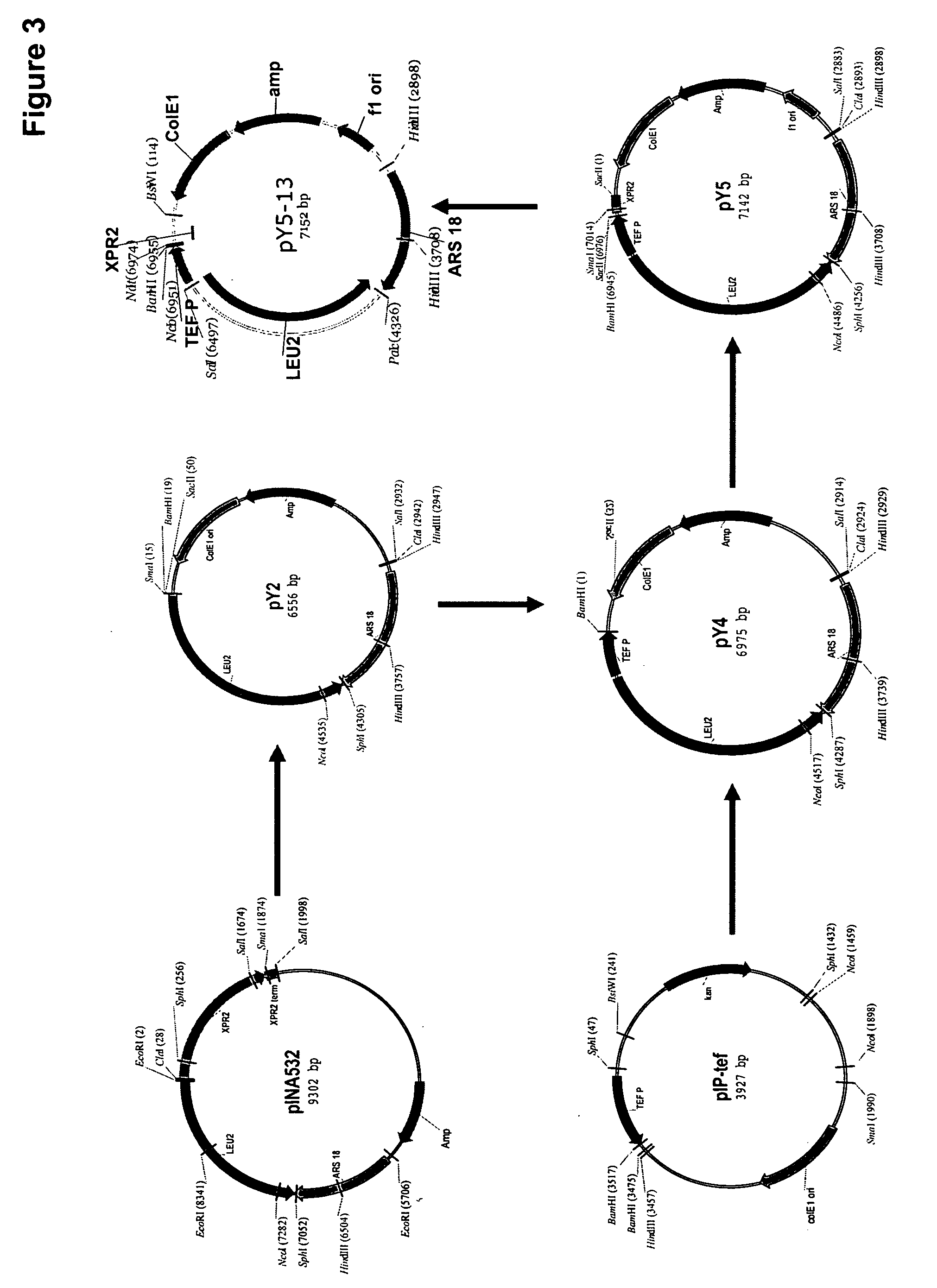
[0230] The present Example describes the construction of plasmids pY5, pY5-13, pY5-20 and pLV5.
Construction of Plasmid pY5
[0231] The plasmid pY5, a derivative of pINA532 (a gift from Dr. Claude Gaillardin, Insitut National Agronomics, Centre de biotechnologie Agro-Industrielle, laboratoire de Genetique Moleculaire et Cellularie INRA-CNRS, F-78850 Thiverval-Grignon, France), was constructed for expression of heterologous genes in Yarrowia lipolytica, as diagrammed in FIG. 3. First, the partially-digested 3598 bp EcoRi fragment containing the ARS18 sequence and LEU2 gene of pINA532 was subcloned into the EcoRi site of pBluescript (Strategene, San Diego, Calif.) to generate pY2. The TEF promoter (Muller S., et al., Yeast, 14:1267-1283 (1998)) was amplified from Y. lipolytica genomic DNA by PCR using TEF5′ (SEQ ID NO:1) and TEF3′ (SEQ ID NO:2) as primers. PCR amplification was carried out in a 50 μl total vo...
example 2
Cloning of a Partial Yarrowia lipolytica Acyl-CoA:Diacylglycerol Acyltransferase (DGAT2) Gene and Disruption of The Endogenous DGAT2 Gene
[0242] The present Example describes the use of degenerate PCR primers to isolate a partial coding sequence of the Yarrowia lipolytica DGAT2 and the use of the partial sequence to disrupt the native gene in Y. lipolytica.
Cloning of a Partial Putative DGAT2 Sequence from Yarrowia lipolytica by PCR Using Degenerate PCR Primers and Chromosome Walking
[0243] Genomic DNA was isolated from Y. lipolytica (ATCC #76982) using a DNeasy Tissue Kit (Qiagen, Catalog #69504) and resuspended in kit buffer AE at a DNA concentration of 0.5 μg / μl. PCR amplifications were performed using the genomic DNA as template and several sets of degenerate primers designed to encode conserved amino acid sequences among different known DGAT2s (i.e., GenBank Accession Nos. NC—001147 [Saccharomyces cerevisiae] and AF391089 and AF391090 [Mortierella ramanniana]). The best result...
example 3
Cloning of a Partial Yarrowia lipolytica Phospholipid:Diacylglycerol Acyltransferase (PDAT) Gene and Disruption of the Endogenous PDAT Gene
[0260] The present Example describes the use of degenerate PCR primers to isolate a partial coding sequence of Y. lipolytica PDAT and the use of the partial sequence to disrupt the native gene in Y. lipolytica.
Cloning of a Partial Putative PDAT Sequence from Yarrowia lipolytica by PCR Using Degenerate PCR Primers and Chromosome Walking
[0261] Genomic DNA was isolated from Y. lipolytica (ATCC #76982) using a DNeasy Tissue Kit (Qiagen, Catalog # 69504) and resuspended in kit buffer AE at a DNA concentration of 0.5 μg / μl. PCR amplifications were performed using genomic DNA as the template and several pairs of degenerate primers encoding conserved amino acid sequences in different known PDATs (GenBank Accession Nos. NP 190069 and AB006704 [(gi:2351069 Arabidopsis thaliana], and NP—596330 [Schizosaccharomyces pombe]; and the Saccharomyces cerevisia...
PUM
| Property | Measurement | Unit |
|---|---|---|
| temperature | aaaaa | aaaaa |
| temperature | aaaaa | aaaaa |
| temperature | aaaaa | aaaaa |
Abstract
Description
Claims
Application Information
 Login to View More