
Use of Growth Hormone Releasing Factor Analogs in Treating Patients Suffering From Wasting
a technology of growth hormone and releasing factor, which is applied in the field of growth hormone secretagogues, can solve the problems of limited success in muscle function, poor prognosis of muscle wasting, and administration of growth hormone, and achieve the effects of increasing muscle function, increasing muscle function, and increasing muscle function
- Summary
- Abstract
- Description
- Claims
- Application Information
AI Technical Summary
Benefits of technology
Problems solved by technology
Method used
Image

Examples
example 1
Study Drug
[0157]The compound used in the studies below is (hexenoyl trans-3)hGRF(1-44)NH2 (also referred to as TH9507 herein), which is a synthetic human growth hormone releasing factor analog that comprises the 44-amino acid sequence of human growth hormone releasing factor (hGRF) on which a hexenoyl moiety, a C6 side chain has been anchored on Tyr 1 at the NH2-terminal. (hexenoyl trans-3)hGRF(1-44)NH2 or TH9507 has the following structure:
(SEQ ID NO: 7)(trans)CH3—CH2—CH═CH—CH2—CO-Tyr-Ala-Asp-Ala-Ile-Phe-Thr-Asn-Ser-Tyr-Arg-Lys-Val-Leu-Gly-Gln-Leu-Ser-Ala-Arg-Lys-Leu-Leu-Gln-Asp-Ile-Met-Ser-Arg-Gln-Gln-Gly-Glu-Ser-Asn-Gln-Glu-Arg-Gly-Ala-Arg-Ala-Arg-Leu-NH2
[0158](hexenoyl trans-3)hGRF(1-44)NH2 was synthesized via the methods set forth in U.S. Pat. No. 5,861,379 (Ibea et al.; Jan. 19, 1999).
example 2
Material and Methods
[0159]The results presented herein were obtained from a multicentre, randomized, double-blind, placebo-controlled study. The compound TH9507 was administered by subcutaneous injection daily (1 or 2 mg dose) for a three-month period. Patients were of both genders, aged 50 years or older, with stable COPD as per the 1995 American Thoracic Society criteria.
[0160]Body Mass Index (BMI) criteria. For subjects aged between 50 and 64, their BMI was less than or equal to 27 (kg / m2). For these subjects, if their BMI was between 23 and 27, their forced expiratory volume in one second (FEV1) is less than or equal to 50% of predicted value (Hankinson J L, Odencrantz J R, Fedan K P. Spirometric reference values from a sample of the general US population. AM J. Respir Crit. Care Med. 1999; 159:179-187). For subjects aged 65 or older, their BMI was less than or equal to 28 (kg / m2). For these subjects, if their BMI was between 24 and 28, their forced expiratory volume in one seco...
example 3
Disposition of Subjects
[0163]Adverse events and safety laboratory parameters (haematology, biochemistry, urinalysis) were measured using standard laboratory methods.
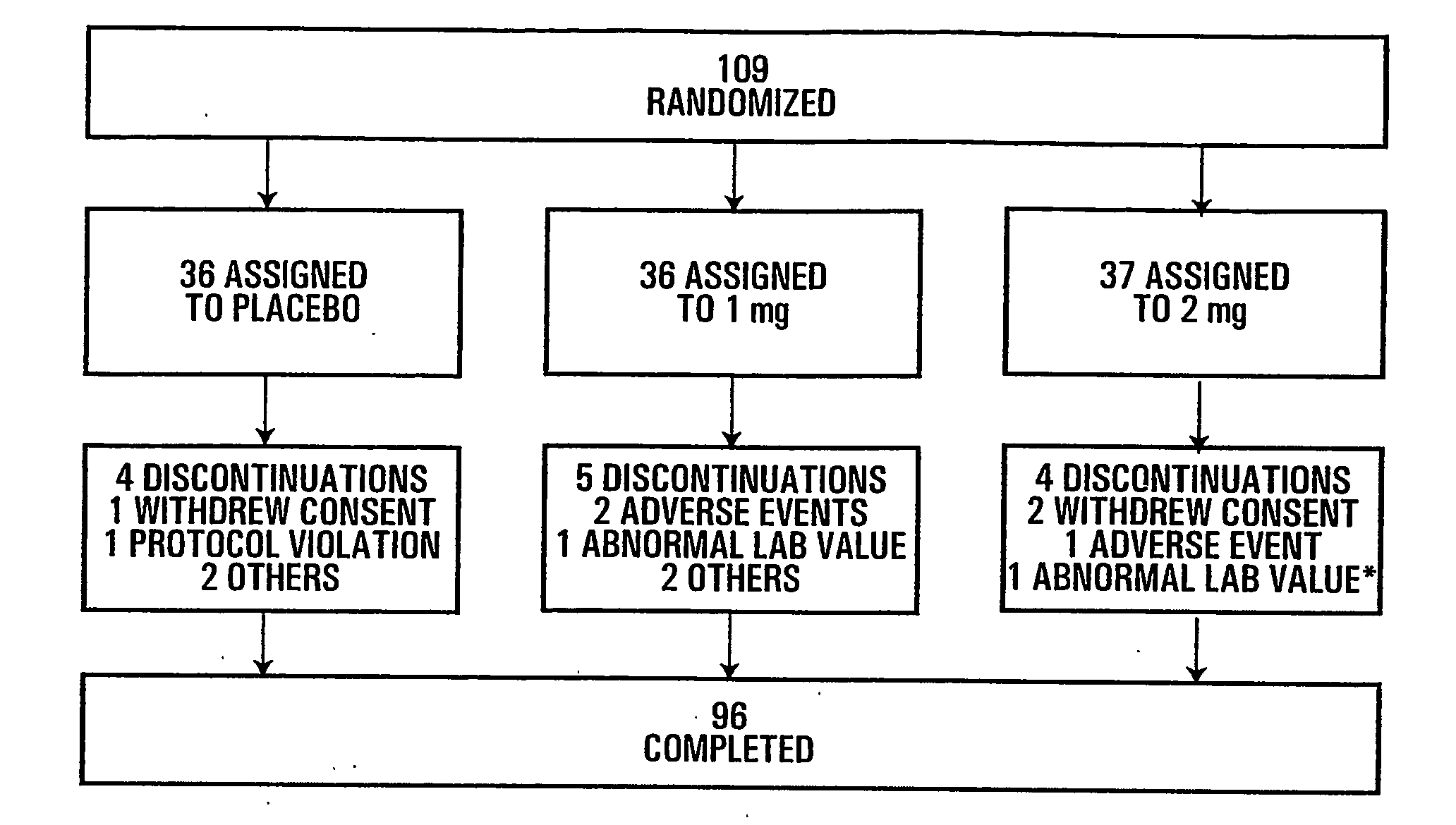
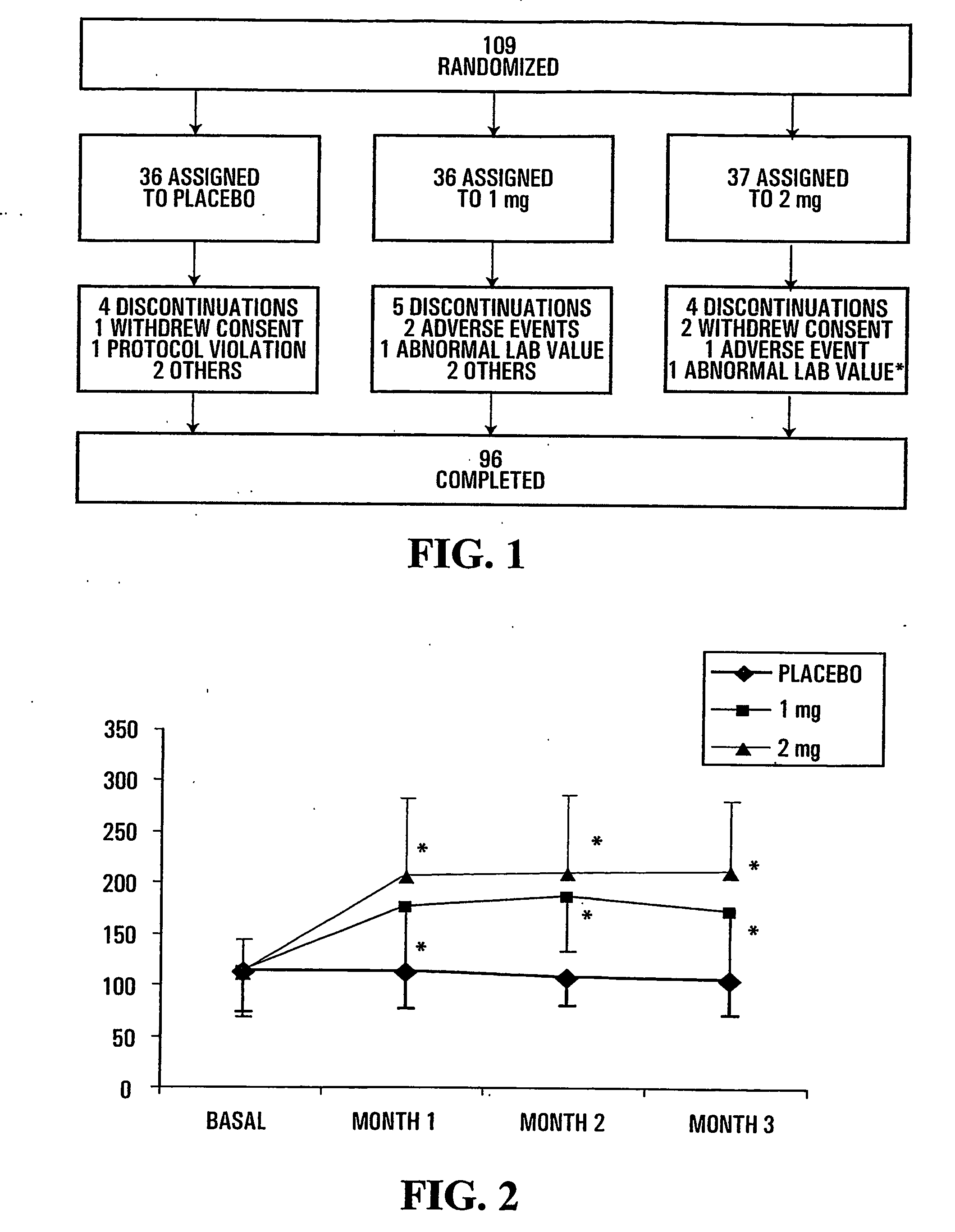
[0164]The disposition of subjects of the study presented herein are shown in FIG. 1. The number of premature discontinuation was comparable in the 3 groups. None of the reasons for discontinuation was related to study drug except for one patient in the 2 mg group who showed elevated creatine phosphokinase (CPK) and serum glutamic oxaloacetic transaminase (SGOT) values (*) following 1 month of treatment and that were considered to be possibly related to treatment.
[0165]Table 1 (below) presents the baseline characteristics of the subjects of the study.
TABLE 1Baseline Characteristics. Data are presented as means ± SD.Placebo1 mg2 mgN363637Women877Men282930Age (years)65.5 ± 8.664.7 ± 7.663.4 ± 8.4(Min-Max) (46.3-80.6) (48.9-84.7) (49.6-79.5)BMI (kg / m2)21.9 ± 2.921.8 ± 3.422.5 ± 3.5FEV1% pred. 40.7 ± 12.8 35.2 ± 13.2 37.7 ± 1...
PUM
| Property | Measurement | Unit |
|---|---|---|
| hydrophobic | aaaaa | aaaaa |
| muscle strength | aaaaa | aaaaa |
| lean body mass | aaaaa | aaaaa |
Abstract
Description
Claims
Application Information
 Login to View More