
Phosphaplatins and their use in the treatment of cancers resistant to cisplatin and carboplatin
a technology of cisplatin and phosphaplatin, which is applied in the direction of phosphorous compound active ingredients, drug compositions, biocides, etc., can solve the problems of renal, nephro- and neurotoxicities, not cured by cisplatin treatment, and high doses also have associated toxicities, so as to achieve stable and effective alternatives
- Summary
- Abstract
- Description
- Claims
- Application Information
AI Technical Summary
Benefits of technology
Problems solved by technology
Method used
Image

Examples
example 1
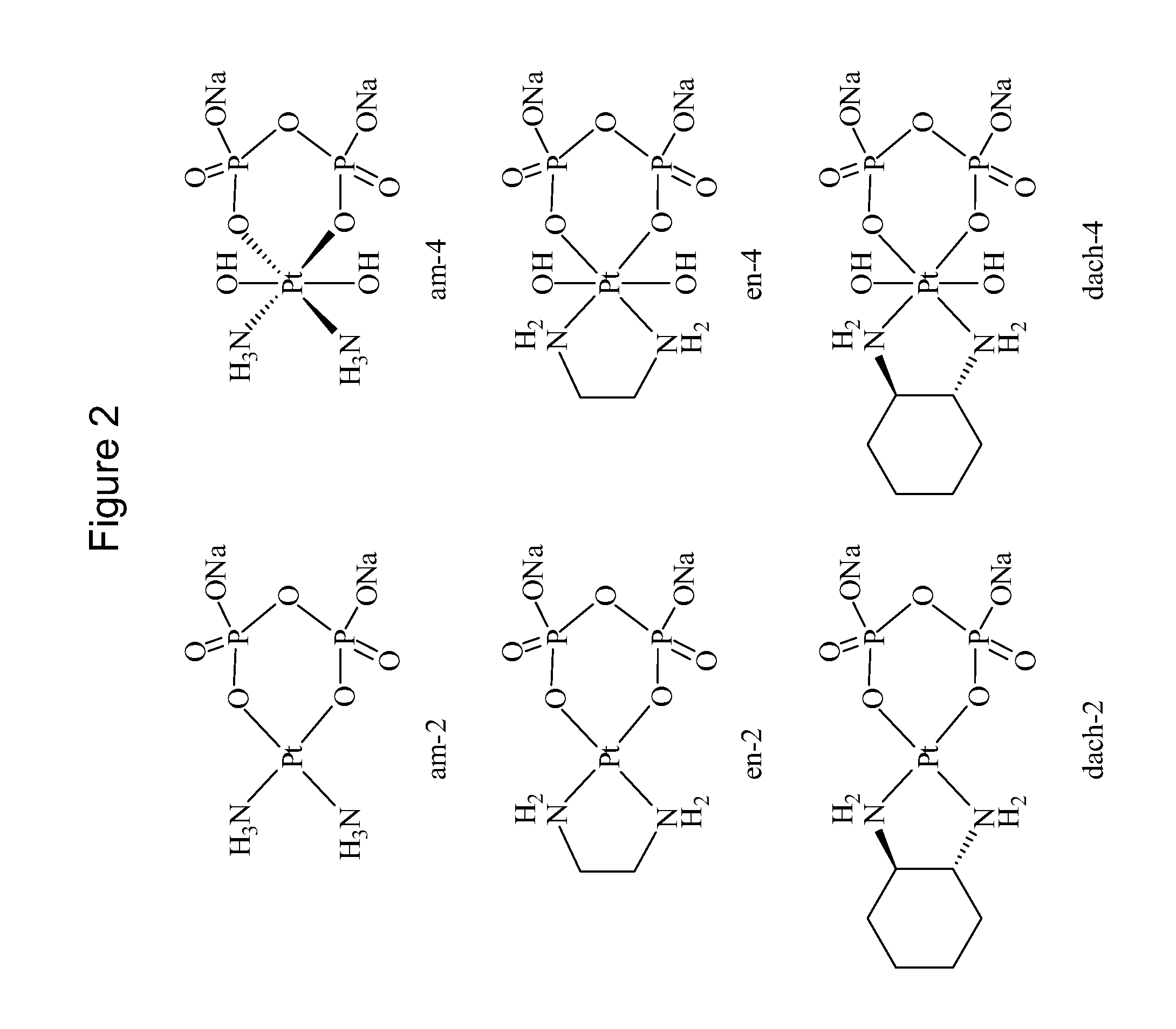
Diammine(dihydrogen pyrophosphato)platinum(II) (am-2)
[0053]Sodium pyrophosphate decahydrate (0.4 g) and 0.1 g of cisplatin were dissolved in 250 mL of distilled water, pH 8, and incubated at 40 degrees C. for 15 hours. Following the incubation period, the solution was concentrated to 5-10 mL by rotary evaporation and filtered to remove any unreacted starting material. Rapidly lowering the pH to approximately 1.0 by addition of 1 N HNO3 precipitated the product as a light yellow powder. Precipitation was completed by cooling on ice, and the product was isolated by vacuum filtration and washed with cold water and acetone. Yield Pt(NH3)2(H2P2O7): 0.04 g (30%). The 31P NMR spectrum displays a single peak at 2.12 ppm, pH 7.99 with respect to 85% phosphoric acid as an external reference. 195Pt NMR resonance is detected at −1503 ppm.
example 2
Cis-diammine-trans-dihydroxo(dihydrogen pyrophosphato)platinum (IV) (am-4)
[0054]Sodium pyrophosphate decahydrate (0.4 g) and 0.1 g of cisplatin were dissolved in 250 mL of distilled water, pH 8, and incubated at 40 degrees C. for 15 hours. Following the incubation period, 1 mL 30% H2O2 was added to the reaction mixture, and it was allowed to react for a further 3 hours. The solution was then concentrated to 5-10 mL by rotary evaporation and filtered to remove any unreacted starting material. Rapidly lowering the pH to approximately 1.0 by addition of 1 N HNO3 precipitated the product as a light yellow powder. Precipitation was completed by cooling on ice, and the product was isolated by vacuum filtration and washed with cold water and acetone. Yield cis, trans-Pt(NH3)2(OH)2(H2P2O7): 0.05 g (34%). The 31P NMR spectrum displays a single peak at 2.32 ppm, pH 8.11, with a 195Pt-31P coupling constant of 15.4 Hz. The 195Pt NMR spectrum shows a pentet at 1733 ppm with a 195Pt-14N coupling ...
example 3
1,2-Ethanediamine(dihydrogen pyrophosphato)platinum(II) (en-2)
[0055]Sodium pyrophosphate decahydrate (0.4 g) and 0.1 g of dichloro(ethylenediamine)platinum(II) were dissolved in 250 mL of distilled water, pH 8, and incubated at 40 degrees C. for 15 hours. Following the incubation period, the solution was concentrated to 5-10 mL by rotary evaporation and filtered to remove any unreacted starting material. Rapidly lowering the pH to approximately 1.0 by addition of 1 N HNO3 did not precipitate the product. The product was characterized in situ by 31P NMR. A single peak is observed at 1.93 ppm in the 31P NMR spectrum with a 195Pt-31P constant of 29.73 Hz.
PUM
| Property | Measurement | Unit |
|---|---|---|
| temperature | aaaaa | aaaaa |
| temperature | aaaaa | aaaaa |
| temperature | aaaaa | aaaaa |
Abstract
Description
Claims
Application Information
 Login to View More