

Tetrahydro-isoquinolin-1-ones for the treatment of cancer
a technology of isoquinolin and tetrahydroisoquinolin, which is applied in the direction of antibody medical ingredients, peptide/protein ingredients, drug compositions, etc., can solve the problems of misregulation and change in the normal ratio of hdm2 to p53, and achieve the effect of cancer therapy therapy utility
- Summary
- Abstract
- Description
- Claims
- Application Information
AI Technical Summary
Benefits of technology
Problems solved by technology
Method used
Image

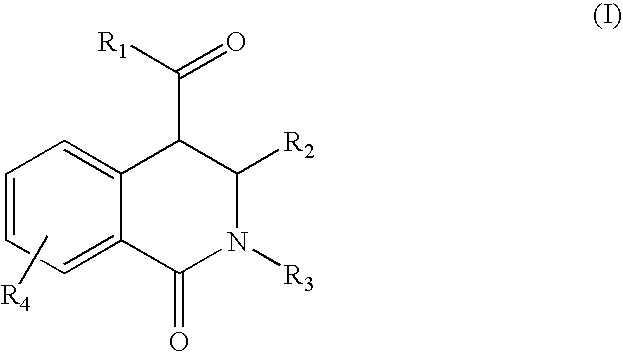
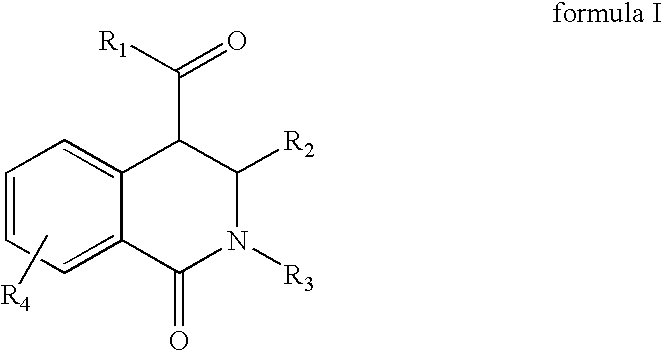
Examples
example 1
General Procedure
[0065]Equimolar amounts of an aldehyde and a primary amine are added at room temperature in a solvent like dichloromethane, tetrahydrofurane, chloroforme, methanol or ethanol to form the corresponding azomethine. A dehydrating agent like a mol sieve can be added to facilitate the reaction. After 1 day of reaction, equimolar amounts of a homophthalic acid anhydride derivative is added and refluxed. After 1 day of reaction the reaction mixture is cooled down. The resulting 1-oxo-1,2,3,4-tetrahydro-isoquinoline-4-carboxylic acid derivative is filtered off if it has precipitated out, or after removal of the solvent in vacuum, the product is re-crystallized from ethanol or purified via standard column chromatographic methods.
example 2
[0066]According to the general procedure in example 1, the following compounds were prepared:
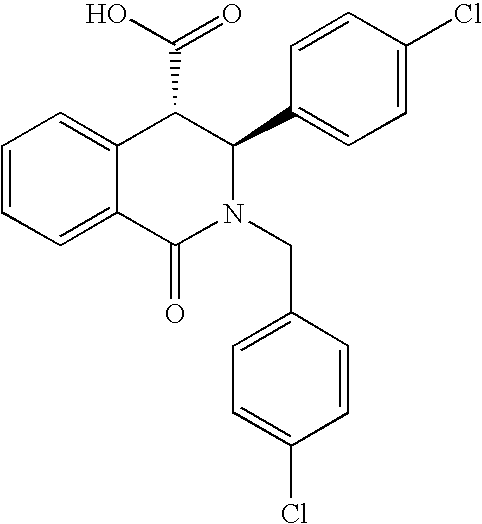
2.a 2-(4-Chloro-benzyl)-3-(4-chloro-phenyl)-1-oxo-1,2,3,4-tetrahydro-isoquinoline-4-carboxylic acid. Molecular Weight=426,3028, calculated from Molecular Formula═C23H17Cl2NO3. (M+) observed 426,5.
2.b 2,3-Bis-(4-chloro-phenyl)-1-oxo-1,2,3,4-tetrahydro-isoquinoline-4-carboxylic acid. Molecular Weight=412,2758, calculated from Molecular Formula═C22H15Cl2NO3. (M+) observed 412,3.
2.c 3-(4-Chloro-benzyl)-2-(4-chloro-phenyl)-1-oxo-1,2,3,4-tetrahydro-isoquinoline-4-carboxylic acid. Molecular Weight=426,3028, calculated from Molecular Formula═C23H17Cl2NO3. (M+) observed 426,3.
2.d 2-(4-Chloro-benzyl)-3-(1H-indol-3-yl)-1-oxo-1,2,3,4-tetrahydro-isoquinoline-4-carboxylic acid. Molecular Weight=430,8948, calculated from Molecular Formula═C25H19ClN2O3. (M+) observed 431,0.
2.e 2-[Carboxy-(4-chloro-phenyl)-methyl]-3-(4-chloro-phenyl)-1-oxo-1,2,3,4-tetrahydro-isoquinoline-4-carboxylic acid. Molecular Weight=4...
example 3
General Procedure
[0067]Compounds prepared according to the general procedure in example 1 are dissolved in dimethylformamide and amine were coupled using standard peptide coupling conditions. Thus, for example the coupling agent EDCI is added to the solution of the acid in DMF, reacted for 30 minutes and then the corresponding amine is added and allowed to react for 2 days at room temperature. Ethylacetate and water is then added to the reaction mixture, the organic layer is separated and washed several times with water. After removing the ethylacetate, the final product is purified either by re-crystallization from ethanol or by standard column chromatographic methods. Using this procedure, the following compounds were prepared:
3.a 2-(4-Chloro-benzyl)-3-(4-chloro-phenyl)-1-oxo-1,2,3,4-tetrahydro-isoquinoline-4-carboxylic acid (2-methoxyethyl)-amide. Molecular Weight=483.3988, calculated from Molecular Formula ═C26H24Cl2N2O3. ([M+H]+) observed 463.4.
3.b 2,3-Bis-(4-chloro-phenyl)-1-o...
PUM
| Property | Measurement | Unit |
|---|---|---|
| particle size | aaaaa | aaaaa |
| movement | aaaaa | aaaaa |
| concentrations | aaaaa | aaaaa |
Abstract
Description
Claims
Application Information
 Login to View More