Method for preparing permanently hydrophobic aerogel and permanently hydrophobic aerogel prepared by using the method

US20090247655A1Inactive Publication Date: 2009-10-01KOREA INST OF IND TECH

Image

Smart Image Click on the blue labels to locate them in the text.
Viewing Examples
Smart Image
  • Method for preparing permanently hydrophobic aerogel and permanently hydrophobic aerogel prepared by using the method
  • Method for preparing permanently hydrophobic aerogel and permanently hydrophobic aerogel prepared by using the method
  • Method for preparing permanently hydrophobic aerogel and permanently hydrophobic aerogel prepared by using the method

Examples

Experimental program
Comparison scheme
Effect test

example 1

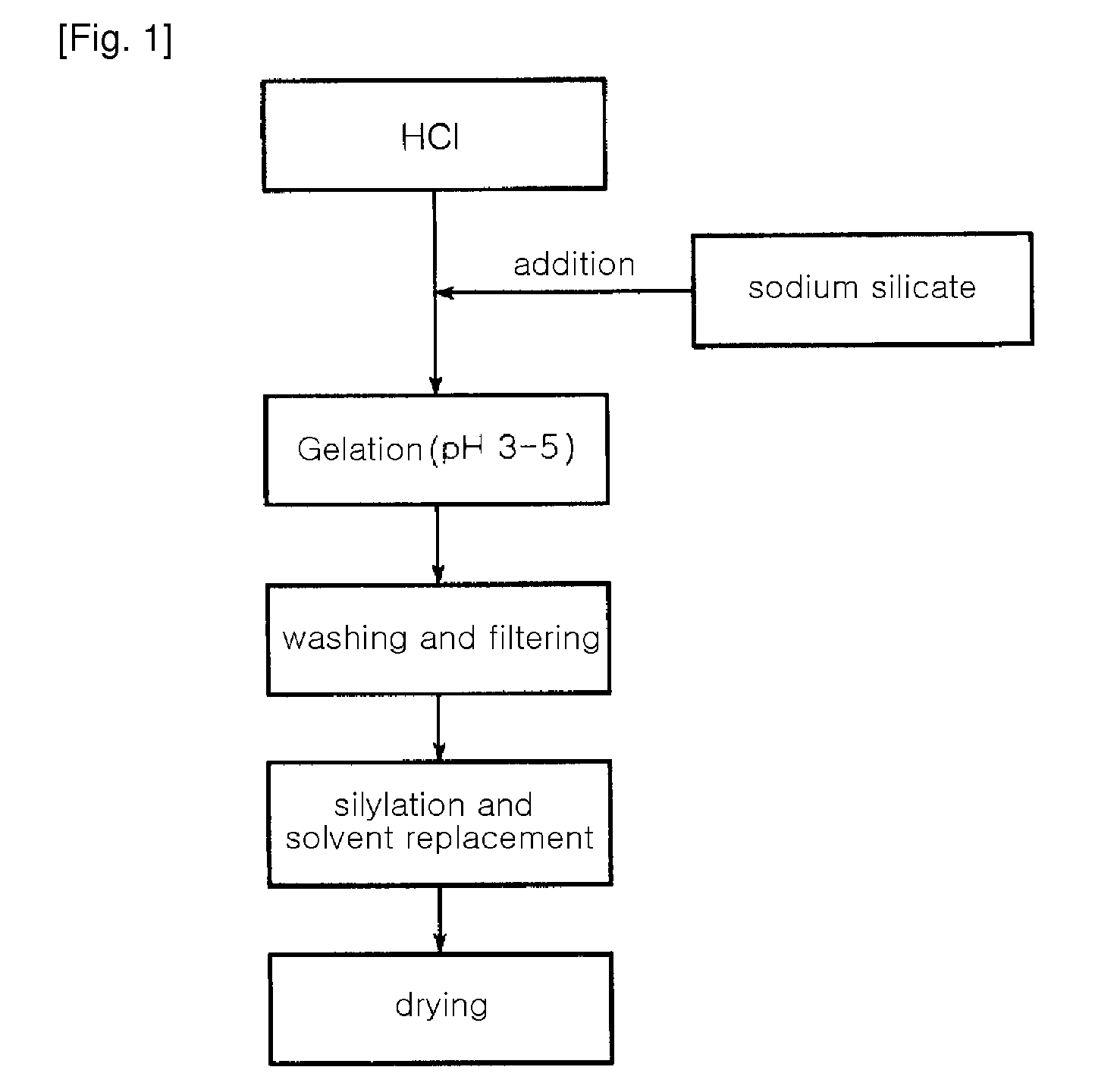
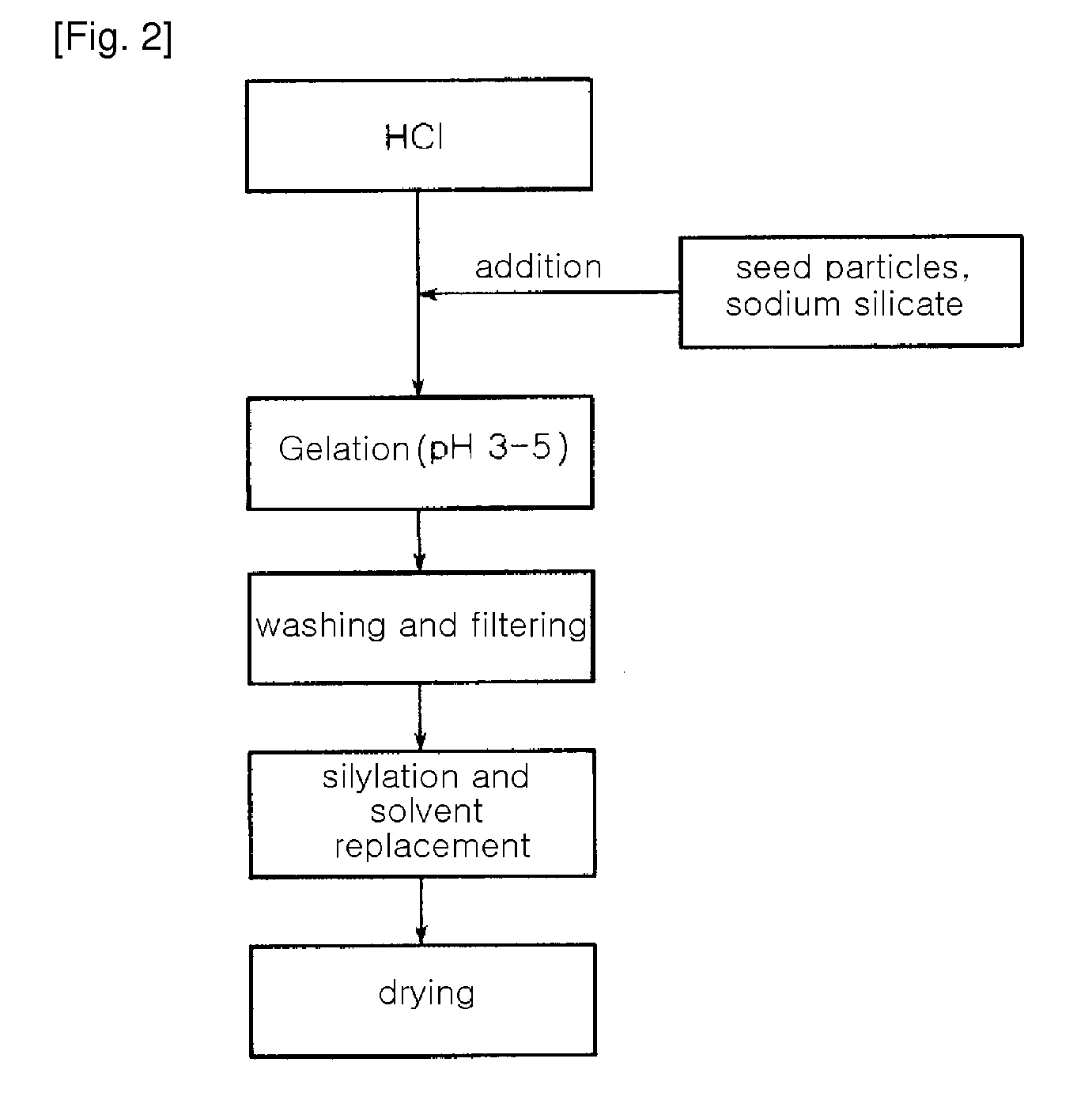
[0052]A water glass solution (a 3-fold dilution of a 35 wt % sodium silicate solution in water (i.e. the ratio of a 35% sodium silicate solution and water (1:3, wt / wt)) was slowly added to IL of a 1N hydrochloric acid solution with stirring, to adjust pH of the water glass solution to 3.5. At this time, a reaction temperature was 80° C. The solution was further stirred for about 2 hours, while the pH of 3.5 was maintained, thereby preparing silica hydrogel. The hydrogel was put in a mixer, and was then washed with distilled water several times for 4 hours, to remove Na+ ions contained therein. The amount of Na+ ions in the washed hydrogel was 2,000 ppm. The resulting silica hydrogel was subjected to solvent displacement to remove water contained therein using solvent such as n-butanol, tert-butanol, propanol, hexane and acetone respectively. The silica hydrogel was immersed in the each solvent and refluxed at 120 to 150° C. for 4 hours. The resulting silica hydrogel was dried at 150...

example 2

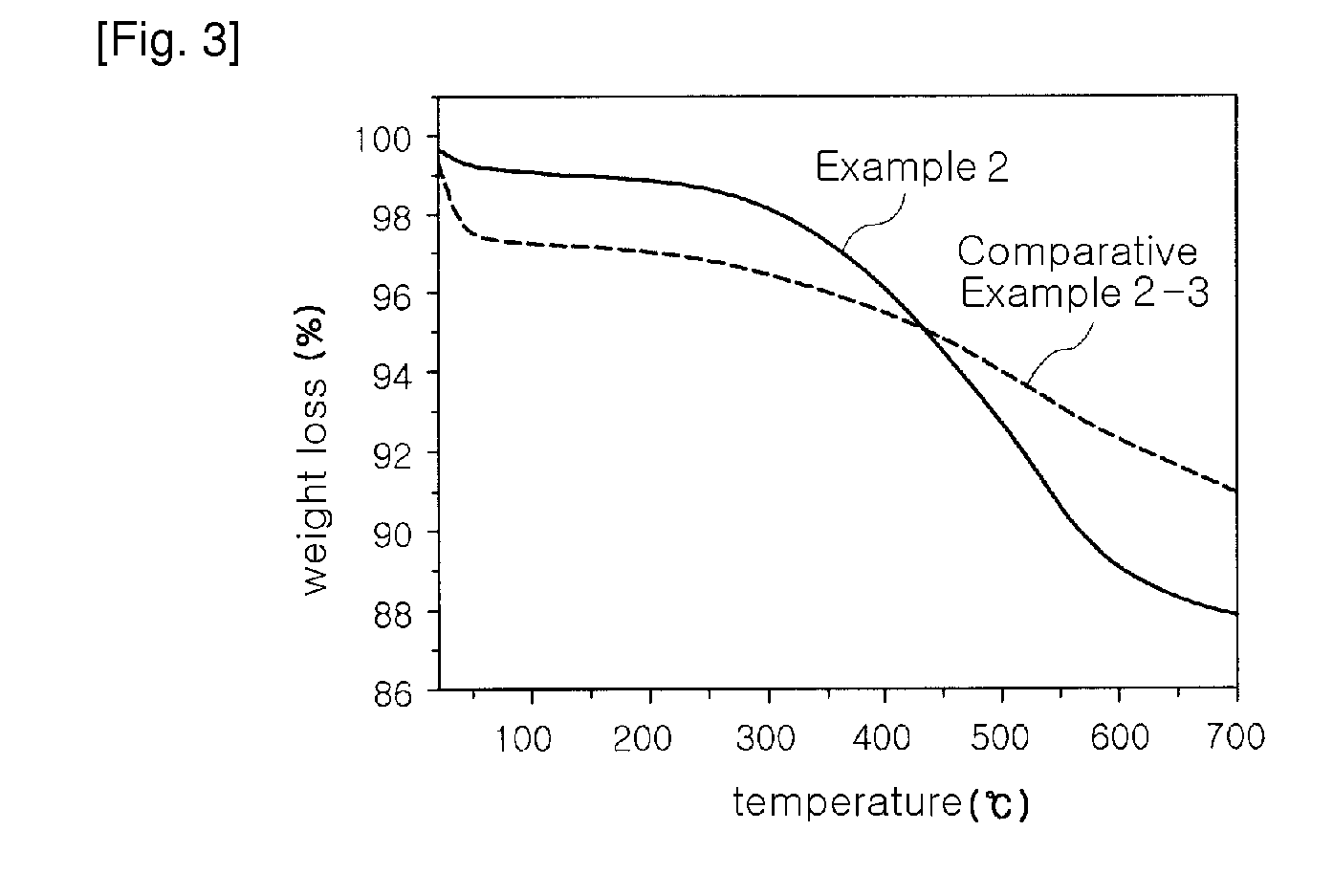
[0054]A water glass solution (a 3-fold dilution of a 35% sodium silicate solution in water (i.e. the ratio of a 35% sodium silicate solution and water (1:3, wt / wt)) was slowly added to 1 L of a 1N hydrochloric acid solution with stirring, to adjust pH of the water glass solution to 3.5. At this time, a reaction temperature was 80° C. The solution was further stirred for about 2 hours, while the pH of 3.5 was maintained, thereby preparing silica hydrogel. The hydrogel was put in a mixer, and was then washed with distilled water several times for 4 hours, to remove Na+ ions contained therein. The amount of Na+ ions in the washed hydrogel was 2,000 ppm The resulting silica hydrogel was simultaneously subjected to permanently hydrophobic treatment of the surface thereof with a silane compound and removal of water contained therein using n-butanol. The silica hydrogel was immersed in a silylating solution of 5 wt % ethyl trimethoxy silane (ETMS) in n-butanol under acidic conditions of pH...

example 3

[0060]Aerogel was prepared in the same manner as in Example 2, except that hexamethyl disilane (HMDS) was used as a silylating agent instead of ETMS. After drying at 150° C. for 2 hours, the thermal conductivity (measured 1 week after the preparation) of prepared aerogel powder was 8 mW / m·K.

the structure of the environmentally friendly knitted fabric provided by the present invention; figure 2 Flow chart of the yarn wrapping machine for environmentally friendly knitted fabrics and storage devices; image 3 Is the parameter map of the yarn covering machine
Login to View More

PUM

No PUM Login to View More

Abstract

A method for preparing permanently hydrophobic aerogel and permanently hydrophobic aerogel prepared by the method. The method comprises adding sodium silicate to HCl at 30 to 90° C. until an acidity reaches pH 3-5, to form silica hydrogel under acidic conditions of pH 3-5, washing the silica hydrogel with distilled water using a mixer, followed by filtering, adding the silica hydrogel to a silylating solution of silylating agent in n-butanol at pH 1-5 using an acid selected from hydrochloric acid, sulfuric acid, phosphoric acid and nitric acid, to simultaneously conduct silylation and solvent replacement, and drying the silica hydrogel; The method has the following advantages; i) silylation and solvent replacement can be simultaneously conducted, ii) n-butanol is used as a reaction solvent instead of methanol upon silylation, thus obtaining a thermal conductivity comparable to conventional aerogel powders, iii) silylation is conducted under improved conditions, i.e., strong acidic conditions of pH 1-5, and as a result, all of the aerogel powders can be reacted with a silylating agent, thereby obtaining permanently hydrophobic aerogel, iv) the washing with a mixer makes the amount of removed sodium ions uniform, thus it is suitable for mass-production, and v) the method provides a relatively simplified procedure and the use of the silylating agent in a small amount enables low costs and mass-production.

Description

TECHNICAL FIELD[0001]The present invention relates to a method for preparing permanently hydrophobic aerogel and permanently hydrophobic aerogel prepared by the method. More specifically, the present invention relates to a method for preparing permanently hydrophobic aerogel that can achieve low-cost and mass-production by simultaneous treatment of silylation and solvent replacement under strongly acidic conditions, and permanently hydrophobic aerogel prepared by the method.BACKGROUND ART[0002]With recent trends toward high-technology, aerogels have increasingly attracted considerable attention. Aerogelsare a transparent advanced-material that has a porosity of 90% or more, a specific surface area of hundreds to 1500 m2 / g and an ultra-low density. Thus, porous aerogels are widely applied to fields including ultra-low dielectrics, catalysts, electrode materials and soundproof materials. In particular, since silica aerogels have a high transmittance and a low thermal conductivity, the...

Claims

the structure of the environmentally friendly knitted fabric provided by the present invention; figure 2 Flow chart of the yarn wrapping machine for environmentally friendly knitted fabrics and storage devices; image 3 Is the parameter map of the yarn covering machine
Login to View More

Application Information

Patent Timeline
01 Oct 2009
Publication
US20090247655A1
IPC
C08J9/28
CPC
C01B33/159; C01B33/107
Inventors
KIM, GYUNG-SOO; CHUN, HYUN-AEE