[0038]A plurality of dimples are formed on the surface of the outermost cover layer. Because the dimples, by virtue of their
diameter, number and depth, exert an influence on the appearance of the ball, it is preferable to form the dimples in a range that does not detract from the advantageous effects of the invention. More specifically, the number of such dimples, while not subject to any particular limitation, is preferably at least 250 but not more than 330. The dimples formed on the surface of the ball have a surface coverage (SR) which, while not subject to any particular limitation, is preferably at least 80%, and more preferably at least 90%, but preferably not more than 98%, and more preferably not more than 95%. For example, if the number of dimples is too large, when light strikes the ball, the visibility effect of the colored ball may diminish. That is, depending on the angle from which the ball is viewed, shadows will form at the bottoms of the dimples, which may cause the ball to appear darker. On the other hand, if the number of dimples is too small, good aerodynamic properties cannot be obtained when the ball is hit, as a result of which the ball may not travel the desired distance.
[0039]When a sphere having the above-described cover is Manufactured, a rubber composition composed primarily of
polybutadiene or the like may be vulcanized under ordinary
vulcanization conditions to form a crosslinked rubber molding (core), following which the cover (intermediate layer and outermost layer) may be successively molded over the core by a known process such as injection molding. Generally, a large number of dimples are formed on the surface of the outermost cover layer, the dimples being formed at the same time as formation of the outermost cover layer through the use of an outermost cover layer forming mold provided on the inner wall of the mold cavity thereof with a plurality of projections corresponding to the dimples.
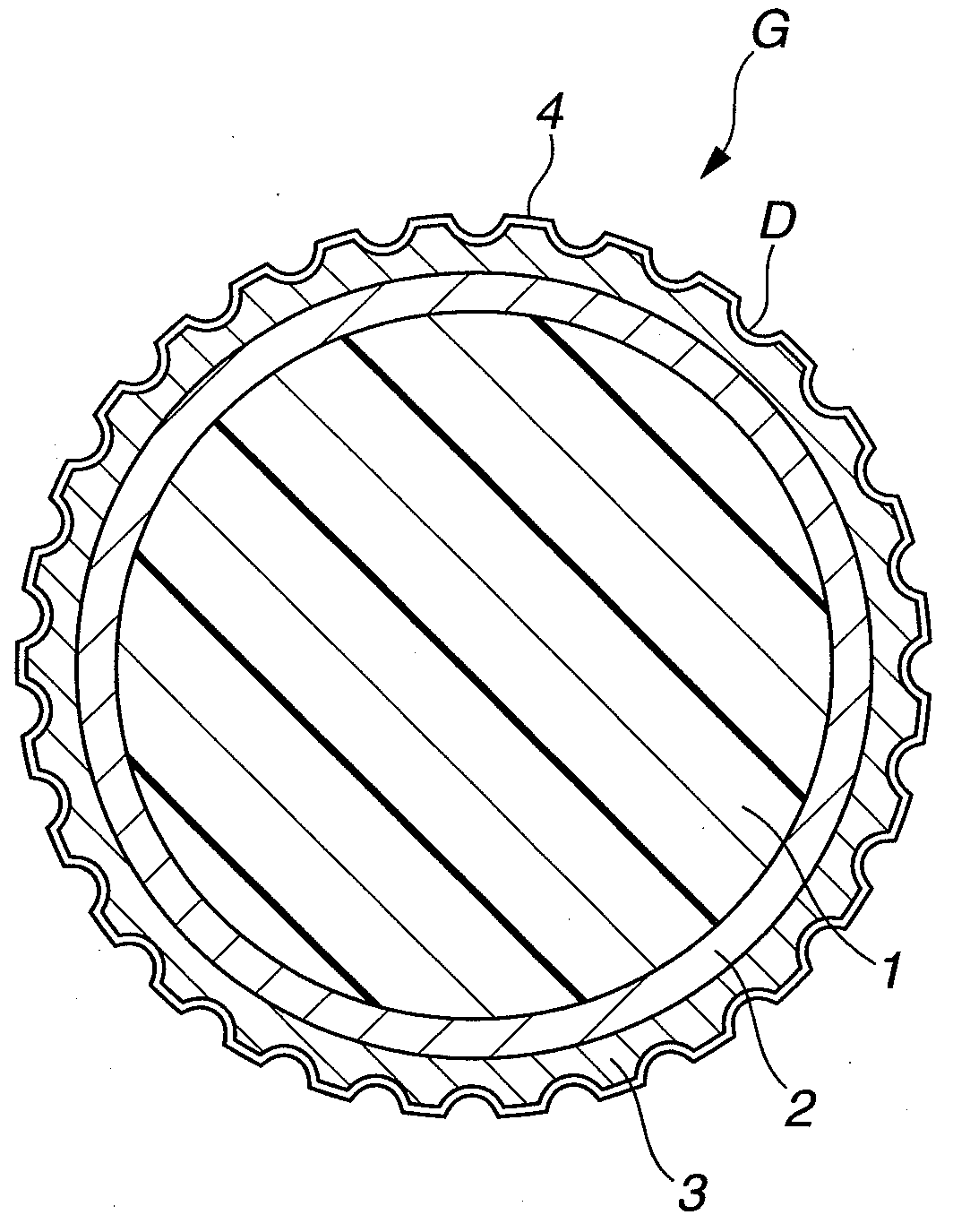
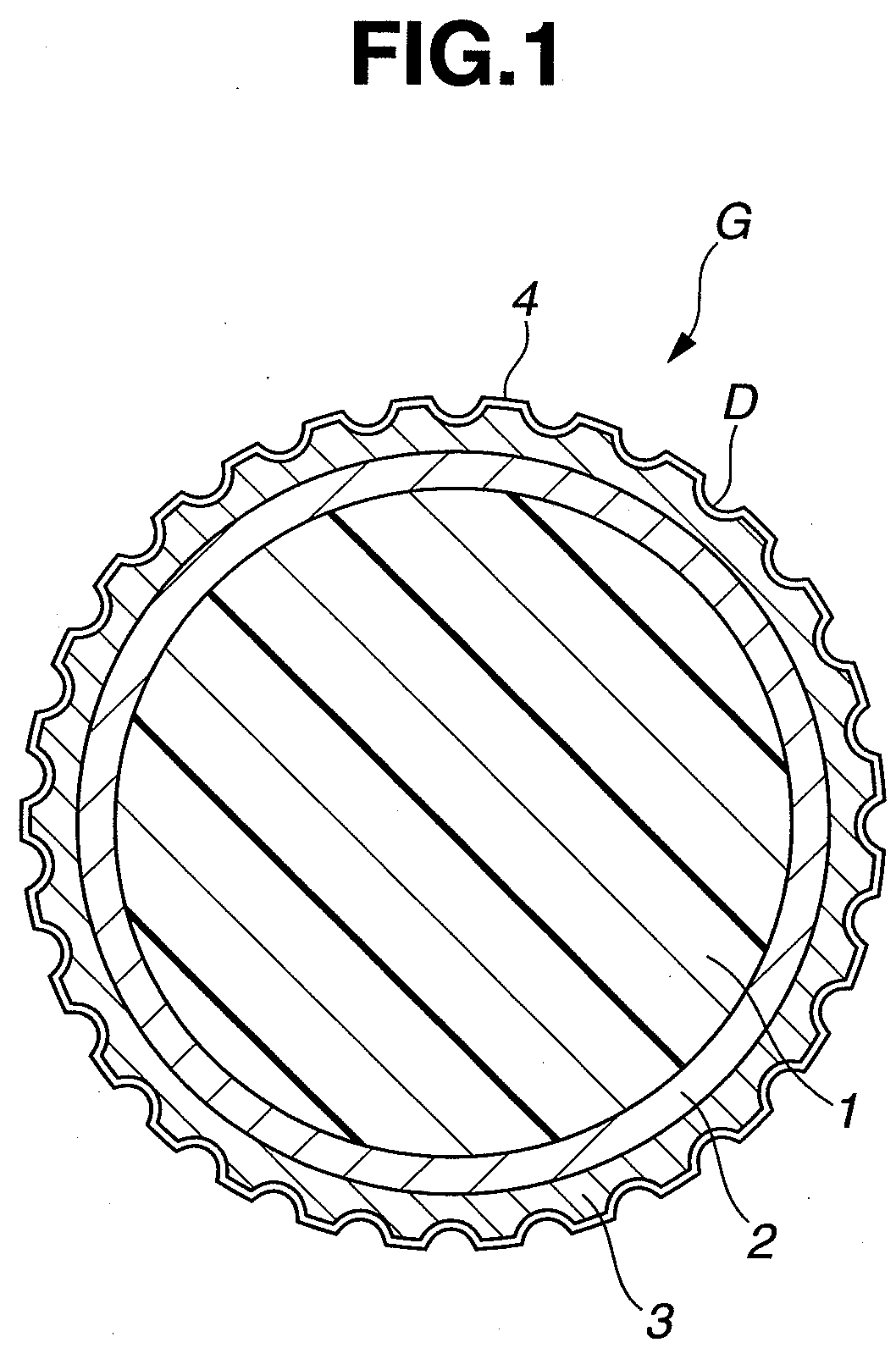
[0040]As shown in FIG. 1, the surface of-the outermost cover layer is covered by a layer of paint 4. This paint layer 4 has a thickness which, while not subject to any particular limitation, is preferably at least 5 μm, and more preferably at least 10 μm, but preferably not more than 20 μm, and more preferably not more than 16 μm. If the paint layer is too thin, the paint may have a poor durability. On the other hand, if the paint layer is too thick, the paint may have a large effect on the
dimple shape, which may make it impossible to obtain flight properties according to design and may thus result in the ball traveling a less than desirable distance. Also, if the paint layer is too thick, the paint will have a tendency to peel, which may lower the durability of the ball to repeated
impact.
[0041]It is preferable to use in the paint layer a paint which is commonly used to coat the surface of golf balls. Illustrative examples include urethane resin paints,
acrylic resin paints,
polyester resin paints, polyether resin paints,
epoxy resin paints, modified forms thereof, or mixtures of any of the above. Of these, a two-component curing urethane resin paint obtained from a mixture of a polyisocyanate with a urethane resin,
acrylic resin or
polyester resin includes on the resin skeleton functional groups, particularly hydroxyl groups, capable of reacting with
isocyanate groups is preferred. Examples of polyisocyanates that may be used include
tolylene diisocyanate,
diphenylmethane-4,4′-diisocyanate
hexamethylene diisocyanate,
isophorone diisocyanate,
naphthalene diisocyanate, 1,4-
phenylene diisocyanate,
xylylene diisocyanate and hydrogenated
xylylene diisocyanate, either singly or in modified forms as combinations thereof. The polyisocyanate component may generally take the form of an
adduct, a biuret or an isocyanurate.
[0042]When the paint layer is formed by clear
coating (
coating with a clear paint), it is preferable to use a two-component curing urethane paint composed of a
polyol component having hydroxyl groups and a polyisocyanate component having
isocyanate groups.
[0043]Any known method used in the art may be employed as the
coating method. For example, the ball may be perched on the tips of needles on a needle
bed, and the entire ball coated with various paints by spraying. Prior to coating, any of a variety of techniques may be used to improve adhesion between the object to be coated and the layer of paint. Illustrative, non-limiting examples of such techniques include
surface modification by
plasma treatment or
corona discharge treatment, and the application of a primer.



 Login to View More