Unlock instant, AI-driven research and patent intelligence for your innovation.

Power conversion apparatus and control method for power conversion apparatus

Active Publication Date: 2011-09-01
PANASONIC CORP
View PDF7 Cites 36 Cited by
  • Summary
  • Abstract
  • Description
  • Claims
  • Application Information

AI Technical Summary

Benefits of technology

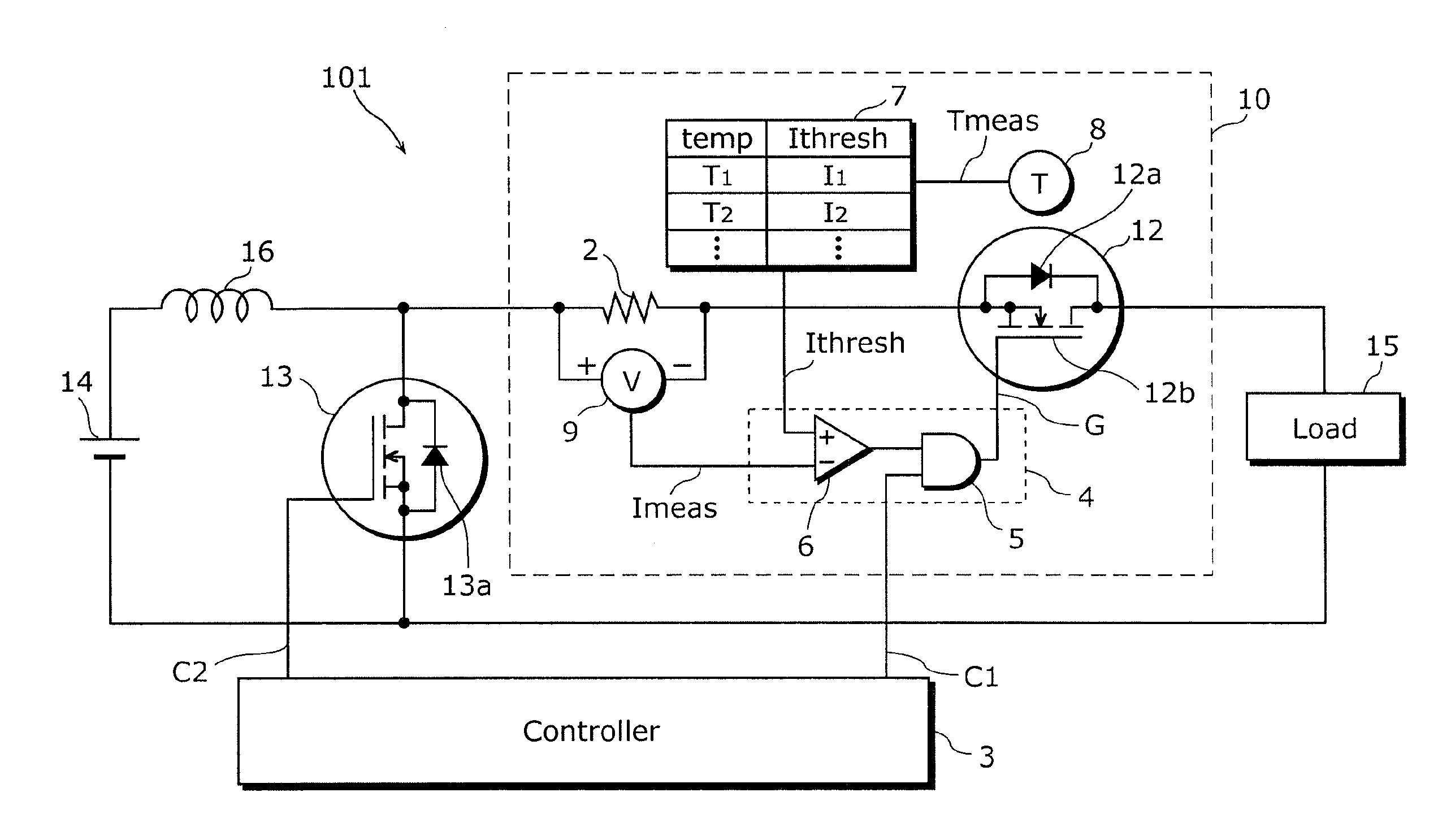
[0033]As described above, a power conversion apparatus according to an implementation of the present invention prohibits synchronous rectification when the amount of a flowing current is so great that on-resistance of a switching element becomes greater than that of a diode in the case where a regenerative current generated by an inductor is synchronously rectified at a switching unit having the switching element and the diode connected in parallel. This structure can provide the regenerative current to one of the switching element and the diode, whichever suffers less conduction loss, according to the amount of the flowing current.
[0034]As a result, the implementation eliminates drive loss due to supply and transmission of a control signal used for synchronous rectification, as well as makes sure to reduce conduction loss caused at the switching unit, and thus makes possible achieving excellent power conversion efficiency on the power conversion apparatus.

Problems solved by technology

In general, however, a forward voltage characteristic of a body diode included in a MOSFET is poor.

Method used

the structure of the environmentally friendly knitted fabric provided by the present invention; figure 2 Flow chart of the yarn wrapping machine for environmentally friendly knitted fabrics and storage devices; image 3 Is the parameter map of the yarn covering machine
View more

Image

Smart Image Click on the blue labels to locate them in the text.
Viewing Examples
Smart Image
  • Power conversion apparatus and control method for power conversion apparatus
  • Power conversion apparatus and control method for power conversion apparatus
  • Power conversion apparatus and control method for power conversion apparatus

Examples

Experimental program
Comparison scheme
Effect test

embodiment 1

Modification of Embodiment 1

[0124]Described next is a buck converter exemplified as the power conversion apparatus in accordance with the present invention.

[0125]FIG. 5 is a circuit diagram exemplifying a conventional buck converter.

[0126]A buck converter 200 shown in FIG. 5 is the boost converter 100 shown in FIG. 11 with the power source 14 and the load 15 replaced.

[0127]The buck converter serving as a power conversion apparatus in accordance with the present invention is built with the MOSFET 12, included in the buck converter 200, replaced with the synchronous rectifying circuit 10 described in Embodiment 1.

[0128]FIG. 6 is a functional block diagram exemplifying a structure of a buck converter 201 serving as a power conversion apparatus in accordance with Embodiment 1 of the present invention.

[0129]In the buck converter 201, the synchronous rectifying circuit 10 operates in a same manner as so in the boost converter 101. Thus, the synchronous rectifying circuit 10 can autonomous...

embodiment 2

[0133]Described as Embodiment 2 is a modification of a synchronous rectification circuit including MOSFETs.

[0134]FIG. 7 is a functional block diagram exemplifying a structure of a synchronous rectifying circuit 22 in accordance with Embodiment 2 of the present invention. The synchronous rectification circuit 22 is different from the synchronous rectifying circuit 10 shown in FIG. 1 in having (i) the MOSFETs 12 connected in parallel and commonly controlled via the gate signal “G”, and (ii) the shunt resistor 2 connected in series only to a single representative MOSFET (the MOSFET 12 placed on the top in FIG. 7) among the MOSFETs 12.

[0135]Having the MOSFETs 12 connected in parallel, the synchronous rectification circuit 22 is suitable for handling a large amount of current. The MOSFETs 12 and the shunt resistor 2 included in the synchronous rectification circuit 22 may be contained in one package and formed into an IPM 11.

[0136]The synchronous rectification circuit 22 structured above...

embodiment 3

[0138]Described next are a full bridge inverter and a three-phase inverter exemplified as a power conversion apparatus in accordance with the present invention.

[0139]FIG. 8A is a functional block diagram exemplifying a structure of a full bridge inverter 301 serving as a power conversion apparatus in accordance with Embodiment 3 of the present invention.

[0140]The full bridge inverter 301 has four switching elements replaced with respective four synchronous rectifying circuits 10, including the synchronous rectifying circuit 10 described above. Such switching elements are included in a bridge circuit of a typical full bridge inverter. Each of the synchronous rectifying circuits 10 is referred to as synchronous rectifying circuits 10a to 10d to be distinguished each other. The full bridge inverter 301 includes an inductor 17 and a capacitor 18 both used for smoothing.

[0141]The pairs of the synchronous rectifying circuits 10a and 10d, and the synchronous rectifying circuits 10b and 10c...

the structure of the environmentally friendly knitted fabric provided by the present invention; figure 2 Flow chart of the yarn wrapping machine for environmentally friendly knitted fabrics and storage devices; image 3 Is the parameter map of the yarn covering machine
Login to View More

PUM

No PUM Login to View More

Abstract

A power conversion apparatus includes: a MOSFET (12) which includes a channel (12b) and a body diode (12a) connected in parallel, the channel (12b) becoming conductive according to a control signal (C1), so that a flow path of a regenerative current of an inductor (16) is formed, and the body diode (12a) having the regenerative current of the inductor (16) flow in a forward direction; a shunt resistor (2) and a voltage measuring unit (9) which measure an amount of a current (Imeas) flowing into the MOSFET (12); a threshold designating unit (7) which designates a threshold current amount (Ithresh); and a synchronous rectification prohibiting circuit (4) which prohibits supplying the control signal (C1) in the case where the amount of the current (Imeas) measured by the shunt resistor (2) and the voltage measuring unit (9) is greater than the threshold current amount (Ithresh) designated by the threshold designating unit (7).

Description

TECHNICAL FIELD[0001]The present invention relates to power conversion apparatuses, and in particular, to a technique to achieve excellent power conversion efficiency on a power conversion apparatus.BACKGROUND ART[0002]Widely available are power conversion apparatuses (a converter and an inverter, for example) which obtain a regulated voltage or a regulated current by intermittently supplying power from a power source to an inductor. Such a power conversion apparatus typically employs a free-wheeling diode. A free-wheeling diode rectifies a regenerative current obtained by: a voltage generating coil provided in the power conversion apparatus; and an inductor which is a load coil provided out of the power conversion apparatus.[0003]FIG. 11 is a circuit diagram exemplifying a conventional boost converter.[0004]A boost converter 100 shown in FIG. 11 includes a low-side metal oxide semiconductor field effect transistor (MOSFET) 13, and a high-side MOSFET 12. The MOSFETs 12 and 13 are pe...

Claims

the structure of the environmentally friendly knitted fabric provided by the present invention; figure 2 Flow chart of the yarn wrapping machine for environmentally friendly knitted fabrics and storage devices; image 3 Is the parameter map of the yarn covering machine
Login to View More

Application Information

Patent Timeline
no application Login to View More
IPC IPC(8): G05F3/02
CPCH02M3/1588H02M7/53875Y02B70/1466H03K17/0822H03K2217/0027Y02B70/10
Inventor KAZAMA, SHUN
Owner PANASONIC CORP