Biomarkers for diagnosing alzheimer's disease
a biomarker and alzheimer's disease technology, applied in the field of diagnostics, can solve the problems of only establishing the clinical diagnosis of alzheimer's disease, high cost and time-consuming tests, and the majority of alzheimer's disease cases are sporadic and heterogeneous
- Summary
- Abstract
- Description
- Claims
- Application Information
AI Technical Summary
Benefits of technology
Problems solved by technology
Method used
Image

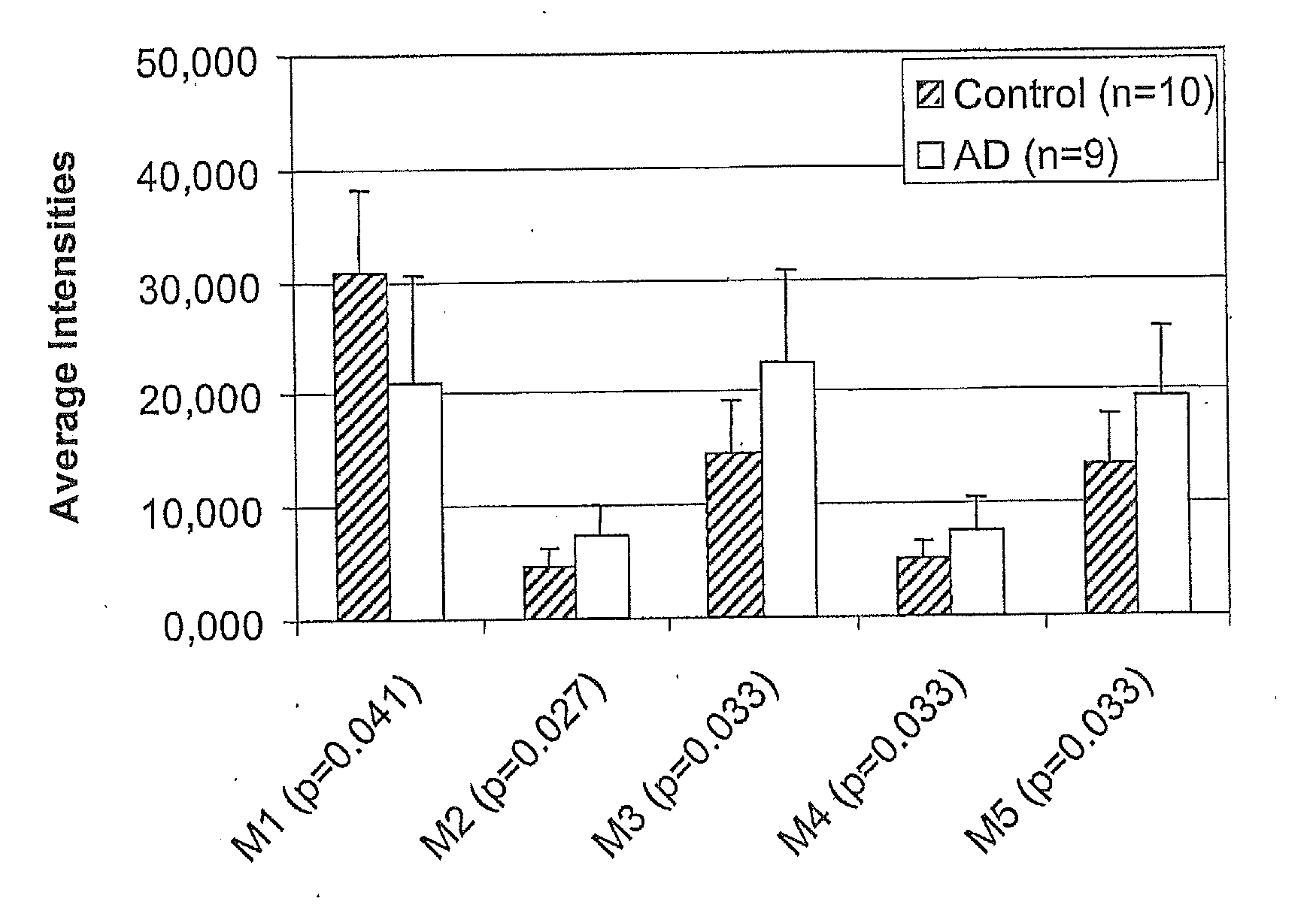

Examples
example 1
Patients Evaluation and CSF Sampling
[0065]Diagnosis of Alzheimer's disease in human subjects was made according to criteria of the National Institute of Neurologic and Communicative Disorders and Stroke-Alzheimer's disease and Related Disorders Association (NINCDS-ADRDA). The Alzheimer's disease group consisted of 9 patients aged 75±7 years, six men and three women. The group of healthy control subjects consisted of 10 individuals aged 78±14 years, two men and eight women with no history, symptoms or signs of psychiatric or neurological disease.
[0066]Informed consent was given by each patient and the patients' caregivers before the investigation. The study was approved by the local ethics committee. After lumbar puncture, CSF samples were frozen on dry ice immediately upon withdrawal at the bedside in 0.5 ml aliquots and stored at −80° C. until analyses.
example 2
ProteinChip SELDI Analysis of CSF on SAX2 Chip
[0067]SAX 2 Proteinchip array (Ciphergen Biosystems, Fremont, Calif., USA) were equilibrated for 5 min with 5 μl of binding buffer (100 mM Na Acetate pH=4.0). The buffer was carefully removed with an handkerchief and 2.5 μl of binding buffer was added to the wells. Crude CSF samples (2.5 μl) were added to the wells and incubated for 20 min at room temperature in a humidity chamber on a rocking platform. CSF was removed and the wells were individually washed with 10 μl of binding buffer for 5 min. The arrays were then placed in a 15 ml conical Eppendorf and washed twice with the binding buffer for 5 min. Finally, the chip was rinsed twice with distilled water. Excess of H2O was removed and while the surface was still moist, two additions per well of 0.5 μl of sinapinic acid (SPA) (2 mg / ml) in 50% (vol / vol) acetonitrile and 0.5% (vol / vol) trifluoroacetic acid was performed and dried. The arrays were then read in a ProteinChip reader system...
example 3
Strong Anionic Exchange Chromatography (SAX) Purification
[0069]In order to identify the proteins corresponding to these peaks, a fractionation of crude CSF on a SAX spin column was performed. The eluted fractions were analysed by SELDI-TOF MS.
[0070]SAX spin column, lot number SAX2-001116-01, (Ciphergen Biosystems, Fremont, Calif., USA) was rehydrated overnight at 4° C. in the equilibration buffer (20 mM tris(hydroxymethyl)aminomethane hydrochloride (Tris-HCl), 5 mM NaCl, pH 9.0). The column was warmed up at room temperature and air bubbles were removed. The equilibration buffer was let flow through column matrix by gravity. Equilibration buffer (0.5 ml) was added to the column and passed through the resin twice. Two ml of control CSF was diluted in the equilibration buffer (1:1, vol / vol). Protein sample was loaded to the column by fraction of 0.8 ml and allowed to run through the column by gravity until no drops came out of the column. The column was then centrifuged at 150×g for 1 ...
PUM
| Property | Measurement | Unit |
|---|---|---|
| molecular mass | aaaaa | aaaaa |
| molecular mass | aaaaa | aaaaa |
| molecular mass | aaaaa | aaaaa |
Abstract
Description
Claims
Application Information
 Login to View More
 - R&D
- Intellectual Property
- Life Sciences
- Materials
- Tech Scout
- Unparalleled Data Quality
- Higher Quality Content
- 60% Fewer Hallucinations
Browse by: Latest US Patents, China's latest patents, Technical Efficacy Thesaurus, Application Domain, Technology Topic, Popular Technical Reports.
© 2025 PatSnap. All rights reserved.Legal|Privacy policy|Modern Slavery Act Transparency Statement|Sitemap|About US| Contact US: help@patsnap.com